- Home
- About us
- Plastic Products and Moulds+
- Steam Iron Plastic Parts Mould and Moulding Services
- Plastic Injection Moulding Services
- Industrial Plastic Crates and Moulds
- Air Conditioner Plastic Parts And Moulds
- Printer Plastic Parts and Moulds
- Laptop Plastic Parts And Moulds
- Vacuum Cleaner Plastic Parts and Moulds
- Air Cooler Plastic Parts and Moulds
- Water Dispenser Plastic Parts and Moulds
- Washing Machine Plastic Parts And Moulds
- Water Purifier Plastic Parts and Moulds
- Robot Plastic Parts Mould and Moulding Services
- CPU Plastic Parts and Moulds
- Refrigerator Plastic Parts and Moulds
- Air Blower Plastic Parts Mould and Moulding Services
- Food Processor Plastic Parts and Moulds
- Lawn Mower Plastic Parts Mould and Moulding Services
- Microwave Oven Plastic Parts Mould and Moulding Services
- Monitor Plastic Parts and Moulds
- Mixer Grinder Plastic Parts Mould and Moulding Services
- Chimney Plastic Parts Mould and Moulding Services
- Geyser Plastic Parts Mould and Moulding Services
- Humidifier Plastic Parts Mould and Moulding Services
- Home Theatre Plastic Parts Mould and Moulding Services
- Steam Mop Plastic Parts Mould and Moulding Services
- Toaster Plastic Parts Mould and Moulding Services
- Egg Boiler Plastic Parts Mould and Moulding Services
- Air Purifier Plastic Parts Mould and Moulding Services
- Hair Straightener Plastic Parts Mould and Moulding Services
- Coffee Maker Plastic Parts Mould and Moulding Services
- Inverter Plastic Parts Mould and Moulding Services
- Air Fryer Plastic Parts Mould and Moulding Services
- Garment Steamer Plastic Parts Mould and Moulding Services
- Hair Dryer Plastic Parts Mould and Moulding Services
- Room Heater Plastic Parts Mould and Moulding Services
- Electric Rice Cooker Plastic Parts Mould and Moulding Services
- Air Curtain Plastic Parts Mould and Moulding Services
- Electric Tandoor Plastic Parts Mould and Moulding Services
- Popcorn Maker Plastic Parts Mould and Moulding Services
- Set Top Box Plastic Parts Mould and Moulding Services
- Floor Scrubber Plastic Parts Mould and Moulding Services
- Electric Upholstery Plastic Parts Mould and Moulding Services
- Automatic Pet Feeder Plastic Parts Mould and Moulding Services
- Electric Flour Mill Plastic Parts Mould and Moulding Services
- Electric Face Steamer Plastic Parts Mould and Moulding Services
- Head Spa Shampoo Machine Plastic Parts Mould and Moulding Services
- Hair Treatment Steamer Plastic Parts Mould and Moulding Services
- Generator Plastic Parts Mould and Moulding Services
- Contact us
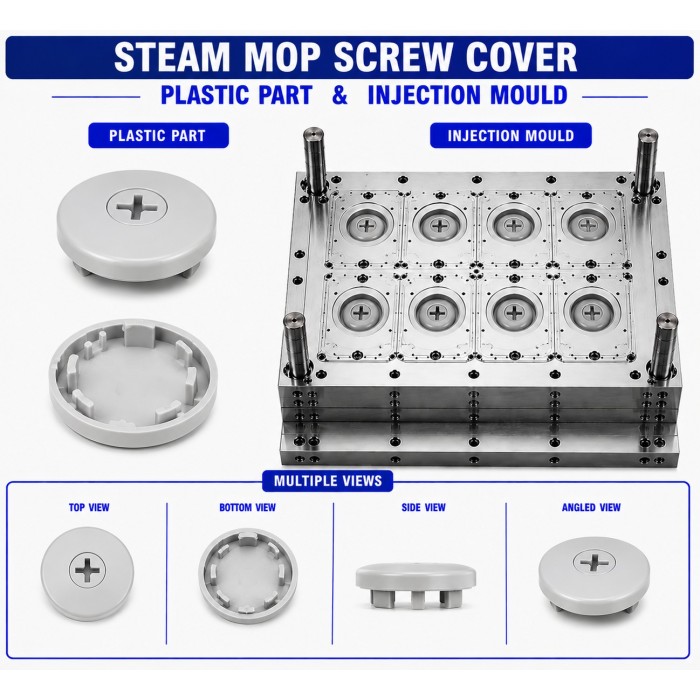
Steam Mop Plastic Screw Cover Mould and Moulding Service
SMPSC
Rs. 5.00
/ Piece (1 Piece) Steam Mop Plastic Screw Cover Mould and Moulding Service
Product Overview
Renovator Appliances Ltd. provides Steam Mop Plastic Screw Cover Mould and Moulding Service for manufacturing precision plastic covers used to conceal and protect exposed screws on steam mop appliances. The Steam Mop Plastic Screw Cover provides a clean finished appearance while helping protect screw heads from dust, moisture, accidental contact, and general handling.
The screw cover can be customized according to screw-head size, mounting-hole diameter, cover depth, fixing method, snap-fit arrangement, retention clips, surface profile, colour, texture, and surrounding housing design. Precision injection moulding helps achieve consistent dimensions and secure fitting with the appliance housing.
Key Features
Screw Concealment: Covers visible screw heads to provide a clean and finished appliance appearance.
Protection: Helps protect screws from dust, moisture, accidental contact, and general environmental exposure.
Secure Retention: Snap-fits, locking tabs, clips, friction-fit features, or other retention methods can be incorporated.
Accurate Screw Fit: The internal cavity can be customized according to the screw-head dimensions.
Easy Installation: Push-fit or snap-fit designs can allow quick installation during appliance assembly.
Easy Removal: A small notch, slot, tab, or removable feature can be incorporated where servicing requires access to the screw.
Flush Appearance: The cover can be designed to sit flush or nearly flush with the surrounding housing.
Custom Appearance: Colour, texture, gloss level, branding, and surface finish can be customized.
Lightweight Construction: Plastic construction provides a lightweight solution for screw concealment.
Consistent Production: Injection moulding helps maintain repeatable dimensions and reliable retention.
Industrial Applications
Steam Mop Plastic Screw Covers are commonly used in:
Domestic Steam Mops: Covers screws on the main housing, handle, base, and other visible areas.
Steam Floor Cleaners: Conceals assembly screws on external appliance panels.
Upright Steam Cleaners: Provides finished screw-covering solutions for body and handle assemblies.
Portable Steam Cleaning Appliances: Covers visible fasteners on compact appliance housings.
OEM Steam Cleaning Equipment: Customized screw covers can be manufactured according to specific housing and fastening designs.
Manufacturing Process
The manufacturing process starts with the customer's screw cover drawing, sample, screw, housing, 3D CAD model, or complete steam mop assembly. The screw-head dimensions, mounting-hole geometry, cover depth, retention method, surrounding surface profile, and service-access requirements are evaluated before mould development.
The selected thermoplastic material is heated inside an injection moulding machine and injected into a precision mould cavity. The mould forms the cover's external profile, internal screw clearance, retention clips, locking tabs, locating features, grip details, and other required geometry.
After cooling, the mould opens and the finished cover is ejected. The moulded component is inspected for dimensions, screw-head clearance, retention accuracy, surface finish, flash, warpage, and housing compatibility.
Trial assembly is performed by fitting the cover over the actual screw and housing. The cover is installed and removed as required to verify secure retention and convenient servicing.
Mould Manufacturing Process
Product Drawing & Screw Review: Screw-head size, mounting location, cover depth, retention method, and surrounding housing geometry are evaluated.
3D CAD Cover Design: A detailed screw-cover model is developed according to the approved housing design.
DFM Evaluation: Wall thickness, draft angles, clips, snap-fits, internal clearance, parting line, and ejection requirements are reviewed.
Mould Steel Selection: Suitable mould steel is selected according to the plastic grade, production quantity, component complexity, and expected mould life.
CNC Machining: CNC machining is used to manufacture the cavity, core, internal screw clearance, external profile, and mould plates.
EDM Machining: EDM can be used for small slots, locking tabs, clips, grooves, and other detailed mould features.
Surface Finishing: Mould surfaces are polished or textured according to the required product appearance.
Mould Assembly: Mould components are assembled and accurately aligned.
Trial Injection Moulding: Trial screw covers are produced to check dimensions, fit, retention features, and surface finish.
Assembly Testing: Covers are installed on the actual screws and housing to verify secure fit and correct appearance.
Final Mould Approval: Necessary mould corrections are completed before regular production.
Raw Materials
PP (Polypropylene): A lightweight and slightly flexible thermoplastic with good chemical resistance. It can be suitable where the cover requires some flexibility for snap-fitting.
ABS (Acrylonitrile Butadiene Styrene): A rigid and impact-resistant plastic with good surface appearance and dimensional stability. It is commonly considered for visible appliance covers.
HIPS (High Impact Polystyrene): An economical impact-resistant thermoplastic that can be considered for suitable rigid screw-cover applications.
PC-ABS: An engineering blend offering good rigidity, impact resistance, and dimensional stability. It can be considered where enhanced mechanical performance is required.
Nylon (Polyamide): A strong engineering plastic with good mechanical strength and wear resistance. It can be considered for screw covers requiring repeated removal and installation.
POM (Polyoxymethylene): A stiff engineering thermoplastic with good dimensional stability and low friction. It can be considered for precision retention features and repeatedly removable covers.
The final material should be selected according to the required flexibility, impact resistance, temperature exposure, appearance, retention performance, and appliance specifications.
Quality Control
Overall Dimension Inspection: Length, width, height, thickness, and critical dimensions are checked against approved specifications.
Screw Clearance Check: The internal cavity is checked to ensure sufficient clearance around the actual screw head.
Retention Test: Snap-fits, clips, tabs, or friction-fit features are checked for secure retention.
Housing Fit Check: The cover is installed on the actual appliance housing to verify proper positioning.
Flushness Inspection: The cover's height relative to the surrounding housing surface is checked where a flush appearance is required.
Removal Test: Where servicing requires removal, the cover is checked for practical removal without unnecessary damage.
Surface Finish Inspection: Visible surfaces are checked for sink marks, flow marks, scratches, weld lines, and uneven texture.
Flash Inspection: Excess plastic around the parting line, clips, slots, and edges is checked.
Warpage Inspection: The cover is inspected for deformation that could affect fitting or appearance.
Colour Inspection: The moulded cover is checked against the approved colour specification where applicable.
Assembly Testing: The cover is tested with the actual screw and surrounding housing.
Production Capacity
Production capacity depends on the screw cover size, component weight, plastic material, mould cavity configuration, injection moulding machine capacity, cycle time, retention-feature complexity, and required production volume. Single-cavity moulds can be considered for development and lower-volume requirements, while multi-cavity moulds may be evaluated for suitable designs and higher-volume production.
Buyer Guide
Before ordering a Steam Mop Plastic Screw Cover Mould and Moulding Service, buyers should provide the screw-head dimensions, mounting-hole dimensions, cover depth, surrounding housing profile, required retention method, removal requirements, material preference, colour, surface finish, product drawing or sample, and expected production quantity.
Providing the actual screw, housing panel, existing screw cover, or complete steam mop assembly helps determine accurate internal clearance, retention geometry, cover height, and finished appearance.
Why Choose Renovator?
Customized Screw Cover Mould Development: Moulds can be developed according to specific screw and housing designs.
Precision Injection Moulding: Accurate moulding helps maintain consistent internal clearance, retention features, and external dimensions.
Material Selection Support: Suitable plastics can be evaluated according to flexibility, strength, appearance, temperature exposure, and wear requirements.
OEM Manufacturing Support: Screw covers can be manufactured according to customer drawings, samples, 3D models, and approved specifications.
Custom Retention Features: Snap-fits, clips, locking tabs, friction-fit sections, removal slots, and locating features can be incorporated.
Bulk Production Capability: Manufacturing solutions can be developed according to required quantities.
Assembly Compatibility Testing: Finished covers can be tested with actual screws and appliance housings.
Frequently Asked Questions (FAQ)
Q1. What is a Steam Mop Plastic Screw Cover used for?
It conceals screw heads on the steam mop housing and provides a cleaner appearance while helping protect the fastener from dust, moisture, and accidental contact.
Q2. Can the screw cover be customized for a particular screw size?
Yes. The internal cavity, depth, diameter, retention features, and external profile can be customized according to the actual screw and housing.
Q3. Which plastic materials can be used for a screw cover?
PP, ABS, HIPS, PC-ABS, Nylon, POM, and other suitable thermoplastics can be considered according to the required appearance, flexibility, strength, and retention performance.
Q4. Can the screw cover be designed for easy removal during servicing?
Yes. Removal tabs, slots, notches, clips, snap-fits, or other service-access features can be incorporated according to the housing design.
Q5. Can Renovator manufacture both the mould and finished screw covers?
Yes. Renovator Appliances Ltd. provides plastic mould manufacturing and injection moulding services for customized, OEM, and bulk production of steam mop plastic screw covers.
Steam Mop Plastic Parts
Mould Material : P20 Steel / H13 Steel / S136 Steel
Plastic Grade : Engineering Grade / Heat Resistant Grade / Impact Resistant GradeProduct Material : ABS / PP / HIPSMould Type : Multi Cavity Mould / Hot Runner MouldWeight : 1–15 gDimensions : 8–40 × 8–40 × 3–15 mm