- Home
- About us
- Plastic Products and Moulds+
- Steam Iron Plastic Parts Mould and Moulding Services
- Plastic Injection Moulding Services
- Industrial Plastic Crates and Moulds
- Air Conditioner Plastic Parts And Moulds
- Printer Plastic Parts and Moulds
- Laptop Plastic Parts And Moulds
- Vacuum Cleaner Plastic Parts and Moulds
- Air Cooler Plastic Parts and Moulds
- Water Dispenser Plastic Parts and Moulds
- Washing Machine Plastic Parts And Moulds
- Water Purifier Plastic Parts and Moulds
- Robot Plastic Parts Mould and Moulding Services
- CPU Plastic Parts and Moulds
- Refrigerator Plastic Parts and Moulds
- Air Blower Plastic Parts Mould and Moulding Services
- Food Processor Plastic Parts and Moulds
- Lawn Mower Plastic Parts Mould and Moulding Services
- Microwave Oven Plastic Parts Mould and Moulding Services
- Monitor Plastic Parts and Moulds
- Mixer Grinder Plastic Parts Mould and Moulding Services
- Chimney Plastic Parts Mould and Moulding Services
- Geyser Plastic Parts Mould and Moulding Services
- Humidifier Plastic Parts Mould and Moulding Services
- Home Theatre Plastic Parts Mould and Moulding Services
- Steam Mop Plastic Parts Mould and Moulding Services
- Toaster Plastic Parts Mould and Moulding Services
- Egg Boiler Plastic Parts Mould and Moulding Services
- Air Purifier Plastic Parts Mould and Moulding Services
- Hair Straightener Plastic Parts Mould and Moulding Services
- Coffee Maker Plastic Parts Mould and Moulding Services
- Inverter Plastic Parts Mould and Moulding Services
- Air Fryer Plastic Parts Mould and Moulding Services
- Garment Steamer Plastic Parts Mould and Moulding Services
- Hair Dryer Plastic Parts Mould and Moulding Services
- Room Heater Plastic Parts Mould and Moulding Services
- Electric Rice Cooker Plastic Parts Mould and Moulding Services
- Air Curtain Plastic Parts Mould and Moulding Services
- Electric Tandoor Plastic Parts Mould and Moulding Services
- Popcorn Maker Plastic Parts Mould and Moulding Services
- Set Top Box Plastic Parts Mould and Moulding Services
- Floor Scrubber Plastic Parts Mould and Moulding Services
- Electric Upholstery Plastic Parts Mould and Moulding Services
- Automatic Pet Feeder Plastic Parts Mould and Moulding Services
- Electric Flour Mill Plastic Parts Mould and Moulding Services
- Electric Face Steamer Plastic Parts Mould and Moulding Services
- Head Spa Shampoo Machine Plastic Parts Mould and Moulding Services
- Hair Treatment Steamer Plastic Parts Mould and Moulding Services
- Generator Plastic Parts Mould and Moulding Services
- Full Body Massager Plastic Parts Mould and Moulding Services
- Air Circulator Plastic Parts Mould and Moulding Services
- X-Ray Machine Plastic Parts Mould and Moulding Services
- MRI Machine Plastic Parts Mould and Moulding Services
- CT Scan Machine Plastic Parts Mould and Moulding Services
- Contact us
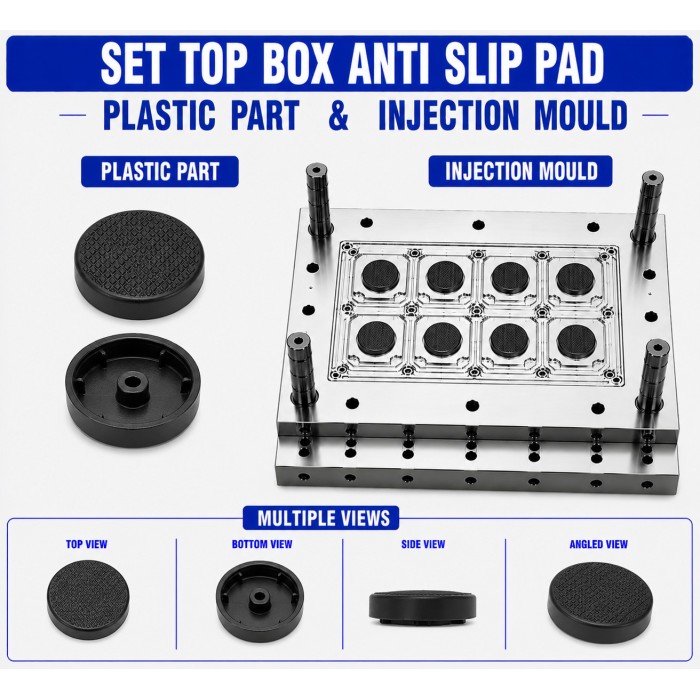
Set Top Box Plastic Anti Slip Pad Mould and Moulding Service
STBPASP
Rs. 10.00
/ Piece (1 Piece) Set Top Box Plastic Anti Slip Pad Mould and Moulding Service | Renovator Appliances Ltd
Product Overview
Set Top Box Plastic Anti Slip Pad Mould and Moulding Service is designed for manufacturing customized anti-slip pads used on the bottom surface of set top boxes, DTH receivers, cable TV receivers, IPTV devices, digital media players, and other compact electronic equipment. The anti-slip pad helps improve stability, reduce unwanted movement, maintain clearance between the enclosure and supporting surface, and protect the enclosure base from direct contact with the table or shelf.
The pad can be designed according to the set top box base geometry, mounting location, required thickness, contact area, enclosure weight, and floor or furniture surface. Depending on the application, it can be manufactured as a flexible elastomeric pad, rubber-type foot, adhesive-backed pad, press-fit pad, or mechanically retained component.
Precision moulding supports consistent pad dimensions, controlled thickness, reliable retention, and repeatable placement on the enclosure. Material hardness, flexibility, colour, surface texture, and shape can be customized according to the approved product design.
Key Features
Customized anti-slip pad for set top box applications
Helps improve stability on tables, shelves, and other supporting surfaces
Helps reduce unwanted sliding or movement
Helps maintain clearance between the enclosure and supporting surface
Designed according to set top box weight and base geometry
Flexible rubber or elastomeric material options
Rigid plastic with an elastomeric contact surface can also be considered
Adhesive-backed, press-fit, snap-fit, or mechanically retained designs
Customized thickness, diameter, height, and contact area
Different hardness and flexibility options
Customized colour and surface texture
Smooth or textured contact surfaces can be developed
Consistent dimensions for repeatable assembly
Suitable for OEM, ODM, and bulk production
Industrial Applications
| Application | Use |
|---|---|
| Digital Set Top Boxes | Base stability and anti-slip support |
| DTH Receivers | Reducing movement on supporting surfaces |
| Cable TV Receivers | Bottom enclosure protection and stability |
| IPTV Devices | Anti-slip base support |
| Smart TV Boxes | Surface grip and ground clearance |
| Digital Media Players | Base stability |
| OEM Electronics Manufacturing | Customized anti-slip pad production |
Manufacturing Process
1. Product Design & Development
The anti-slip pad is developed according to the set top box weight, base dimensions, mounting position, contact surface, required thickness, clearance, and retention method. The required hardness, flexibility, shape, and contact area are also considered during development. CAD drawings, 3D models, samples, or technical specifications can be used for product development.
2. Mould Design
The mould is designed according to the pad profile, thickness, contact surface texture, mounting features, retaining grooves, adhesive area, and other functional details. Parting lines, gate locations, venting, cooling, and ejection arrangements are considered according to the selected material and moulding process.
3. Mould Manufacturing
The mould can be manufactured using suitable mould steel such as P20 Steel, H13 Steel, or S136 Steel, depending on production quantity, material selection, surface requirements, and expected mould life. Precision machining, EDM where required, polishing, fitting, and mould assembly are performed according to the approved design.
4. Moulding
The selected elastomer, rubber, or plastic material is processed through the appropriate moulding method under controlled conditions. For flexible materials, parameters such as material temperature, mould temperature, pressure, curing or cooling time, and cycle time are controlled according to the selected material and component design.
5. Finishing & Assembly Preparation
After moulding, flash and excess material are removed where applicable. The anti-slip pads are inspected for deformation, incomplete filling, surface defects, dimensional variation, and unwanted sharp edges. Adhesive backing or other assembly features can be incorporated according to the approved design.
6. Quality Inspection
Finished pads are checked for dimensions, thickness, hardness or flexibility, retention, contact surface condition, enclosure fitment, and stability characteristics according to the approved specification.
Raw Materials
| Material | Suitable Characteristics |
|---|---|
| TPE | Flexible material option with good surface contact characteristics |
| TPU | Flexible and wear-resistant option for selected anti-slip applications |
| EPDM | Suitable elastomer option for selected environmental conditions |
| Silicone Rubber | Flexible option where temperature and surface-contact requirements justify its use |
| Flexible PVC | Can be considered for selected flexible pad applications |
| Rubber Compound | Suitable where specific grip, hardness, and compression characteristics are required |
| PP | Rigid plastic option for selected base-support designs |
| ABS | Suitable for rigid pad or support designs where appropriate |
| Nylon / PA | Higher-strength rigid option for selected mounting applications |
| Glass-Filled Nylon | Higher-rigidity option for demanding structural support designs |
Material selection should be based on the set top box weight, required grip, hardness, compression characteristics, surface type, temperature, vibration, environmental exposure, and expected service life.
Quality Control
Raw Material Inspection: Material grade, hardness or flexibility characteristics, colour, and incoming material condition are checked.
Mould Inspection: Cavity, core, inserts, surface texture, alignment, venting, and ejection arrangement are inspected.
Dimensional Inspection: Overall dimensions, thickness, height, diameter, and mounting features are measured.
Hardness & Flexibility Inspection: Flexible pads are checked according to the specified material and hardness requirements.
Fitment Inspection: The pad is checked against the designated mounting location on the set top box enclosure.
Retention Inspection: Press-fit, snap-fit, groove, adhesive, or other fixing arrangements are checked.
Contact Surface Inspection: The bottom contact surface is checked for proper texture, finish, deformation, and moulding defects.
Stability Inspection: The assembled pad is evaluated for proper contact and stability according to the approved application requirements.
Visual Inspection: Flash, short shots, surface defects, scratches, warpage, colour variation, and other defects are checked.
Packaging Inspection: Finished pads are packed to prevent deformation, contamination, sticking, and handling damage.
Buyer Guide
Before ordering Set Top Box Plastic Anti Slip Pad Mould and Moulding Service, buyers should provide:
Set top box overall weight
Base dimensions and mounting locations
Required pad dimensions
Required pad thickness and height
Required contact area
Supporting surface type
Required grip or anti-slip characteristics
Preferred material or elastomer type
Required hardness or flexibility
Required mounting method
Adhesive-backed or mechanical fixing requirement
CAD drawing or 3D model
Physical sample, if available
Operating temperature and environmental conditions
Colour and surface texture requirements
Expected production quantity
Prototype requirements
Packaging requirements
Providing accurate enclosure weight, base geometry, surface information, and pad dimensions helps in selecting the appropriate material and developing the mould correctly.
Why Choose Renovator Appliances Ltd?
Customized Anti-Slip Pad Development
We support customized anti-slip pad development according to set top box dimensions, weight, base geometry, mounting arrangement, and supporting surface requirements.
Flexible & Rigid Material Options
Suitable elastomers, rubber compounds, and rigid plastics can be considered according to grip, flexibility, hardness, load, temperature, and environmental requirements.
Precision Moulding
Controlled moulding helps maintain consistent dimensions, thickness, surface texture, and repeatable production quality.
Application-Focused Quality Control
Critical characteristics such as dimensions, hardness, retention, contact surface, fitment, and stability are considered during inspection.
OEM & Bulk Production Support
Customized anti-slip pads can be manufactured for set top box manufacturers, electronics OEMs, ODMs, and bulk buyers according to approved specifications.
Frequently Asked Questions
1. What is Set Top Box Plastic Anti Slip Pad Mould and Moulding Service?
It is a customized mould development and moulding service for manufacturing anti-slip pads used beneath set top boxes and other electronic devices to improve stability and maintain separation from the supporting surface.
2. Which materials can be used for an anti-slip pad?
TPE, TPU, EPDM, silicone rubber, flexible PVC, suitable rubber compounds, and selected rigid plastics such as PP, ABS, Nylon, and Glass-Filled Nylon can be considered depending on the application.
3. Can the anti-slip pad be customized according to the set top box weight?
Yes. Pad size, thickness, contact area, material hardness, flexibility, and mounting arrangement can be developed according to the enclosure weight and application requirements.
4. Can the anti-slip pad be adhesive-backed or mechanically mounted?
Yes. Depending on the product design, adhesive-backed, press-fit, snap-fit, groove-mounted, or other mechanical retention methods can be considered.
5. Can Renovator Appliances Ltd manufacture customized anti-slip pads for OEM production?
Yes. Customized anti-slip pads and their moulds can be developed and manufactured according to OEM drawings, CAD models, samples, material specifications, dimensional requirements, and production quantities.
Set Top Box Plastic Parts
Mould Material : P20 Steel / H13 Steel / S136 Steel
Plastic Grade : Anti Slip Grade / Impact Resistant / Heat ResistantProduct Material : TPE / TPU / Flexible PVCMould Type : Single Cavity / Multi CavityWeight : 3–25 gDimensions : 15–80 × 15–60 × 3–20 mm