- Home
- About us
- Plastic Products and Moulds+
- Steam Iron Plastic Parts Mould and Moulding Services
- Plastic Injection Moulding Services
- Industrial Plastic Crates and Moulds
- Air Conditioner Plastic Parts And Moulds
- Printer Plastic Parts and Moulds
- Laptop Plastic Parts And Moulds
- Vacuum Cleaner Plastic Parts and Moulds
- Air Cooler Plastic Parts and Moulds
- Water Dispenser Plastic Parts and Moulds
- Washing Machine Plastic Parts And Moulds
- Water Purifier Plastic Parts and Moulds
- Robot Plastic Parts Mould and Moulding Services
- CPU Plastic Parts and Moulds
- Refrigerator Plastic Parts and Moulds
- Air Blower Plastic Parts Mould and Moulding Services
- Food Processor Plastic Parts and Moulds
- Lawn Mower Plastic Parts Mould and Moulding Services
- Microwave Oven Plastic Parts Mould and Moulding Services
- Monitor Plastic Parts and Moulds
- Mixer Grinder Plastic Parts Mould and Moulding Services
- Chimney Plastic Parts Mould and Moulding Services
- Geyser Plastic Parts Mould and Moulding Services
- Humidifier Plastic Parts Mould and Moulding Services
- Home Theatre Plastic Parts Mould and Moulding Services
- Steam Mop Plastic Parts Mould and Moulding Services
- Egg Boiler Plastic Parts Mould and Moulding Services
- Air Purifier Plastic Parts Mould and Moulding Services
- Air Fryer Plastic Parts Mould and Moulding Services
- Garment Steamer Plastic Parts Mould and Moulding Services
- Hair Dryer Plastic Parts Mould and Moulding Services
- Room Heater Plastic Parts Mould and Moulding Services
- Electric Rice Cooker Plastic Parts Mould and Moulding Services
- Contact us
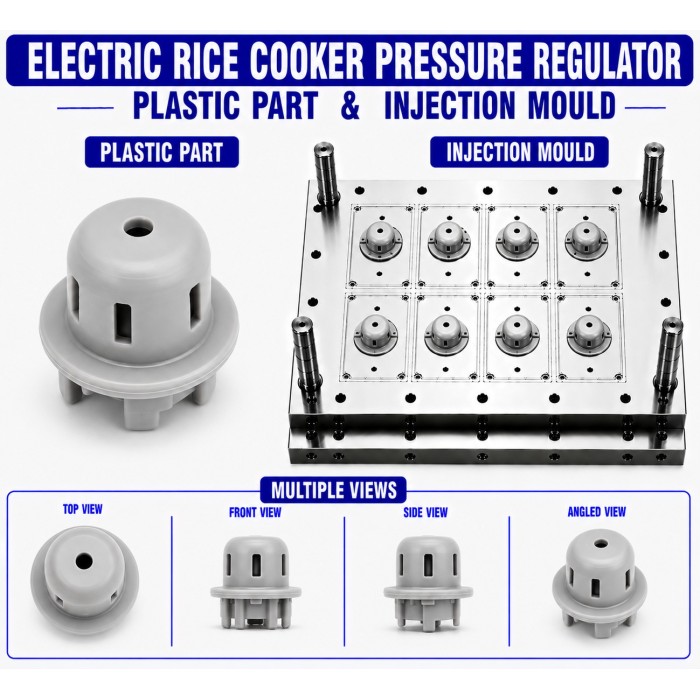
Electric Rice Cooker Plastic Pressure Regulator Mould and Moulding Service
ERCPPR
Rs. 20.00
/ Piece (1 Piece) Electric Rice Cooker Plastic Pressure Regulator Mould and Moulding Service
Product Overview
Electric Rice Cooker Plastic Pressure Regulator Mould and Moulding Service is used for manufacturing precision plastic pressure regulator components designed for pressure-type electric rice cookers. The component is part of the pressure-control assembly and can be designed to regulate, guide, or interact with the pressure-management mechanism according to the cooker design.
The pressure regulator can be manufactured according to specific regulator dimensions, pressure-control geometry, valve interface, steam passage, sealing surfaces, mounting arrangement, operating temperature, pressure rating, material, colour, and rice cooker design using precision plastic injection moulding.
Key Features
Precision-moulded plastic pressure regulator
Designed for pressure cooker and rice cooker assemblies
Accurate pressure-control geometry
Controlled steam passage
Precise valve interface
Customized sealing surfaces
Heat and steam-resistant material options
Good dimensional stability
Lightweight and durable construction
Customized colour and surface finish
Industrial Applications
Electric Rice Cooker Plastic Pressure Regulators are used in:
Electric pressure rice cookers
Multifunction rice cookers
Automatic pressure cookers
Digital pressure cookers
Cooker lid assemblies
Pressure-control systems
Steam-management assemblies
Pressure-regulating mechanisms
Kitchen appliances
Household cooking appliances
Manufacturing Process
The Electric Rice Cooker Plastic Pressure Regulator is manufactured using the plastic injection moulding process. Selected plastic granules are fed into an injection moulding machine and heated to the required processing temperature.
The molten plastic is injected into a precision-engineered mould cavity containing the required regulator profile, steam passages, valve interfaces, mounting features, and sealing geometry. Controlled cooling allows the plastic to solidify into the required shape.
After cooling, the mould opens and the finished pressure regulator is ejected. The moulded component is inspected for overall dimensions, steam passage dimensions, valve interface, sealing surfaces, pressure-control geometry, mounting accuracy, surface finish, flash, sink marks, and warpage.
Mould Manufacturing Process
The mould is designed according to the required product drawing or 3D CAD model. Particular attention is given to the steam passages, pressure-control geometry, valve interface, sealing surfaces, mounting points, wall thickness, draft angles, parting line, cooling channels, and ejection mechanism.
Suitable mould steel such as P20, H13, or S136 can be selected according to production volume, component complexity, mould life, and required surface finish.
Mould components are manufactured using CNC machining, EDM, precision drilling, grinding, polishing, and precision fitting. After mould assembly, trial moulding is performed to verify filling, cooling, ejection, dimensions, steam passages, valve fit, sealing performance, surface appearance, and assembly compatibility.
Raw Materials
Suitable materials may include:
PBT
PA66 Nylon
PPS
POM
PEEK where required
PC
Heat-resistant engineering plastics
Glass-filled engineering plastics
Flame-retardant grades where required
Food-contact suitable grades where applicable
Material selection depends on temperature exposure, steam contact, pressure conditions, mechanical strength, dimensional stability, wear resistance, and appliance requirements.
Quality Control
The Pressure Regulator can be inspected for:
Overall dimensions
Steam passage dimensions
Valve interface dimensions
Pressure-control geometry
Sealing-surface accuracy
Mounting dimensions
Wall thickness
Product weight
Heat resistance
Steam resistance
Surface finish
Flash and burrs
Warpage
Cracks and sink marks
Assembly compatibility
Pressure-control performance
Production Capacity
Production capacity depends on mould cavity count, injection moulding machine capacity, product weight, cycle time, cooling time, plastic material, and machine operating efficiency.
For example, an 8-cavity mould operating with a 25-second cycle time can theoretically produce approximately 1,152 pieces per hour, before accounting for downtime, inspection, material changes, and other production losses.
Actual production capacity depends on the final pressure regulator design, mould configuration, machine specifications, material, and operating conditions.
Buyer Guide
When ordering an Electric Rice Cooker Plastic Pressure Regulator Mould and Moulding Service, buyers should provide the product drawing or 3D CAD model, regulator dimensions, steam passage specifications, pressure-control requirements, valve interface dimensions, sealing requirements, mounting arrangement, operating temperature, operating pressure, plastic material, colour, expected production quantity, and assembly specifications.
For pressure-management components, buyers should also specify the required pressure range, steam-flow characteristics, valve travel, leakage limits, sealing performance, and applicable safety requirements.
These details help determine the appropriate mould design, mould steel, cavity configuration, plastic material, and injection moulding machine.
Why Choose Renovator Appliances Ltd.?
Customized pressure regulator mould development
Precision plastic injection moulding
Accurate steam passages
Precise valve and sealing interfaces
Controlled dimensional tolerances
Heat-resistant engineering plastic options
Steam-resistant material options
Glass-filled material options
Food-contact suitable material options where applicable
Single-cavity and multi-cavity mould solutions
High-volume production support
Frequently Asked Questions (FAQ)
1. What is an Electric Rice Cooker Plastic Pressure Regulator?
An Electric Rice Cooker Plastic Pressure Regulator is a plastic component used as part of a pressure-control assembly in pressure-type rice cookers. Its specific function depends on the cooker design and associated valve mechanism.
2. Which plastic materials can be used for the pressure regulator?
Common materials include PBT, PA66 Nylon, PPS, POM, PC, and other suitable heat-resistant engineering plastics. Glass-filled grades can be considered where higher strength and dimensional stability are required.
3. Can the pressure regulator be customized?
Yes. It can be customized according to dimensions, steam passages, pressure range, valve interface, sealing surfaces, mounting arrangement, operating temperature, material, colour, and surface finish.
4. Can the pressure regulator be manufactured for high-temperature steam applications?
Yes. Suitable heat- and steam-resistant engineering plastics can be selected according to the required operating temperature, pressure conditions, chemical exposure, and dimensional requirements.
5. Does Renovator Appliances Ltd. provide both mould manufacturing and moulding services?
Yes. Renovator Appliances Ltd. provides customized plastic mould manufacturing and injection moulding services for Electric Rice Cooker Plastic Pressure Regulators according to customer drawings, 3D models, material specifications, and production requirements.
Electric Rice Cooker Plastic Parts
Mould Material : P20 Steel / H13 Steel / S136 Steel
Plastic Grade : Heat Resistant Grade / Engineering Grade / Chemical Resistant GradeProduct Material : PP / POM / PA / PBTMould Type : Single Cavity Mould / Multi Cavity MouldWeight : 10–80 gDimensions : 20–100 × 15–60 × 15–60 mm