- Home
- About us
- Plastic Products and Moulds+
- Steam Iron Plastic Parts Mould and Moulding Services
- Plastic Injection Moulding Services
- Industrial Plastic Crates and Moulds
- Air Conditioner Plastic Parts And Moulds
- Printer Plastic Parts and Moulds
- Laptop Plastic Parts And Moulds
- Vacuum Cleaner Plastic Parts and Moulds
- Air Cooler Plastic Parts and Moulds
- Water Dispenser Plastic Parts and Moulds
- Washing Machine Plastic Parts And Moulds
- Water Purifier Plastic Parts and Moulds
- Robot Plastic Parts Mould and Moulding Services
- CPU Plastic Parts and Moulds
- Refrigerator Plastic Parts and Moulds
- Air Blower Plastic Parts Mould and Moulding Services
- Food Processor Plastic Parts and Moulds
- Lawn Mower Plastic Parts Mould and Moulding Services
- Microwave Oven Plastic Parts Mould and Moulding Services
- Monitor Plastic Parts and Moulds
- Mixer Grinder Plastic Parts Mould and Moulding Services
- Chimney Plastic Parts Mould and Moulding Services
- Geyser Plastic Parts Mould and Moulding Services
- Humidifier Plastic Parts Mould and Moulding Services
- Home Theatre Plastic Parts Mould and Moulding Services
- Steam Mop Plastic Parts Mould and Moulding Services
- Toaster Plastic Parts Mould and Moulding Services
- Egg Boiler Plastic Parts Mould and Moulding Services
- Air Purifier Plastic Parts Mould and Moulding Services
- Hair Straightener Plastic Parts Mould and Moulding Services
- Coffee Maker Plastic Parts Mould and Moulding Services
- Inverter Plastic Parts Mould and Moulding Services
- Air Fryer Plastic Parts Mould and Moulding Services
- Popcorn Maker Plastic Parts Mould and Moulding Services
- Garment Steamer Plastic Parts Mould and Moulding Services
- Hair Dryer Plastic Parts Mould and Moulding Services
- Room Heater Plastic Parts Mould and Moulding Services
- Electric Rice Cooker Plastic Parts Mould and Moulding Services
- Air Curtain Plastic Parts Mould and Moulding Services
- Electric Tandoor Plastic Parts Mould and Moulding Services
- Contact us
Electric Tandoor Plastic Anti Slip Foot Mould and Moulding Service
ETPASF
Rs. 10.00
/ Piece (1 Piece) Electric Tandoor Plastic Anti Slip Foot Mould and Moulding Service | Renovator Appliances Ltd
Product Overview
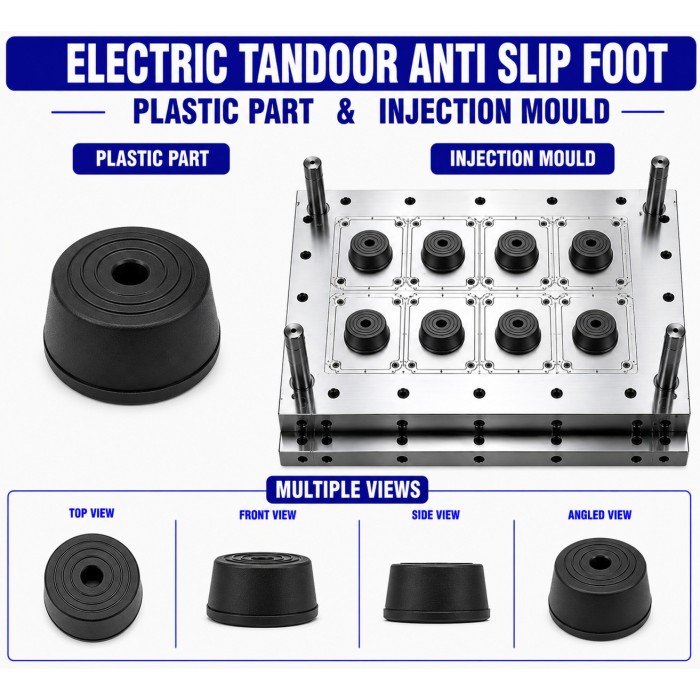
Electric Tandoor Plastic Anti Slip Foot is a molded support component fitted at the bottom of an electric tandoor to provide stability, maintain ground clearance, and help reduce unwanted movement during appliance operation. Depending on the design, the foot can be made from rigid plastic, flexible elastomer, or a combination of structural and non-slip materials.
Renovator Appliances Ltd provides Electric Tandoor Plastic Anti Slip Foot Mould and Moulding Service for OEM and customized electric tandoor applications. The component can be developed with mounting bosses, fixing holes, retention grooves, locating features, ribs, and a textured or high-grip contact surface according to the appliance design.
Material selection should be based on the actual appliance weight, floor or countertop surface, vibration, temperature exposure, mounting arrangement, and required friction characteristics. Where the anti-slip contact surface is exposed to elevated temperatures, the elastomer or plastic grade should be validated for the actual operating conditions.
Key Features
Designed to support and stabilize electric tandoor appliances.
Helps maintain defined clearance between the appliance base and supporting surface.
Anti-slip contact geometry can be developed according to the required grip characteristics.
Mounting holes, bosses, grooves, clips, and locating features can be customized.
Textured or patterned contact surfaces can be incorporated.
Reinforcing ribs can be added where increased structural support is required.
Compact design suitable for integration with the appliance bottom base.
Consistent dimensions for reliable mounting and appliance stability.
Suitable for rigid plastic, flexible elastomer, or application-specific material combinations.
Colour, surface texture, and external geometry can be customized.
Suitable for OEM, ODM, and customized electric tandoor manufacturing.
Industrial Applications
| Application | Use |
|---|---|
| Electric Tandoors | Base support and anti-slip stabilization |
| Electric Ovens | Appliance foot and base support |
| OTG Appliances | Bottom support and ground clearance |
| Kitchen Cooking Appliances | Stability and vibration support |
| Countertop Heating Appliances | Non-slip base support |
| OEM Appliance Manufacturing | Customized anti-slip foot production |
Manufacturing Process
1. Product Design & Development
The anti-slip foot is designed according to the appliance weight, bottom-base geometry, mounting arrangement, supporting surface, required ground clearance, and expected operating conditions. Contact area, grip pattern, mounting features, load-bearing geometry, and clearances are considered during development.
2. Plastic Mould Design
A precision mould is designed according to the anti-slip foot geometry and selected material. Parting line, gate location, draft angles, ejection system, cooling arrangement, wall thickness, and material shrinkage are considered for consistent production.
For flexible elastomeric versions, the mould design and processing method are selected according to the specific elastomer and required flexibility.
3. Mould Manufacturing
The mould can be manufactured using suitable mould steels such as P20 Steel, H13 Steel, or S136 Steel, depending on production volume, material, dimensional requirements, surface texture, and expected mould life.
CNC machining, EDM, drilling, polishing or texturing, mould fitting, and trial moulding can be carried out as required.
4. Injection Moulding
The selected rigid plastic or suitable elastomeric material is processed using an appropriate moulding process. Injection temperature, pressure, holding pressure, cooling or curing conditions, and cycle parameters are controlled according to the selected material and component design.
5. Finishing & Assembly Preparation
After moulding, components are inspected and trimmed where required. Flash, excessive gate marks, sharp edges, incomplete filling, surface defects, and other moulding imperfections are controlled before assembly.
6. Quality Inspection
Finished anti-slip feet are checked for dimensions, mounting features, contact geometry, surface condition, fitment, and structural integrity. Sample components can be assembled with the appliance base to evaluate stability and installation.
Raw Materials
| Material | Typical Use |
|---|---|
| PP | Can be considered for suitable rigid support applications |
| ABS | Suitable where operating temperature and loading remain within the material's validated range |
| Nylon (PA) | Can be selected where higher mechanical strength is required |
| Glass-Filled Nylon | Suitable for reinforced load-bearing applications |
| PBT | Can be considered where dimensional stability and thermal performance are required |
| PC+ABS | Suitable for applications requiring impact strength and dimensional stability |
| TPE | Suitable for flexible and grip-oriented contact surfaces where validated |
| TPU | Can be considered where flexible, abrasion-resistant contact characteristics are required |
| EPDM | Suitable for certain flexible and temperature-resistant foot applications, subject to application validation |
| Flame-Retardant Plastic | Can be selected where specific flame-resistance characteristics are required |
The final material should be selected according to appliance weight, static and dynamic loading, supporting surface, vibration, temperature exposure, abrasion, and required grip. For elastomeric anti-slip feet, hardness and friction characteristics should also be validated for the intended surface and operating conditions.
Quality Control
Renovator Appliances Ltd follows controlled inspection procedures for Electric Tandoor Plastic Anti Slip Foot production:
Raw Material Inspection: Plastic or elastomer grade and incoming material quality are checked according to specified requirements.
Mould Inspection: Cavity condition, surface texture, ejection system, and critical mould features are inspected.
Dimensional Inspection: Overall dimensions, mounting holes, locating features, contact area, and critical interfaces are verified.
Visual Inspection: Components are checked for flash, cracks, incomplete filling, sink marks, surface defects, and moulding irregularities.
Fitment Inspection: Sample feet can be assembled with the appliance bottom base to verify proper installation and alignment.
Load & Stability Review: The component can be evaluated according to customer-defined static or dynamic loading requirements.
Grip Surface Review: Contact geometry and material characteristics can be assessed according to the intended supporting surface.
Thermal Suitability Review: Material performance should be validated against actual operating temperature and heat exposure.
Packaging Inspection: Finished components are appropriately packed to prevent deformation, contamination, and surface damage.
Buyer Guide
When sourcing an Electric Tandoor Plastic Anti Slip Foot, buyers should consider:
Appliance Weight: Provide the approximate total weight supported by the feet.
Number of Feet: Specify the number and arrangement of feet used on the appliance.
Mounting Arrangement: Provide screw holes, bosses, clips, slots, or other fixing details.
Contact Surface: Specify whether the appliance will be placed on a countertop, table, metal surface, tile, or another surface.
Ground Clearance: Define the required distance between the appliance base and supporting surface.
Material Requirement: Select suitable rigid plastic or flexible elastomer according to the load and grip requirements.
Temperature Exposure: Specify expected continuous and peak temperature around the foot location.
Grip Requirement: Consider surface texture, material hardness, friction, and expected movement.
Production Quantity: Select the mould configuration according to expected production volume.
Quality Requirements: Define dimensional tolerances, colour, surface texture, load requirements, and fitment specifications.
Why Choose Renovator Appliances Ltd?
Advanced Injection Moulding Facility
Renovator Appliances Ltd supports precision moulded component manufacturing using controlled processes for appliance support, enclosure, and functional components.
In-House Mould Manufacturing
Our mould manufacturing capability supports customized anti-slip foot designs with application-specific mounting geometry, surface texture, and dimensional requirements.
OEM & ODM Manufacturing
We support OEM and ODM requirements from product development and mould manufacturing through moulded component production and supply.
Quality Assurance
Dimensional, visual, fitment, surface, and application-specific inspections help maintain consistent quality for molded appliance foot components.
Cost-Effective Manufacturing
Optimized mould design, appropriate material selection, and repeatable moulding processes can support economical production for customized electric tandoor anti-slip feet.
Frequently Asked Questions
1. What is an Electric Tandoor Plastic Anti Slip Foot?
It is a molded support component fitted underneath an electric tandoor to provide stability, maintain ground clearance, and help reduce unwanted movement on the supporting surface.
2. Which materials can be used for an anti-slip foot?
Depending on the application, PP, ABS, Nylon, Glass-Filled Nylon, PBT, PC+ABS, TPE, TPU, EPDM, or other suitable materials may be considered. The final material should be selected according to load, temperature, surface, and grip requirements.
3. Can the anti-slip foot be customized?
Yes. Dimensions, mounting holes, bosses, clips, grooves, ribs, contact-surface texture, material hardness, colour, and overall geometry can be customized according to the appliance design.
4. Can Renovator manufacture the mould for this component?
Yes. Renovator Appliances Ltd provides mould manufacturing and moulding services for customized Electric Tandoor Plastic Anti Slip Foot requirements.
5. What information is required for manufacturing?
A 2D drawing, 3D CAD model, sample component, appliance weight, number of feet, mounting details, supporting-surface type, required ground clearance, temperature exposure, material requirement, production quantity, and stability requirements are useful for accurate development.
Electric Tandoor Plastic Parts
Mould Material : P20 Steel / H13 Steel
Plastic Grade : Impact Resistant / Heat Resistant / Anti Slip GradeProduct Material : TPE / TPU / Heat Resistant NylonMould Type : Single Cavity / Multi CavityWeight : 5–40 gDimensions : 20–80 × 20–70 × 10–40 mm