- Home
- About us
- Plastic Products and Moulds+
- Steam Iron Plastic Parts Mould and Moulding Services
- Plastic Injection Moulding Services
- Industrial Plastic Crates and Moulds
- Air Conditioner Plastic Parts And Moulds
- Printer Plastic Parts and Moulds
- Laptop Plastic Parts And Moulds
- Vacuum Cleaner Plastic Parts and Moulds
- Air Cooler Plastic Parts and Moulds
- Water Dispenser Plastic Parts and Moulds
- Washing Machine Plastic Parts And Moulds
- Water Purifier Plastic Parts and Moulds
- Robot Plastic Parts Mould and Moulding Services
- CPU Plastic Parts and Moulds
- Refrigerator Plastic Parts and Moulds
- Air Blower Plastic Parts Mould and Moulding Services
- Food Processor Plastic Parts and Moulds
- Lawn Mower Plastic Parts Mould and Moulding Services
- Microwave Oven Plastic Parts Mould and Moulding Services
- Monitor Plastic Parts and Moulds
- Mixer Grinder Plastic Parts Mould and Moulding Services
- Chimney Plastic Parts Mould and Moulding Services
- Geyser Plastic Parts Mould and Moulding Services
- Humidifier Plastic Parts Mould and Moulding Services
- Home Theatre Plastic Parts Mould and Moulding Services
- Steam Mop Plastic Parts Mould and Moulding Services
- Toaster Plastic Parts Mould and Moulding Services
- Egg Boiler Plastic Parts Mould and Moulding Services
- Air Purifier Plastic Parts Mould and Moulding Services
- Hair Straightener Plastic Parts Mould and Moulding Services
- Coffee Maker Plastic Parts Mould and Moulding Services
- Inverter Plastic Parts Mould and Moulding Services
- Air Fryer Plastic Parts Mould and Moulding Services
- Garment Steamer Plastic Parts Mould and Moulding Services
- Hair Dryer Plastic Parts Mould and Moulding Services
- Room Heater Plastic Parts Mould and Moulding Services
- Electric Rice Cooker Plastic Parts Mould and Moulding Services
- Air Curtain Plastic Parts Mould and Moulding Services
- Electric Tandoor Plastic Parts Mould and Moulding Services
- Popcorn Maker Plastic Parts Mould and Moulding Services
- Set Top Box Plastic Parts Mould and Moulding Services
- Floor Scrubber Plastic Parts Mould and Moulding Services
- Electric Upholstery Plastic Parts Mould and Moulding Services
- Automatic Pet Feeder Plastic Parts Mould and Moulding Services
- Electric Flour Mill Plastic Parts Mould and Moulding Services
- Electric Face Steamer Plastic Parts Mould and Moulding Services
- Head Spa Shampoo Machine Plastic Parts Mould and Moulding Services
- Hair Treatment Steamer Plastic Parts Mould and Moulding Services
- Generator Plastic Parts Mould and Moulding Services
- Full Body Massager Plastic Parts Mould and Moulding Services
- Air Circulator Plastic Parts Mould and Moulding Services
- X-Ray Machine Plastic Parts Mould and Moulding Services
- Contact us
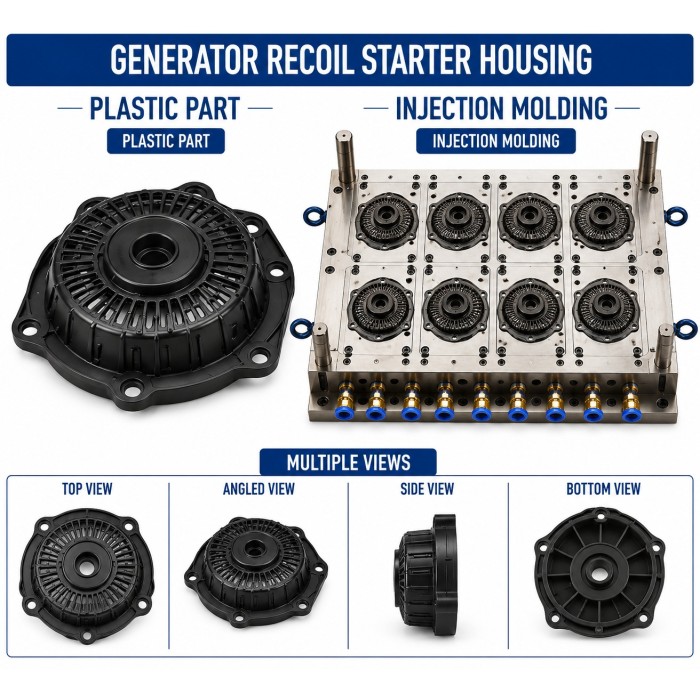
Generator Plastic Recoil Starter Housing Mould and Moulding Service
GPRSH
Rs. 120.00
/ Piece (1 Piece) Generator Plastic Recoil Starter Housing Mould and Moulding Service | Renovator Appliances Ltd
Product Overview
Renovator Appliances Ltd manufactures Generator Plastic Recoil Starter Housing Mould and Moulding Service for generator recoil-starting assemblies. The housing provides a protective and accurately positioned enclosure for the recoil starter mechanism, including the recoil pulley, starter rope arrangement, spring mechanism, and related mounting interfaces. The plastic component is designed with appropriate internal clearances, mounting points, wall thickness, ribs, and ventilation or access features according to the generator assembly.
The injection mould is developed to maintain dimensional consistency around the starter mechanism and mounting locations. Proper mould design helps achieve reliable fitment with the generator frame or engine-side mounting area while supporting smooth assembly and repeatable production.
Key Features
Application-specific housing design for generator recoil starter assemblies
Accurate internal clearance for recoil pulley and starter mechanism movement
Precisely positioned mounting holes, bosses, and locating features
Controlled wall thickness for dimensional stability and strength
Reinforced ribs around mounting and high-stress areas where required
Smooth internal surfaces to reduce interference with moving starter components
Provision for rope outlet and starter-handle routing according to assembly design
Suitable retention and fastening features for secure assembly
Consistent moulded dimensions for repeat production
Material selection based on impact, vibration, temperature, and environmental requirements
Controlled surface finish for the visible housing areas
Designed for OEM and bulk injection moulding production
Industrial Applications
| Application Area | Component Function |
|---|---|
| Portable Generators | Protects and encloses the recoil starter mechanism |
| Petrol Generator Sets | Supports mounting and positioning of the manual starting assembly |
| Compact Generator Engines | Provides a lightweight protective housing around starter components |
| Residential Backup Generators | Supports repeated manual starting operations and component protection |
| Industrial Portable Power Equipment | Provides consistent mounting and enclosure for recoil starter assemblies |
| OEM Generator Manufacturing | Suitable for high-volume production of application-specific starter housings |
Manufacturing Process
1. Product Design & Development
The housing is developed according to the recoil starter assembly dimensions, mounting-hole locations, starter pulley clearance, rope outlet position, fastening method, generator frame interface, and available installation space. Special attention is given to clearance from moving components and alignment with the engine or generator mounting structure.
2. Plastic Mould Design
The injection mould is designed around the required housing geometry, including mounting bosses, locating ribs, screw towers, rope openings, internal clearances, and reinforcement features. Parting lines, gate positions, ejector locations, draft angles, and cooling channels are planned to support stable moulding and easy part ejection.
3. Mould Manufacturing
The mould is manufactured using suitable tool steel such as P20, H13, or S136 depending on production volume, surface-finish requirements, material characteristics, and expected mould life. CNC machining, EDM, drilling, polishing, fitting, and mould trials are performed to achieve the required cavity accuracy.
4. Injection Moulding
Selected engineering or general-purpose thermoplastic material is processed under controlled injection temperature, pressure, speed, cooling time, and holding conditions. Process parameters are optimized to minimize warpage, sink marks, short shots, flash, and dimensional variation around mounting and clearance features.
5. Finishing & Assembly Preparation
After moulding, the housing is inspected for flash, gate marks, sharp edges, and other moulding defects. Any required trimming or secondary finishing is completed before the component is prepared for assembly with the recoil starter mechanism.
6. Quality Inspection
Each production batch can be checked for overall dimensions, mounting-hole position, boss geometry, rope outlet alignment, internal clearance, wall thickness, surface quality, and fitment with the corresponding recoil starter assembly.
Raw Materials
| Material | Application Consideration |
|---|---|
| PP | Suitable where lightweight construction, impact resistance, and cost efficiency are required |
| ABS | Considered where higher rigidity and surface appearance are important |
| HIPS | Suitable for selected rigid housing applications where impact and cost requirements permit |
| Engineering Grade Plastic | Used where higher dimensional stability, mechanical performance, or temperature resistance is required |
| Glass-Filled Nylon | Considered for demanding structural applications requiring increased stiffness and dimensional stability |
| Flame-Retardant Plastic | Used where the generator assembly requires enhanced resistance to ignition and flame propagation |
Material selection should be finalized according to the actual operating temperature, vibration, impact exposure, starter mechanism requirements, and applicable generator safety specifications.
Quality Control
Renovator Appliances Ltd applies component-specific inspection controls for Generator Plastic Recoil Starter Housing Mould and Moulding Service, including:
Housing length, width, height, and profile inspection
Mounting-hole position and diameter verification
Recoil mechanism clearance inspection
Starter rope outlet alignment checking
Boss and rib dimensional inspection
Wall-thickness consistency verification
Warpage and distortion inspection
Flash and moulding-defect inspection
Fitment testing with the recoil starter assembly
Fastener engagement and mounting stability verification
Material and colour consistency checks
Sample-based functional and assembly validation
Buyer Guide
Before ordering the Generator Plastic Recoil Starter Housing Mould and Moulding Service, buyers should provide the recoil starter assembly drawing or sample, housing dimensions, mounting-hole pattern, engine/generator interface details, starter pulley dimensions, rope outlet position, required material, surface-finish expectations, colour, annual production quantity, and packaging requirements.
The mould design should also account for moving-part clearance, fastening access, assembly sequence, expected vibration, operating temperature, and the required mould life. For high-volume generator production, multi-cavity tooling can be evaluated where component demand and cycle-time requirements justify it.
Why Choose Renovator Appliances Ltd?
Advanced Injection Moulding Facility
Production is supported by controlled plastic injection moulding processes for consistent component dimensions and repeatable output.
In-House Mould Manufacturing
Mould development and manufacturing are coordinated with the component design to support accurate mounting, clearance, and functional features.
OEM & ODM Manufacturing
The component can be developed according to customer drawings, samples, specifications, and generator assembly requirements.
Quality Assurance
Dimensional, visual, material, and assembly-related inspections help maintain consistency across production batches.
Cost-Effective Manufacturing
Tooling and moulding parameters can be planned according to component complexity, production volume, material requirements, and required mould life.
Frequently Asked Questions
1. What is a Generator Plastic Recoil Starter Housing used for?
It provides a protective enclosure and mounting structure for the recoil starter mechanism used to manually start compatible generator engines.
2. What plastic materials can be used for this housing?
PP, ABS, HIPS, engineering-grade plastics, glass-filled nylon, or flame-retardant materials may be considered depending on the required mechanical, thermal, impact, and safety performance.
3. Can the mould be manufactured according to an existing recoil starter sample?
Yes. The mould can be developed from customer drawings, 3D CAD data, technical specifications, or a physical sample, subject to dimensional and engineering evaluation.
4. How is the mould designed to prevent interference with the recoil mechanism?
The cavity is designed with controlled internal clearances around the recoil pulley, rope path, spring mechanism, and other moving parts so the housing does not obstruct normal starter operation.
5. Can this component be manufactured for bulk generator production?
Yes. The mould and injection moulding process can be planned for OEM and bulk production, with cavity configuration selected according to required volume, cycle time, component geometry, and tooling requirements.
Generator Plastic Parts
Mould Material : P20 Steel / H13 Steel / S136 Steel
Plastic Grade : Impact Resistant Grade / Heat Resistant Grade / Engineering GradeProduct Material : Nylon / PP / PA66Mould Type : Single Cavity / Multi CavityWeight : 100–400 gDimensions : 150–300 × 120–250 × 50–120 mm