- Home
- About us
- Plastic Products and Moulds+
- Steam Iron Plastic Parts Mould and Moulding Services
- Plastic Injection Moulding Services
- Industrial Plastic Crates and Moulds
- Air Conditioner Plastic Parts And Moulds
- Printer Plastic Parts and Moulds
- Laptop Plastic Parts And Moulds
- Vacuum Cleaner Plastic Parts and Moulds
- Air Cooler Plastic Parts and Moulds
- Water Dispenser Plastic Parts and Moulds
- Washing Machine Plastic Parts And Moulds
- Water Purifier Plastic Parts and Moulds
- Robot Plastic Parts Mould and Moulding Services
- CPU Plastic Parts and Moulds
- Refrigerator Plastic Parts and Moulds
- Air Blower Plastic Parts Mould and Moulding Services
- Food Processor Plastic Parts and Moulds
- Lawn Mower Plastic Parts Mould and Moulding Services
- Microwave Oven Plastic Parts Mould and Moulding Services
- Monitor Plastic Parts and Moulds
- Mixer Grinder Plastic Parts Mould and Moulding Services
- Chimney Plastic Parts Mould and Moulding Services
- Geyser Plastic Parts Mould and Moulding Services
- Humidifier Plastic Parts Mould and Moulding Services
- Home Theatre Plastic Parts Mould and Moulding Services
- Steam Mop Plastic Parts Mould and Moulding Services
- Toaster Plastic Parts Mould and Moulding Services
- Egg Boiler Plastic Parts Mould and Moulding Services
- Air Purifier Plastic Parts Mould and Moulding Services
- Hair Straightener Plastic Parts Mould and Moulding Services
- Coffee Maker Plastic Parts Mould and Moulding Services
- Inverter Plastic Parts Mould and Moulding Services
- Air Fryer Plastic Parts Mould and Moulding Services
- Garment Steamer Plastic Parts Mould and Moulding Services
- Hair Dryer Plastic Parts Mould and Moulding Services
- Room Heater Plastic Parts Mould and Moulding Services
- Electric Rice Cooker Plastic Parts Mould and Moulding Services
- Air Curtain Plastic Parts Mould and Moulding Services
- Electric Tandoor Plastic Parts Mould and Moulding Services
- Popcorn Maker Plastic Parts Mould and Moulding Services
- Set Top Box Plastic Parts Mould and Moulding Services
- Floor Scrubber Plastic Parts Mould and Moulding Services
- Electric Upholstery Plastic Parts Mould and Moulding Services
- Automatic Pet Feeder Plastic Parts Mould and Moulding Services
- Electric Flour Mill Plastic Parts Mould and Moulding Services
- Electric Face Steamer Plastic Parts Mould and Moulding Services
- Head Spa Shampoo Machine Plastic Parts Mould and Moulding Services
- Hair Treatment Steamer Plastic Parts Mould and Moulding Services
- Generator Plastic Parts Mould and Moulding Services
- Contact us
Home Theatre Plastic Bass Reflex Tube Mould and Moulding Service
HTPBRT
Rs. 50.00
/ Piece (1 Piece) Home Theatre Plastic Bass Reflex Tube Mould and Moulding Service | Renovator Appliances Ltd
Product Overview
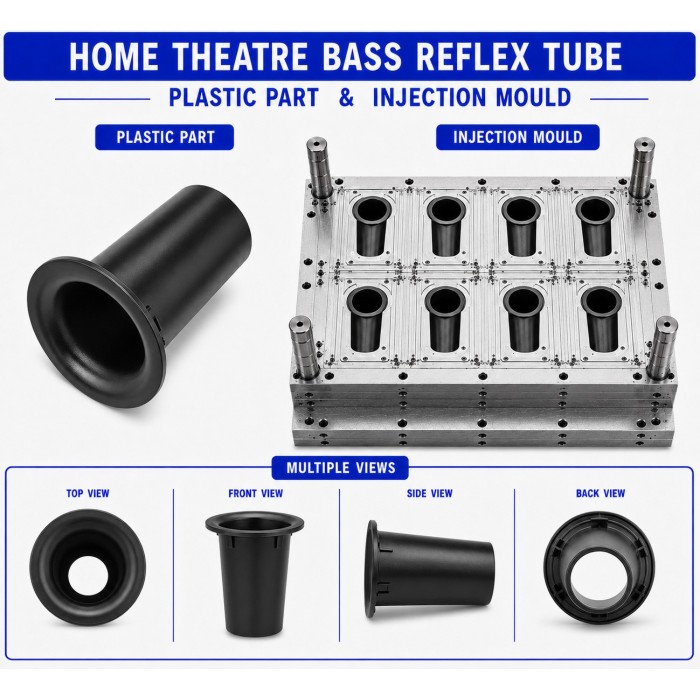
Home Theatre Plastic Bass Reflex Tube is a precision injection-moulded acoustic component installed in the speaker cabinet of home theatre systems to create a bass reflex or ported enclosure. It forms a controlled air passage between the internal speaker cabinet and the outside environment, allowing the enclosure to use the rear radiation from the speaker driver to improve low-frequency performance.
The bass reflex tube is designed with a specific internal diameter, tube length, wall thickness, mounting flange, and cabinet interface according to the acoustic requirements of the speaker enclosure. Accurate dimensions are important because changes in port diameter or length can affect the tuning frequency and overall bass response.
Renovator Appliances Ltd provides complete Home Theatre Plastic Bass Reflex Tube Mould and Moulding Services, including product development, acoustic-oriented component design, mould design, precision mould manufacturing, mould trials, plastic injection moulding, dimensional inspection, cabinet fitment testing, and bulk production.
Key Features
The Home Theatre Plastic Bass Reflex Tube provides a dedicated air passage through the speaker cabinet and can be designed for the required enclosure tuning.
The tube can include an integrated mounting flange, screw holes, locating ribs, sealing surface, cabinet-locking features, and internal or external flared profiles according to the speaker design.
The internal surface can be manufactured with a controlled diameter and smooth finish to provide a consistent airflow passage.
The port length and internal diameter can be customized according to the speaker enclosure volume, woofer characteristics, target tuning frequency, cabinet opening, and available installation space.
Flared or rounded port ends can also be incorporated to help reduce airflow turbulence and unwanted port noise where required by the acoustic design.
Industrial Applications
The Home Theatre Plastic Bass Reflex Tube is used in ported speaker enclosures for:
Home Theatre Speaker Systems
Bookshelf Speakers
Floor-Standing Speakers
Surround Sound Speakers
Subwoofer Systems
Multimedia Speaker Systems
Soundbar Speaker Systems
Bass Reflex Speaker Cabinets
Professional Audio Equipment
OEM Speaker Cabinets
The final port design depends on the enclosure volume, speaker driver characteristics, target tuning frequency, port diameter, port length, and cabinet construction.
Manufacturing Process
The Home Theatre Plastic Bass Reflex Tube is manufactured using plastic injection moulding.
The product geometry is first developed according to the required internal diameter, tube length, wall thickness, mounting flange, cabinet opening, and acoustic design.
The selected thermoplastic material is heated and injected into the precision mould cavity. The mould forms the tube body, internal passage, mounting flange, locating features, sealing surface, and flared or rounded port profile.
After filling and packing, the component is cooled under controlled conditions to maintain dimensional stability. The mould then opens and the finished bass reflex tube is ejected.
The moulded component is inspected for internal diameter, tube length, wall thickness, flange dimensions, roundness, surface finish, and speaker-cabinet fitment.
Mould Manufacturing Process
The Home Theatre Plastic Bass Reflex Tube Mould is designed according to the required port diameter, tube length, flange arrangement, wall thickness, cabinet interface, and production quantity.
The mould incorporates the required cavity, core, parting line, gate system, cooling channels, and ejection mechanism.
The core is particularly important because it forms the internal air passage of the bass reflex tube. It is manufactured and finished to maintain the specified internal diameter and smoothness.
For components with complex flared ends, undercuts, or specialized mounting profiles, appropriate mould inserts, slides, or other tooling features can be incorporated.
Mould components are manufactured using CNC machining, EDM, drilling, grinding, and precision finishing. After mould assembly, trial moulding is performed using the selected plastic material.
Trial components are checked for internal diameter, tube length, roundness, wall thickness, flange dimensions, warpage, flash, surface finish, and cabinet fitment before production approval.
Raw Materials
The material for a Home Theatre Plastic Bass Reflex Tube should provide good dimensional stability, rigidity, smooth surface quality, and resistance to normal speaker vibration.
Depending on the application, ABS, PP, HIPS, or PC-ABS can be considered.
ABS and HIPS are suitable for rigid speaker-port applications where dimensional accuracy and surface appearance are important. PP can be considered for lightweight designs, while PC-ABS can be selected where higher mechanical performance is required.
The final material should be selected according to the port dimensions, cabinet vibration, operating temperature, mounting method, required rigidity, surface finish, and customer specifications.
Quality Control
Quality control for the Home Theatre Plastic Bass Reflex Tube focuses on dimensional accuracy because the port geometry directly influences the intended acoustic design.
The component can be checked for:
Internal Diameter
External Diameter
Tube Length
Wall Thickness
Flange Diameter
Mounting-Hole Diameter
Mounting-Hole Position
Port Roundness
Cabinet Opening Fit
Surface Finish
The moulded tube is inspected for flash, short shots, sink marks, cracks, warpage, burrs, weld lines, and surface defects.
The component can also be assembled with the actual speaker cabinet and driver system to verify the port's fitment, sealing interface, mounting position, and clearance.
Where required, the finished speaker assembly can undergo acoustic testing to verify the intended enclosure tuning and bass response.
Production Capacity
Production capacity depends on the tube size, product weight, mould cavity count, cycle time, plastic material, injection moulding machine capacity, mould design, and production efficiency.
For example, a 4-cavity mould operating at a 20-second cycle has a theoretical production capacity of approximately 720 pieces per hour before inspection, handling, downtime, mould maintenance, and other production losses.
For high-volume requirements, multi-cavity tooling can be considered where the tube dimensions and moulding process permit it.
Final production capacity should be determined according to the actual product weight, cavity count, cycle time, machine capacity, and required monthly production quantity.
Buyer Guide
Before ordering a Home Theatre Plastic Bass Reflex Tube Mould and Moulding Service, the buyer should provide a 2D drawing, 3D CAD model, existing port sample, speaker cabinet, or acoustic enclosure design.
Important specifications include internal diameter, external diameter, tube length, wall thickness, flange diameter, mounting-hole pattern, cabinet opening, sealing method, flare profile, plastic material, colour, surface finish, dimensional tolerance, target acoustic tuning, and production quantity.
For acoustic applications, providing the speaker driver specifications and enclosure volume is recommended because port dimensions are directly related to the intended speaker tuning.
Why Choose Renovator?
Renovator Appliances Ltd provides an integrated manufacturing solution for customized plastic acoustic and structural components used in home theatre, speaker, soundbar, subwoofer, and audio equipment.
For the Home Theatre Plastic Bass Reflex Tube, our service covers the complete process from product development and mould design to precision mould manufacturing, injection moulding, dimensional inspection, cabinet fitment testing, and bulk production.
The bass reflex tube can be developed according to the customer's actual speaker enclosure, including specific port diameter, tube length, flange design, cabinet interface, material grade, colour, surface finish, and production quantity.
This integrated approach helps maintain consistency between the speaker driver, enclosure volume, bass reflex tube, cabinet opening, mould, plastic material, and final speaker assembly.
Frequently Asked Questions (FAQ)
1. What is a Home Theatre Plastic Bass Reflex Tube?
A Home Theatre Plastic Bass Reflex Tube is a moulded plastic port installed in a speaker cabinet to provide a controlled air passage for a bass-reflex enclosure.
2. Why are the diameter and length of the Bass Reflex Tube important?
The internal diameter and tube length influence the acoustic tuning of the speaker enclosure. Therefore, these dimensions should be selected according to the speaker driver and cabinet design.
3. Which plastic materials are suitable for a Bass Reflex Tube?
Common options include ABS, PP, HIPS, and PC-ABS. Material selection depends on rigidity, dimensional stability, surface finish, vibration, and cabinet requirements.
4. Can the Bass Reflex Tube have a flared opening?
Yes. The tube can be designed with flared, rounded, or straight openings according to the acoustic and mechanical requirements of the speaker.
5. Can Renovator manufacture both the Bass Reflex Tube mould and finished components?
Yes. Renovator can provide complete mould manufacturing and plastic injection moulding services, including mould trials, dimensional inspection, cabinet fitment testing, quality inspection, and bulk production according to customer requirements.
Home Theatre Plastic Parts
Mould Material : P20 Steel / H13 Steel / S136 Steel
Plastic Grade : Engineering Grade / UV Stabilized Grade / Impact Resistant GradeProduct Material : ABS / PP / HIPS / PC-ABSMould Type : Single Cavity Mould / Multi Cavity MouldWeight : 30–250 gDimensions : 50–180 × 50–180 × 80–300 mm