- Home
- About us
- Plastic Products and Moulds+
- Plastic Injection Moulding Services
- Industrial Plastic Crates and Moulds
- Air Conditioner Plastic Parts And Moulds
- Printer Plastic Parts and Moulds
- Laptop Plastic Parts And Moulds
- Vacuum Cleaner Plastic Parts and Moulds
- Air Cooler Plastic Parts and Moulds
- Water Dispenser Plastic Parts and Moulds
- Washing Machine Plastic Parts And Moulds
- Water Purifier Plastic Parts and Moulds
- Robot Plastic Parts Mould and Moulding Services
- CPU Plastic Parts and Moulds
- Refrigerator Plastic Parts and Moulds
- Air Blower Plastic Parts Mould and Moulding Services
- Food Processor Plastic Parts and Moulds
- Lawn Mower Plastic Parts Mould and Moulding Services
- Microwave Oven Plastic Parts Mould and Moulding Services
- Monitor Plastic Parts and Moulds
- Mixer Grinder Plastic Parts Mould and Moulding Services
- Chimney Plastic Parts Mould and Moulding Services
- Geyser Plastic Parts Mould and Moulding Services
- Humidifier Plastic Parts Mould and Moulding Services
- Air Purifier Plastic Parts Mould and Moulding Services
- Home Theatre Plastic Parts Mould and Moulding Services
- Steam Mop Plastic Parts Mould and Moulding Services
- Contact us
Plastic Plant Tray Mould and Moulding Service
PPT
Rs. 50.00
/ Piece (1 Piece) Plastic Plant Tray Mould and Moulding Service | Renovator Appliances Ltd
Product Overview
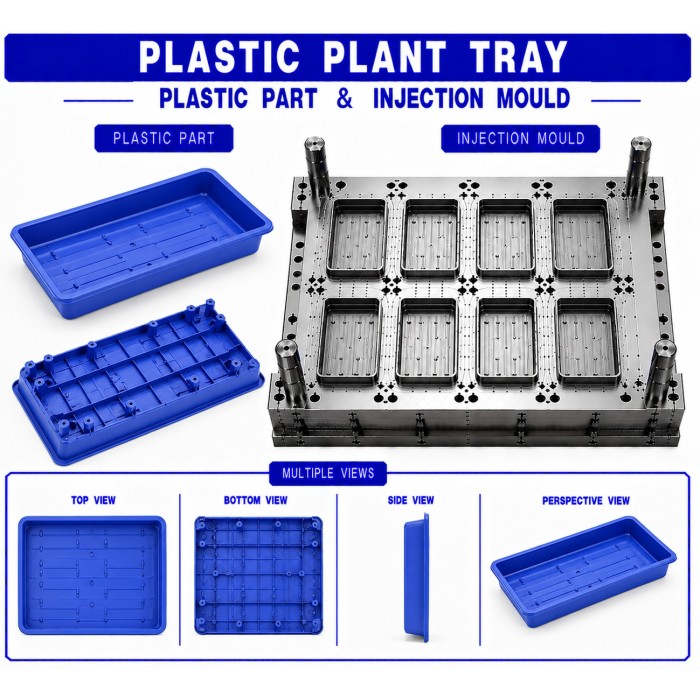
Renovator Appliances Ltd provides professional Plastic Plant Tray Mould and Moulding Services for manufacturing durable, lightweight, reusable, and practical plastic trays used for supporting, organizing, transporting, and displaying plants, seedlings, nursery pots, flower pots, and gardening materials. Our complete service includes plastic plant tray mould design, mould manufacturing, mould trial, injection moulding, prototype development, component assembly, and bulk production according to customer requirements.
We manufacture precision-engineered plant tray moulds using advanced CNC machining, EDM, Wire Cut EDM, and plastic injection moulding technology. Our moulding solutions are suitable for different tray sizes, shapes, cell configurations, drainage designs, stacking arrangements, carrying features, pot holders, seedling compartments, reinforced structures, and customized OEM branding requirements.
Types of Plastic Plant Trays
Plastic Plant Tray
Plastic Nursery Tray
Plastic Plant Nursery Tray
Plastic Seedling Tray
Plastic Seed Tray
Plastic Propagation Tray
Plastic Gardening Tray
Plastic Garden Plant Tray
Plastic Flower Plant Tray
Plastic Flower Pot Tray
Plastic Plant Pot Tray
Plastic Nursery Pot Tray
Plastic Plant Holder Tray
Plastic Plant Collection Tray
Plastic Plant Carrying Tray
Plastic Plant Transport Tray
Plastic Multi-Cell Plant Tray
Plastic Multi-Compartment Plant Tray
Plastic Seedling Propagation Tray
Plastic Growing Tray
Plastic Plant Growing Tray
Plastic Plant Display Tray
Plastic Greenhouse Plant Tray
Plastic Horticulture Tray
Plastic Agriculture Plant Tray
Plastic Commercial Nursery Tray
Plastic Stackable Plant Tray
Plastic Reusable Plant Tray
Plastic Heavy-Duty Plant Tray
Plastic Drainage Plant Tray
Plastic Water Collection Plant Tray
Plastic Rectangular Plant Tray
Plastic Square Plant Tray
Plastic Round Plant Tray
Plastic Customized Plant Tray
Plastic OEM Plant Tray
These plant trays can be manufactured in different sizes, shapes, cell counts, compartment configurations, drainage holes, depths, wall thicknesses, stacking designs, colors, textures, surface finishes, and customized branding designs according to customer requirements.
Key Features
Custom Plant Tray Mould Design
Our plastic plant tray moulds are designed according to the required tray length, width, height, cell size, number of compartments, drainage configuration, stacking arrangement, wall thickness, and customer specifications.
Precision Mould Manufacturing
We manufacture plant tray moulds using CNC machining, EDM, Wire Cut EDM, drilling, grinding, and precision tooling processes to achieve accurate dimensions and consistent product quality.
High-Volume Injection Moulding
Our injection moulding services support efficient mass production of plastic plant trays with consistent dimensions, weight, cell size, structural strength, and surface finish.
Multi-Cell Design
Plant trays can be developed with multiple cells for growing and organizing seedlings, plants, cuttings, and nursery plants.
Drainage Hole Design
Drainage holes can be incorporated into individual cells or tray sections to help manage excess water according to the required product design.
Stackable Design
Stackable plant trays can be developed to maximize storage, transportation, and nursery handling efficiency.
Reinforced Structure
Ribs, support sections, reinforced edges, and strengthened corners can be incorporated to improve tray rigidity and durability.
Pot Holder Design
Specialized compartments can be designed to securely hold nursery pots, flower pots, plant containers, or seedling containers.
Carrying Design
Handles, grip areas, or reinforced edges can be incorporated for convenient movement and transportation of plants and seedlings.
Reusable Design
Durable plastic materials and suitable product structures can be selected for repeated use in nurseries, greenhouses, gardening, and horticulture applications.
Customized Product Development
Customers can customize tray size, cell count, cell shape, depth, drainage holes, stacking features, handles, colors, textures, branding, and other product specifications.
| Feature | Description |
|---|---|
| Mould Design | Custom plastic plant tray moulds developed according to product drawings and specifications. |
| Product Customization | Size, cell count, compartments, drainage, depth, stacking, handles, color, texture, and branding can be customized. |
| Injection Moulding | Precision injection moulding for consistent and repeatable production. |
| OEM Manufacturing | Complete mould development and production support for OEM and private-label gardening products. |
Industrial Applications
Plastic plant trays manufactured using our moulding services are suitable for:
| Industry | Application |
|---|---|
| Horticulture | Nursery and plant propagation |
| Agriculture | Seedling and crop plant production |
| Nurseries | Plant and seedling organization |
| Greenhouses | Controlled plant cultivation |
| Gardening | Home and commercial gardening |
| Floriculture | Flower and ornamental plant cultivation |
| Landscaping | Plant preparation and transportation |
| Plant Retail | Plant display and handling |
| Commercial Farming | Seedling production and plant management |
| Garden Centers | Plant storage, display, and transportation |
| OEM & ODM | Customized plant tray manufacturing |
Manufacturing Process
Our Plastic Plant Tray Mould and Moulding Service follows a systematic manufacturing process to achieve reliable mould performance and consistent finished products.
Product Design & Development
Customer drawings, 3D models, tray dimensions, cell size, cell count, compartment layout, drainage holes, wall thickness, stacking requirements, handles, and functional requirements are reviewed before mould development.
Mould Flow & Engineering Analysis
The product design is evaluated for wall thickness, draft angle, shrinkage, gate position, cooling requirements, parting line, ejection system, structural ribs, drainage openings, and mould filling.
Mould Design
The plant tray mould is designed using CAD/CAM software according to the required product geometry and injection moulding machine specifications.
CNC & EDM Machining
Mould components are manufactured using CNC machining, EDM, Wire Cut EDM, drilling, and grinding processes for accurate dimensions and high-quality mould surfaces.
Mould Assembly
Individual mould components are assembled and checked for alignment, cavity and core movement, cooling channels, ejector operation, guide systems, inserts, and proper mould closing.
Mould Trial & Sampling
The completed mould is installed on a compatible injection moulding machine and trial samples are produced for dimensional, drainage, stacking, fitment, and visual verification.
Injection Moulding Production
Selected plastic material is heated and melted inside the injection moulding machine and injected into the mould cavity under controlled pressure and temperature.
Cooling & Ejection
The moulded plant tray is cooled inside the mould and carefully ejected to maintain dimensional stability and prevent deformation.
Finishing
Excess plastic or flash is removed from the product. Drainage openings, edges, stacking areas, and other critical features are checked and finished as required.
Quality Inspection
Finished plant trays are inspected for dimensions, weight, cell size, drainage performance, stacking fitment, structural strength, surface quality, and overall functionality.
Raw Materials
| Material | Description |
|---|---|
| Polypropylene (PP) | Lightweight, durable, flexible, impact-resistant, and suitable for many plant tray applications. |
| HDPE | Provides good impact strength, moisture resistance, durability, and suitability for selected outdoor applications. |
| ABS | Provides rigidity and dimensional stability for selected plant tray applications. |
| HIPS | Suitable for selected rigid plant tray designs requiring economical production and dimensional stability. |
Material selection depends on the required strength, flexibility, impact resistance, moisture resistance, durability, weight, and intended application.
Mould Material
| Mould Material | Application |
|---|---|
| P20 Steel | Suitable for general-purpose and medium-volume plant tray mould production. |
| H13 Steel | Suitable for demanding applications requiring higher hardness and improved mould durability. |
| S136 Steel | Suitable for applications requiring corrosion resistance and high-quality mould surfaces. |
The final mould steel is selected according to production quantity, product design, expected mould life, surface finish, plastic material, and customer requirements.
Quality Control
We maintain strict quality control throughout mould manufacturing and plastic plant tray production.
Raw Material Inspection
Plastic materials are checked for grade, quality, color, and suitability before production.
Mould Dimension Inspection
Critical mould dimensions, cavity alignment, cooling channels, ejector system, guide components, inserts, and tolerances are inspected before mould trials.
First Sample Inspection
Initial plant tray samples are checked against approved drawings, samples, or specifications.
Dimensional Inspection
Tray length, width, height, cell dimensions, cell depth, wall thickness, drainage hole dimensions, and other critical measurements are verified.
Weight Inspection
Finished plant trays are checked for consistent product weight according to the approved specification.
Cell Inspection
Individual cells or compartments are checked for correct dimensions, depth, shape, and consistency.
Drainage Inspection
Drainage holes and channels are inspected for correct dimensions and unobstructed water flow according to the approved design.
Stacking Inspection
Stackable trays are checked for correct nesting, alignment, and separation.
Structural Inspection
Walls, ribs, corners, handles, edges, and other structural features are inspected for stability and strength.
Visual Inspection
Products are inspected for flash, sink marks, warpage, short shots, scratches, bubbles, flow marks, and other surface defects.
Surface Finish Inspection
Surface texture, gloss, matte finish, patterns, embossing, logos, and other finishing requirements are inspected according to approved specifications.
Packaging Inspection
Finished plant trays are securely packed to minimize damage during handling, storage, and transportation.
Buyer Guide
When selecting a Plastic Plant Tray Mould and Moulding Service, consider the following factors:
Tray Size
Specify the required length, width, height, depth, and overall dimensions.
Cell Configuration
Specify the number of cells, cell size, shape, depth, and arrangement according to the type of plant or seedling.
Drainage
Specify the number, size, location, and configuration of drainage holes or channels.
Plant Application
Specify whether the tray will be used for seedlings, flower plants, nursery plants, propagation, greenhouse cultivation, or general gardening.
Stacking Configuration
Specify whether the trays need to be stackable, nestable, or designed for easy transportation and storage.
Material Selection
Select PP, HDPE, ABS, HIPS, or another suitable plastic according to strength, flexibility, durability, moisture resistance, weight, and application requirements.
Handle Design
Specify whether integrated handles, grip areas, reinforced edges, or other carrying features are required.
Branding & Customization
Logo embossing, printing areas, colors, textures, labels, graphics, and customized branding areas can be incorporated into the product and mould.
Mould Life
Choose mould steel according to expected production volume and required service life.
Production Quantity
Production quantity helps determine the appropriate mould type, cavity configuration, injection moulding machine, and production strategy.
Why Choose Renovator Appliances Ltd?
Renovator Appliances Ltd provides complete plastic mould manufacturing and injection moulding solutions from product development to bulk plant tray production.
Complete Mould Development
We provide product development support, mould design, mould manufacturing, mould trials, sampling, and production assistance.
Precision Tooling
Our tooling processes include CNC machining, EDM, Wire Cut EDM, mould assembly, precision inspection, and trial production.
Custom Manufacturing
Plant tray dimensions, cell count, cell shape, depth, drainage holes, stacking configuration, handles, colors, textures, surface finishes, and branding areas can be customized according to customer specifications.
OEM & ODM Solutions
We support OEM and ODM customers with customized mould development and contract plastic manufacturing solutions.
Consistent Production Quality
Controlled injection moulding parameters help maintain consistent product dimensions, weight, cell dimensions, drainage performance, stacking fitment, structural strength, and surface appearance.
Competitive Manufacturing
Efficient tooling and injection moulding processes provide cost-effective solutions for medium- and high-volume plant tray production.
Production Support
We support customers from mould development and sampling through approved production and bulk manufacturing.
Production Capacity
Plastic plant tray production capacity depends on tray size, product weight, number of cells, mould cavity configuration, injection moulding machine tonnage, cycle time, plastic material, mould design, and production requirements.
For example, if a single-cavity plant tray mould operates with a 25-second cycle time, its theoretical output is approximately 144 trays per hour. A 2-cavity mould operating at the same cycle time could theoretically produce approximately 288 trays per hour.
Actual production capacity may vary due to cooling time, machine efficiency, mould loading, material handling, quality inspection, operator requirements, and other production conditions.
| Plant Tray Type | Production Capability |
|---|---|
| Small Seedling Tray | Suitable for high-volume production depending on mould cavity and cycle time |
| Multi-Cell Nursery Tray | Suitable for continuous nursery and commercial production |
| Plant Pot Tray | Production based on mould and product configuration |
| Propagation Tray | Production based on mould cavity and cycle time |
| Heavy-Duty Plant Tray | Production based on machine capacity and product weight |
| Customized Plant Tray | Production based on customized mould and product configuration |
Actual production capacity is finalized after reviewing the product drawing, 3D model, product weight, cell configuration, mould cavity configuration, machine capacity, cycle time, material, and required production quantity.
Frequently Asked Questions
Q1. What is a Plastic Plant Tray Mould?
A plastic plant tray mould is a precision-engineered injection mould used to manufacture plastic trays for seedlings, nursery plants, flower plants, propagation, gardening, and horticulture applications.
Q2. Which materials can be used for plastic plant trays?
Common materials include PP and HDPE, while ABS and HIPS may be used for selected designs. Material selection depends on the required strength, flexibility, durability, moisture resistance, weight, and intended application.
Q3. Can plastic plant trays be customized?
Yes. Plant trays can be customized according to size, cell count, cell shape, cell depth, drainage holes, stacking design, handles, colors, textures, branding areas, and customer drawings.
Q4. How is a plastic plant tray manufactured?
Plastic plant trays are generally manufactured through injection moulding. Plastic granules are melted, injected into the mould cavity, cooled, and ejected. The finished tray is then inspected and packed for use or further distribution.
Q5. Does Renovator Appliances Ltd provide both mould and moulding services?
Yes. Renovator Appliances Ltd provides complete Plastic Plant Tray Mould and Moulding Services, including mould design, mould manufacturing, mould trials, injection moulding, prototype development, quality inspection, and bulk production according to customer requirements.
Plastic Product Parts
Mould Material : P20 Steel / H13 Steel / S136 Steel
Plastic Grade : Engineering Grade / UV Stabilized Grade / Flame Retardant GradeProduct Material : PP / HDPE / ABS / HIPSMould Type : Single Cavity Mould / Multi Cavity Mould / Hot Runner MouldWeight : 100–1500 gDimensions : 200 × 150 × 30 mm to 600 × 400 × 150 mm