- Home
- About us
- Plastic Products and Moulds+
- Plastic Injection Moulding Services
- Industrial Plastic Crates and Moulds
- Air Conditioner Plastic Parts And Moulds
- Printer Plastic Parts and Moulds
- Laptop Plastic Parts And Moulds
- Vacuum Cleaner Plastic Parts and Moulds
- Air Cooler Plastic Parts and Moulds
- Water Dispenser Plastic Parts and Moulds
- Washing Machine Plastic Parts And Moulds
- Water Purifier Plastic Parts and Moulds
- Robot Plastic Parts Mould and Moulding Services
- CPU Plastic Parts and Moulds
- Refrigerator Plastic Parts and Moulds
- Air Blower Plastic Parts Mould and Moulding Services
- Food Processor Plastic Parts and Moulds
- Lawn Mower Plastic Parts Mould and Moulding Services
- Microwave Oven Plastic Parts Mould and Moulding Services
- Monitor Plastic Parts and Moulds
- Mixer Grinder Plastic Parts Mould and Moulding Services
- Chimney Plastic Parts Mould and Moulding Services
- Geyser Plastic Parts Mould and Moulding Services
- Humidifier Plastic Parts Mould and Moulding Services
- Home Theatre Plastic Parts Mould and Moulding Services
- Steam Mop Plastic Parts Mould and Moulding Services
- Egg Boiler Plastic Parts Mould and Moulding Services
- Air Purifier Plastic Parts Mould and Moulding Services
- Room Heater Plastic Parts Mould and Moulding Services
- Contact us
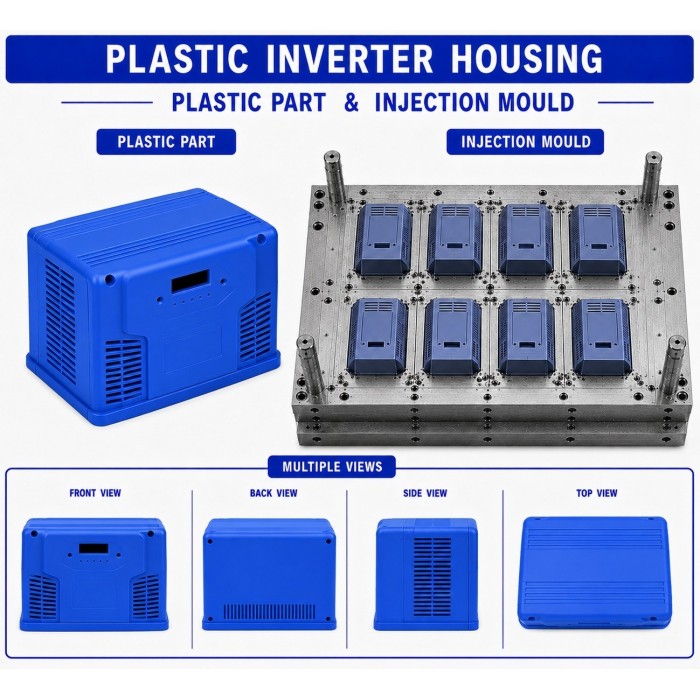
Plastic Inverter Housing Mould and Moulding Service
Plastic-IH
Rs. 250.00
/ Piece (1 Piece) Plastic Inverter Housing Mould and Moulding Service | Renovator Appliances Ltd
Product Overview
Renovator Appliances Ltd provides professional Plastic Inverter Housing Mould and Moulding Services for manufacturing durable, lightweight, electrically insulating, impact-resistant, and dimensionally stable plastic housings used to protect and enclose inverter systems, power conversion units, control electronics, battery inverter assemblies, solar inverter components, and other electrical power equipment.
Our complete service includes plastic inverter housing mould design, mould manufacturing, mould trial, injection moulding, prototype development, finishing, component assembly, quality inspection, and bulk production according to customer drawings, 3D models, samples, PCB layouts, component arrangements, and production requirements.
We manufacture precision-engineered inverter housing moulds using advanced CNC machining, EDM, Wire Cut EDM, drilling, grinding, precision tooling, and plastic injection moulding technology. Our moulding solutions support different inverter housing sizes, shapes, wall thicknesses, ventilation openings, cooling-air channels, PCB mounting bosses, screw posts, cable entries, connector openings, display openings, switch openings, mounting points, snap-fit clips, locking features, battery-compartment interfaces, heat-management features, handles, covers, colors, surface finishes, and customized OEM branding requirements.
Types of Plastic Inverter Housings
Plastic Inverter Housing
Plastic Inverter Enclosure
Plastic Power Inverter Housing
Plastic Solar Inverter Housing
Plastic Home Inverter Housing
Plastic Battery Inverter Housing
Plastic DC Inverter Housing
Plastic AC Inverter Housing
Plastic Hybrid Inverter Housing
Plastic Solar Power Inverter Housing
Plastic Off-Grid Inverter Housing
Plastic Grid-Tie Inverter Housing
Plastic UPS Inverter Housing
Plastic Inverter Control Housing
Plastic Inverter Electronics Housing
Plastic Inverter PCB Housing
Plastic Inverter Main Housing
Plastic Inverter Front Housing
Plastic Inverter Rear Housing
Plastic Inverter Top Cover
Plastic Inverter Bottom Housing
Plastic Inverter Side Cover
Plastic Inverter Terminal Cover
Plastic Inverter Display Housing
Plastic Inverter Housing with Ventilation
Plastic Inverter Housing with Cooling Slots
Plastic Inverter Housing with Fan Opening
Plastic Inverter Housing with PCB Mount
Plastic Inverter Housing with Screw Boss
Plastic Inverter Housing with Cable Entry
Plastic Inverter Housing with Connector Opening
Plastic Inverter Housing with Display Opening
Plastic Inverter Housing with Switch Opening
Plastic Inverter Housing with Mounting Holes
Plastic Inverter Housing with Snap-Fit
Plastic Inverter Housing with Locking Clip
Plastic Inverter Housing with Heat Dissipation
Plastic Inverter Housing with Handle
Plastic Customized Inverter Housing
Plastic OEM Inverter Housing
These inverter housings can be manufactured in different dimensions, shapes, wall thicknesses, ventilation patterns, mounting configurations, cable-entry arrangements, connector openings, display openings, fastening systems, colors, textures, surface finishes, and customized branding designs according to customer requirements.
Key Features
Custom Inverter Housing Mould Design
Our plastic inverter housing moulds are designed according to the required inverter dimensions, PCB size, component layout, battery configuration, cooling requirements, mounting system, wall thickness, cable-entry arrangement, connector positions, and customer specifications.
Precision Mould Manufacturing
We manufacture inverter housing moulds using CNC machining, EDM, Wire Cut EDM, drilling, grinding, and precision tooling processes to achieve accurate dimensions and consistent production quality.
PCB Mounting Features
Internal mounting bosses, standoffs, guides, clips, and support structures can be incorporated to position and secure inverter PCBs.
Ventilation & Cooling Design
Ventilation slots, fan openings, airflow passages, cooling vents, and other suitable features can be incorporated to support thermal management.
Cable Entry Design
Cable-entry openings, wire passages, cable clamps, and strain-relief features can be customized according to cable dimensions and installation requirements.
Connector Openings
Openings can be developed for battery terminals, AC input/output, DC terminals, communication ports, switches, displays, indicators, and other electrical interfaces.
Screw Bosses
Reinforced screw bosses can be incorporated for housing assembly, PCB mounting, cover fastening, and component retention.
Snap-Fit & Locking Features
Snap-fit clips, locking tabs, latches, and other retention features can be incorporated for convenient assembly and disassembly.
Mounting Options
Inverter housings can be designed for wall mounting, floor mounting, panel mounting, bracket mounting, screw mounting, or other customized installation systems.
Protective Construction
Suitable engineering plastics can provide physical protection and electrical insulation for internal electronic and power components.
Customized Branding
Logo embossing, product codes, identification marks, labels, textures, and other customized branding features can be incorporated into the product and mould.
| Feature | Description |
|---|---|
| Mould Design | Custom plastic inverter housing moulds developed according to product drawings, PCB layouts, samples, and specifications. |
| Product Customization | Size, shape, PCB mounting, ventilation, cable entry, connector openings, display openings, mounting system, color, finish, and branding can be customized. |
| Injection Moulding | Precision injection moulding for consistent and repeatable inverter housing production. |
| OEM Manufacturing | Complete mould development and production support for OEM and private-label inverter manufacturers. |
Industrial Applications
Plastic inverter housings manufactured using our moulding services are suitable for:
| Industry | Application |
|---|---|
| Solar Energy | Solar inverters and photovoltaic power conversion equipment |
| Renewable Energy | Power conversion and energy management equipment |
| Home Power Systems | Residential inverter and backup power systems |
| Electrical Equipment | Power conversion and control equipment |
| Industrial Automation | Industrial power conversion and control systems |
| Telecommunications | Backup power and power conversion systems |
| UPS Systems | Inverter and backup power equipment |
| Battery Systems | Battery inverter and energy storage equipment |
| Power Electronics | Power conversion and electronic control modules |
| OEM & ODM | Customized inverter housing manufacturing |
Manufacturing Process
Our Plastic Inverter Housing Mould and Moulding Service follows a systematic manufacturing process to achieve reliable mould performance and consistent finished products.
Product Design & Development
Customer drawings, 3D models, physical samples, inverter dimensions, PCB layouts, component locations, battery configuration, cable-entry requirements, connector positions, display requirements, cooling requirements, and functional specifications are reviewed before mould development.
Engineering & Mould Flow Analysis
The housing design is evaluated for wall thickness, draft angle, shrinkage, gate position, cooling requirements, parting line, ejection system, screw bosses, PCB supports, ventilation openings, fan openings, cable entries, snap-fits, ribs, and mould filling.
Mould Design
The inverter housing mould is designed using CAD/CAM software according to the required product geometry and injection moulding machine specifications.
CNC & EDM Machining
Mould components are manufactured using CNC machining, EDM, Wire Cut EDM, drilling, and grinding processes for accurate dimensions and high-quality mould surfaces.
Mould Assembly
Individual mould components are assembled and checked for cavity and core alignment, cooling channels, ejector operation, guide systems, inserts, sliders, lifters, and proper mould closing.
Mould Trial & Sampling
Trial inverter housing components are produced for dimensional accuracy, PCB fitment, component clearance, cover alignment, screw-boss positioning, cable entry, connector openings, ventilation, mounting accuracy, and visual verification.
Injection Moulding Production
Selected plastic material is heated and melted inside the injection moulding machine and injected into the mould cavity under controlled pressure and temperature.
Cooling & Ejection
The moulded inverter housing components are cooled and carefully ejected to maintain dimensional stability and prevent deformation.
Finishing & Assembly
Flash and excess plastic are removed. Where required, PCB boards, screws, fans, connectors, switches, displays, covers, cable glands, brackets, and other compatible components can be assembled.
Quality Inspection
Finished inverter housings are inspected for dimensions, PCB fitment, component clearance, cover alignment, screw-boss accuracy, cable entry, connector alignment, ventilation, structural strength, surface quality, and overall functionality.
Raw Materials
| Material | Description |
|---|---|
| ABS | Provides good rigidity, impact resistance, dimensional stability, and surface finish for general inverter housing applications. |
| PC | Provides high impact resistance and suitable temperature performance for selected inverter housings. |
| PC+ABS | Combines rigidity, impact resistance, dimensional stability, and suitable thermal performance. |
| PBT | Provides good dimensional stability, electrical insulation, and thermal performance for selected electrical housings. |
| PA (Nylon) | Provides good mechanical strength and temperature resistance for selected structural components. |
| PP | Lightweight and economical material suitable for selected lower-demand housing applications. |
Material selection should be based on the required electrical insulation, impact resistance, mechanical strength, temperature resistance, flame-retardant requirements, dimensional stability, environmental exposure, UV exposure, and intended application.
Mould Material
| Mould Material | Application |
|---|---|
| P20 Steel | Suitable for general-purpose and medium-volume inverter housing mould production. |
| H13 Steel | Suitable for demanding applications requiring higher hardness and improved mould durability. |
| S136 Steel | Suitable for applications requiring corrosion resistance and high-quality mould surfaces. |
The final mould steel is selected according to production quantity, product design, expected mould life, surface finish, plastic material, and customer requirements.
Quality Control
We maintain strict quality control throughout mould manufacturing and plastic inverter housing production.
Raw Material Inspection
Plastic materials are checked for grade, quality, color, and suitability before production.
Mould Dimension Inspection
Critical mould dimensions, cavity alignment, cooling channels, ejector system, guide components, inserts, sliders, lifters, and tolerances are inspected before mould trials.
First Sample Inspection
Initial inverter housing samples are checked against approved drawings, samples, PCB layouts, or specifications.
Dimensional Inspection
Housing length, width, height, wall thickness, mounting-hole positions, PCB support dimensions, screw-boss locations, connector openings, cable-entry dimensions, and other critical measurements are verified.
PCB Fitment Inspection
The housing is checked against the intended PCB to verify correct positioning, mounting, component clearance, and fitment.
Cover Fitment Inspection
Upper and lower housing components are checked for proper alignment, joining, fastening, and closure.
Screw Boss Inspection
Screw bosses and mounting posts are inspected for position, dimensions, alignment, and assembly compatibility.
Cable Entry Inspection
Cable openings, wire passages, cable clamps, and strain-relief features are checked according to approved specifications.
Ventilation Inspection
Ventilation slots, fan openings, and cooling passages are checked for correct position, dimensions, geometry, and consistency.
Structural Inspection
Housing walls, corners, ribs, mounting bosses, supports, clips, and other structural features are inspected for consistency and integrity.
Visual Inspection
Products are inspected for flash, sink marks, warpage, short shots, scratches, bubbles, flow marks, black spots, and other surface defects.
Surface Finish Inspection
Surface texture, gloss, matte finish, embossing, logos, labels, and other finishing requirements are inspected according to approved specifications.
Packaging Inspection
Finished inverter housings are securely packed to minimize scratches, deformation, contamination, and damage during handling, storage, and transportation.
Buyer Guide
When selecting a Plastic Inverter Housing Mould and Moulding Service, consider the following factors:
Inverter Type
Specify whether the housing is intended for a home inverter, solar inverter, hybrid inverter, UPS inverter, battery inverter, industrial inverter, or another power conversion application.
Housing Dimensions
Specify the required length, width, height, wall thickness, internal clearance, and overall housing geometry.
PCB Size
Specify the PCB length, width, thickness, mounting-hole positions, component heights, and mounting requirements.
Component Clearance
Specify clearance requirements for transformers, capacitors, heat sinks, fans, terminals, connectors, batteries, switches, and other internal components.
Cooling Requirements
Specify ventilation slots, fan openings, airflow channels, cooling passages, heat-dissipation provisions, and other thermal management requirements.
Cable Entry
Specify cable diameter, entry location, cable direction, cable gland, strain relief, and wire-routing requirements.
Connector Openings
Specify openings for battery terminals, AC input/output, DC output, communication ports, USB ports, switches, indicators, displays, or other interfaces.
Mounting Configuration
Specify wall mounting, floor mounting, panel mounting, bracket mounting, screw mounting, clip mounting, or another installation method.
Assembly Method
Specify screw fastening, snap-fit assembly, clips, ultrasonic welding, adhesive assembly, or another suitable joining method.
Material Selection
Select ABS, PC, PC+ABS, PBT, PA, PP, or another suitable plastic according to electrical, mechanical, thermal, UV, flame-retardant, and environmental requirements.
Color & Surface Finish
Specify the required color, texture, matte or glossy finish, and product appearance.
Branding & Customization
Logo embossing, product codes, labels, identification marks, graphics, and customized branding areas can be incorporated into the product and mould.
Production Quantity
Production quantity helps determine the appropriate mould type, cavity configuration, injection moulding machine, and production strategy.
Why Choose Renovator Appliances Ltd?
Renovator Appliances Ltd provides complete plastic mould manufacturing and injection moulding solutions from product development to bulk inverter housing production.
Complete Mould Development
We provide product development support, mould design, mould manufacturing, mould trials, sampling, and production assistance.
Precision Tooling
Our tooling processes include CNC machining, EDM, Wire Cut EDM, drilling, grinding, mould assembly, precision inspection, and trial production.
Custom Manufacturing
Inverter housing dimensions, PCB mounting, component clearance, screw bosses, cable entries, connector openings, ventilation, fan openings, mounting systems, colors, surface finishes, and branding can be customized.
OEM & ODM Solutions
We support OEM and ODM customers with customized mould development and contract plastic manufacturing solutions.
Consistent Production Quality
Controlled injection moulding parameters help maintain consistent housing dimensions, PCB fitment, component clearance, cover alignment, mounting accuracy, structural strength, ventilation, and surface appearance.
Competitive Manufacturing
Efficient tooling and injection moulding processes provide cost-effective solutions for medium- and high-volume inverter housing production.
Production Support
We support customers from mould development and sampling through approved production and bulk manufacturing.
Production Capacity
Plastic inverter housing production capacity depends on housing size, product weight, mould cavity configuration, injection moulding machine tonnage, cycle time, plastic material, mould design, assembly requirements, and production quantity.
For example, if a 2-cavity inverter housing mould operates with a 40-second cycle time, its theoretical output is approximately 180 housing sets per hour.
Actual production capacity may vary due to cooling time, machine efficiency, mould loading, material handling, quality inspection, operator requirements, assembly, finishing, and packaging.
| Inverter Housing Type | Production Capability |
|---|---|
| Small Inverter Housing | Suitable for high-volume production depending on mould cavity and cycle time |
| Standard Inverter Housing | Suitable for continuous OEM and commercial production |
| Solar Inverter Housing | Production based on housing dimensions, ventilation, and machine capacity |
| Home Inverter Housing | Production based on product size and mould configuration |
| Ventilated Inverter Housing | Production based on cooling design and mould configuration |
| Customized Inverter Housing | Production based on customized mould and product specifications |
Actual production capacity is finalized after reviewing the product drawing, 3D model, PCB dimensions, component layout, product weight, mould cavity configuration, machine capacity, cycle time, material, assembly requirements, and required production quantity.
Frequently Asked Questions
Q1. What is a Plastic Inverter Housing Mould?
A Plastic Inverter Housing Mould is a precision-engineered injection mould used to manufacture plastic enclosures that protect and contain inverter PCBs, electrical components, power conversion systems, and related assemblies.
Q2. Which materials can be used for plastic inverter housings?
Common materials include ABS, PC, PC+ABS, PBT, PA (Nylon), and PP. Material selection depends on electrical insulation, impact resistance, temperature resistance, UV exposure, flame-retardant requirements, dimensional stability, and intended application.
Q3. Can the Plastic Inverter Housing Mould be customized?
Yes. Housing dimensions, PCB mounting, component clearance, ventilation slots, fan openings, cable entries, connector openings, display openings, mounting features, snap-fits, colors, surface finishes, and branding can be customized.
Q4. Can inverter housings be manufactured for solar and home inverter applications?
Yes. Customized housings can be developed for suitable solar inverters, home inverters, hybrid inverters, UPS systems, battery inverters, power conversion equipment, and other electrical power products.
Q5. Does Renovator Appliances Ltd provide both mould and moulding services?
Yes. Renovator Appliances Ltd provides complete Plastic Inverter Housing Mould and Moulding Services, including mould design, mould manufacturing, mould trials, injection moulding, prototype development, quality inspection, finishing, assembly support, and bulk production according to customer requirements.
Plastic Product Parts
Mould Material : P20 Steel / H13 Steel / S136 Steel
Plastic Grade : Engineering Grade / Flame Retardant Grade / UV Stabilized GradeProduct Material : ABS / PC / PC+ABS / PBT / PA (Nylon) / PPMould Type : Single Cavity Mould / Multi Cavity MouldWeight : 100–2000 gDimensions : 100 × 80 × 40 mm to 600 × 400 × 200 mm