- Home
- About us
- Plastic Products and Moulds+
- Plastic Injection Moulding Services
- Industrial Plastic Crates and Moulds
- Air Conditioner Plastic Parts And Moulds
- Printer Plastic Parts and Moulds
- Laptop Plastic Parts And Moulds
- Vacuum Cleaner Plastic Parts and Moulds
- Air Cooler Plastic Parts and Moulds
- Water Dispenser Plastic Parts and Moulds
- Washing Machine Plastic Parts And Moulds
- Water Purifier Plastic Parts and Moulds
- Robot Plastic Parts Mould and Moulding Services
- CPU Plastic Parts and Moulds
- Refrigerator Plastic Parts and Moulds
- Air Blower Plastic Parts Mould and Moulding Services
- Food Processor Plastic Parts and Moulds
- Lawn Mower Plastic Parts Mould and Moulding Services
- Microwave Oven Plastic Parts Mould and Moulding Services
- Monitor Plastic Parts and Moulds
- Mixer Grinder Plastic Parts Mould and Moulding Services
- Chimney Plastic Parts Mould and Moulding Services
- Geyser Plastic Parts Mould and Moulding Services
- Humidifier Plastic Parts Mould and Moulding Services
- Air Purifier Plastic Parts Mould and Moulding Services
- Home Theatre Plastic Parts Mould and Moulding Services
- Steam Mop Plastic Parts Mould and Moulding Services
- Contact us
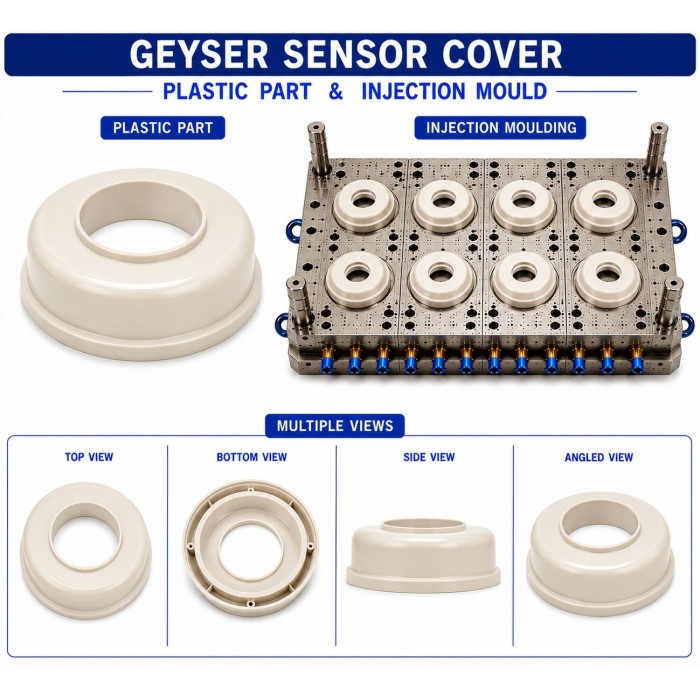
Geyser Plastic Sensor Cover Mould and Moulding Service
GPSC
Rs. 50.00
/ Piece (1 Piece) Geyser Plastic Sensor Cover Mould and Moulding Service | Renovator Appliances Ltd
Product Overview
Geyser Plastic Sensor Cover Mould and Moulding Service is a specialized plastic injection moulding solution for manufacturing the protective sensor cover used in electric geysers and water heating appliances. The sensor cover is designed to protect and enclose temperature sensors, thermal sensing components, or related sensor assemblies while allowing the sensor to function according to the geyser's design.
Renovator Appliances Ltd provides an integrated solution covering product development, mould design, mould manufacturing, mould trials, plastic injection moulding, quality inspection, and bulk production. The Geyser Plastic Sensor Cover can be manufactured according to customer drawings, 3D CAD models, existing samples, sensor dimensions, mounting requirements, and specific geyser model specifications.
The component can be customized with the required sensor opening, mounting clips, fixing bosses, ribs, cable clearance, ventilation provisions, wall thickness, dimensions, colour, and surface finish.
Key Features
Precision injection moulded sensor cover
Designed for protection of geyser sensor assemblies
Customized according to sensor and appliance design
Accurate sensor mounting and clearance dimensions
Lightweight plastic construction
Heat-resistant material options available
Customized clips, bosses, and fixing features
Protection against accidental contact and mechanical damage
Smooth or textured surface finish
Customized colours
Suitable for OEM and bulk production
Consistent production using precision-engineered moulds
Industrial Applications
The Geyser Plastic Sensor Cover is used in water heating appliances where temperature or sensing components require a protective plastic enclosure.
Typical applications include:
Electric Storage Geysers
Electric Water Heaters
Domestic Water Heating Appliances
Residential Geysers
Commercial Water Heating Equipment
Temperature Sensor Assemblies
Thermal Sensor Protection Systems
OEM Geyser Assemblies
Customized Water Heater Products
Depending on the appliance design, the sensor cover may be used around temperature sensors, thermostat sensing areas, thermal monitoring components, wiring interfaces, or sensor mounting locations.
Manufacturing Process
The Geyser Plastic Sensor Cover is manufactured using a controlled plastic injection moulding process.
1. Product Design
The sensor cover is designed according to the sensor dimensions, mounting arrangement, required clearances, cable routing, wall thickness, clips, bosses, and overall appliance assembly.
2. Material Selection
A suitable thermoplastic material is selected based on the required temperature resistance, electrical insulation properties where applicable, mechanical strength, dimensional stability, and application environment.
3. Plastic Preparation
The selected plastic granules are prepared according to the material manufacturer's processing specifications and fed into the injection moulding machine.
4. Injection
The plastic is heated and converted into molten material before being injected into the mould cavity under controlled pressure and temperature.
5. Filling and Packing
The mould cavity is filled with molten plastic and holding pressure is applied to maintain the required geometry and dimensional accuracy.
6. Cooling
The mould cooling system removes heat from the component until it reaches sufficient rigidity for safe ejection.
7. Ejection
After cooling, the mould opens and the finished sensor cover is removed through the designed ejection mechanism.
8. Finishing and Inspection
The moulded component is inspected for flash, warpage, sink marks, short shots, surface defects, dimensional accuracy, sensor clearance, and assembly fitment.
Mould Manufacturing Process
The Geyser Plastic Sensor Cover Mould is designed according to the component's geometry, sensor interface, required production quantity, injection machine capacity, and expected mould life.
1. Product and Mould Design
Customer drawings, CAD models, or approved samples are used to develop the mould. The cavity, core, parting line, gates, runners, cooling channels, and ejection system are designed according to the sensor cover.
2. Mould Material Selection
Suitable mould steel is selected according to production volume, expected mould life, component complexity, dimensional requirements, and surface finish.
3. Precision Machining
The cavity, core, inserts, sensor openings, and other mould components are manufactured using CNC machining, EDM, drilling, grinding, and precision finishing processes.
4. Cooling System
Cooling channels are designed to provide controlled and uniform cooling and to minimize dimensional variation.
5. Ejection System
Ejector pins, plates, inserts, or other suitable mechanisms are incorporated according to the sensor cover's geometry.
6. Mould Assembly
The cavity, core, inserts, guide components, cooling system, runner/gating system, and ejection system are assembled and accurately aligned.
7. Mould Trial
Trial production is performed to check filling, sensor opening dimensions, cooling, ejection, surface finish, warpage, and assembly fitment.
8. Final Tool Correction
Any required modifications identified during the mould trial are completed before the mould is released for regular production.
Raw Materials
Material selection should consider the sensor cover's operating temperature, electrical insulation requirements where applicable, dimensional stability, mechanical strength, and exposure conditions.
Potential materials include:
PP – Polypropylene
ABS – Acrylonitrile Butadiene Styrene
PA – Polyamide/Nylon, where technically suitable
PC/ABS – Polycarbonate ABS Blend
Heat-resistant engineering thermoplastics
Flame-retardant plastic grades, where required
Temperature-resistant grades, where required
The final material should be selected according to the actual sensor location, operating temperature, electrical requirements, and customer technical specifications.
Quality Control
Quality control can include inspection of:
Overall length, width, and height
Sensor opening dimensions
Sensor mounting clearance
Wall thickness
Clip and boss dimensions
Cable clearance
Mounting dimensions
Surface finish
Colour consistency
Warpage and deformation
Flash and burrs
Sink marks
Short shots
Cracks
Assembly fitment
Sensor installation clearance
Batch-to-batch dimensional consistency
Where specified, the component can also undergo temperature resistance, fitment, or functional inspection according to customer requirements.
Production Capacity
Production capacity depends on product weight, mould cavity count, injection moulding machine capacity, plastic material, mould design, cycle time, and production efficiency.
For example, a single-cavity mould operating with a 20-second cycle has a theoretical output of approximately 180 pieces per hour, before accounting for machine downtime, inspection, material handling, mould maintenance, and other production losses.
Multi-cavity moulds can be considered for higher-volume production where the component design permits.
Actual production capacity should be finalized after reviewing the sensor cover's product weight, dimensions, mould configuration, machine capacity, and required production volume.
Buyer Guide
Before ordering a Geyser Plastic Sensor Cover Mould and Moulding Service, buyers should provide:
2D product drawing
3D CAD model
Existing product sample, if available
Geyser model and capacity
Sensor model or dimensions
Sensor mounting arrangement
Required sensor clearance
Required plastic material and grade
Operating temperature
Target product weight
Required colour
Surface finish requirements
Cable clearance requirements
Critical dimensional tolerances
Required production quantity
Expected monthly or annual production volume
Providing the sensor dimensions, operating temperature, mounting location, and surrounding assembly details is important for accurate mould and product development.
Why Choose Renovator?
Renovator Appliances Ltd provides an integrated manufacturing solution for customized plastic components used in home appliances and electrical equipment.
Our service can include:
Customized product development
Plastic injection mould design
Precision mould manufacturing
Injection moulding production
Mould trial and validation
Material selection support
Dimensional quality inspection
Assembly fitment inspection
OEM and bulk production
Customized colours and surface finishes
Support from mould development through finished component production
Our focus is on producing consistent sensor covers according to customer drawings, samples, technical specifications, operating requirements, and production volumes.
Frequently Asked Questions (FAQ)
1. What is a Geyser Plastic Sensor Cover?
A Geyser Plastic Sensor Cover is a moulded plastic protective component used to cover or enclose a temperature sensor or related sensing assembly inside a geyser.
2. Which materials can be used for a Geyser Plastic Sensor Cover?
Depending on the operating conditions, materials such as PP, ABS, PC/ABS, PA, and suitable heat-resistant engineering thermoplastics can be considered. The final material depends on temperature, electrical, mechanical, and dimensional requirements.
3. Can the Sensor Cover be customized?
Yes. The sensor cover can be customized according to sensor dimensions, mounting arrangement, openings, cable clearance, clips, bosses, wall thickness, colour, surface finish, and customer drawings or CAD models.
4. What determines the production capacity of the Sensor Cover?
Production capacity depends on mould cavity count, cycle time, product weight, injection moulding machine capacity, material, mould design, and overall production efficiency.
5. Does Renovator provide both mould manufacturing and moulding services?
Yes. Renovator can provide an integrated service covering product development, mould design, mould manufacturing, mould trials, plastic injection moulding, quality inspection, and bulk production according to customer requirements.
Geyser Plastic Parts
Mould Material : P20 Steel / H13 Steel / S136 Steel
Plastic Grade : Engineering Grade / Heat Resistant Grade / Flame Retardant GradeProduct Material : PP / ABS / PC-ABS / PAMould Type : Single Cavity Mould / Multi Cavity MouldWeight : 20–150 gDimensions : 50–180 × 30–100 × 20–70 mmRelated Products
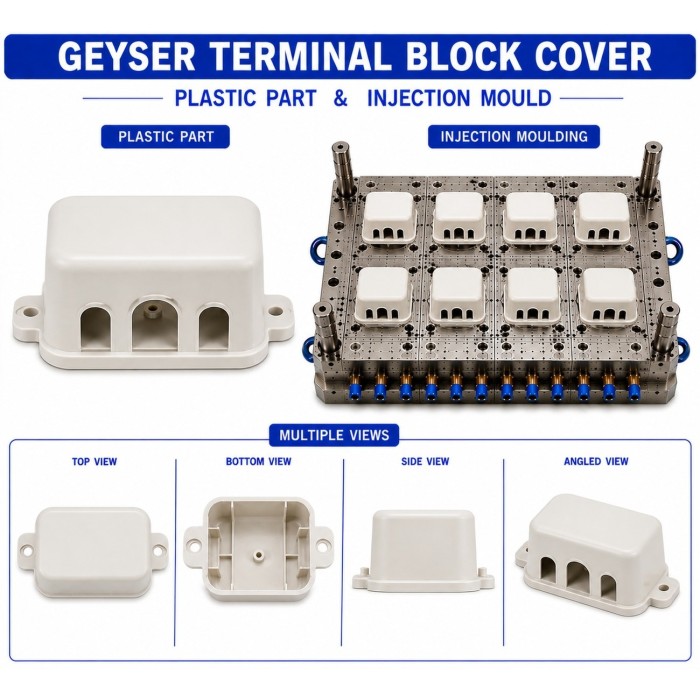
Geyser Plastic Terminal Block Cover Mould and Moulding Service
Geyser Plastic Terminal Block Cover Mould and Moulding Service | Renovator Appliances LtdProduct Ove..