- Home
- About us
- Plastic Products and Moulds+
- Steam Iron Plastic Parts Mould and Moulding Services
- Plastic Injection Moulding Services
- Industrial Plastic Crates and Moulds
- Air Conditioner Plastic Parts And Moulds
- Printer Plastic Parts and Moulds
- Laptop Plastic Parts And Moulds
- Vacuum Cleaner Plastic Parts and Moulds
- Air Cooler Plastic Parts and Moulds
- Water Dispenser Plastic Parts and Moulds
- Washing Machine Plastic Parts And Moulds
- Water Purifier Plastic Parts and Moulds
- Robot Plastic Parts Mould and Moulding Services
- CPU Plastic Parts and Moulds
- Refrigerator Plastic Parts and Moulds
- Air Blower Plastic Parts Mould and Moulding Services
- Food Processor Plastic Parts and Moulds
- Lawn Mower Plastic Parts Mould and Moulding Services
- Microwave Oven Plastic Parts Mould and Moulding Services
- Monitor Plastic Parts and Moulds
- Mixer Grinder Plastic Parts Mould and Moulding Services
- Chimney Plastic Parts Mould and Moulding Services
- Geyser Plastic Parts Mould and Moulding Services
- Humidifier Plastic Parts Mould and Moulding Services
- Home Theatre Plastic Parts Mould and Moulding Services
- Steam Mop Plastic Parts Mould and Moulding Services
- Toaster Plastic Parts Mould and Moulding Services
- Egg Boiler Plastic Parts Mould and Moulding Services
- Air Purifier Plastic Parts Mould and Moulding Services
- Hair Straightener Plastic Parts Mould and Moulding Services
- Coffee Maker Plastic Parts Mould and Moulding Services
- Inverter Plastic Parts Mould and Moulding Services
- Air Fryer Plastic Parts Mould and Moulding Services
- Garment Steamer Plastic Parts Mould and Moulding Services
- Hair Dryer Plastic Parts Mould and Moulding Services
- Room Heater Plastic Parts Mould and Moulding Services
- Electric Rice Cooker Plastic Parts Mould and Moulding Services
- Air Curtain Plastic Parts Mould and Moulding Services
- Electric Tandoor Plastic Parts Mould and Moulding Services
- Popcorn Maker Plastic Parts Mould and Moulding Services
- Set Top Box Plastic Parts Mould and Moulding Services
- Floor Scrubber Plastic Parts Mould and Moulding Services
- Electric Upholstery Plastic Parts Mould and Moulding Services
- Automatic Pet Feeder Plastic Parts Mould and Moulding Services
- Electric Flour Mill Plastic Parts Mould and Moulding Services
- Electric Face Steamer Plastic Parts Mould and Moulding Services
- Contact us
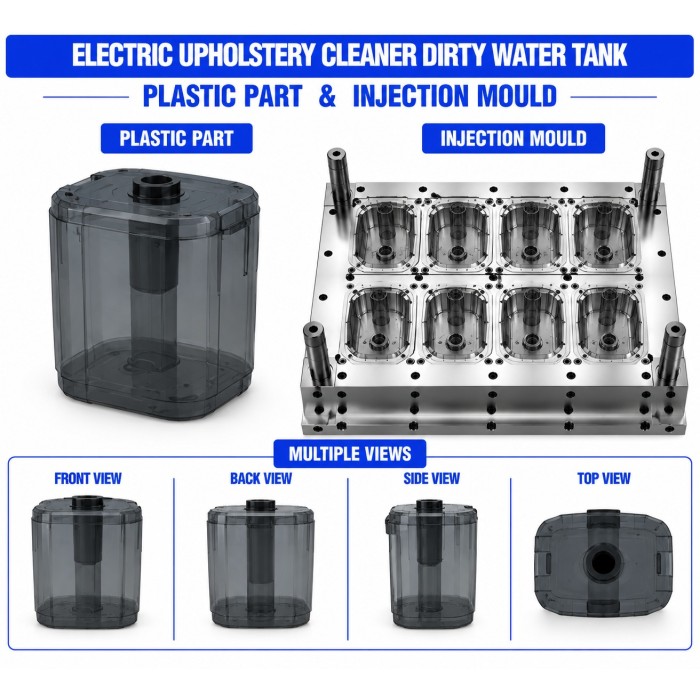
Electric Upholstery Cleaner Plastic Dirty Water Tank Mould and Moulding Service
EUCPDWT
Rs. 400.00
/ Piece (1 Piece) Electric Upholstery Cleaner Plastic Dirty Water Tank Mould and Moulding Service | Renovator Appliances Ltd
Product Overview
Renovator Appliances Ltd manufactures Electric Upholstery Cleaner Plastic Dirty Water Tank using precision plastic injection moulding processes for electric upholstery cleaners, portable spot cleaners, carpet cleaning machines, and compact wet-cleaning equipment. The dirty water tank is designed to collect recovered water, cleaning solution residue, dirt, dust, and extracted contaminants during upholstery and fabric cleaning operations.
The tank can be developed according to the machine's recovery-water capacity, internal layout, mounting arrangement, inlet and outlet configuration, lid interface, hose connections, sealing requirements, and overall product dimensions. Proper mould design and controlled injection moulding help achieve consistent wall thickness, dimensional accuracy, leak resistance, structural strength, and reliable fitment with the cleaner assembly.
Custom manufacturing is available for OEM and ODM requirements, including tank capacity, shape, transparent or opaque construction, colour, surface finish, handles, locating features, clips, mounting bosses, hose ports, sealing grooves, and other application-specific details.
Key Features
Application-specific dirty water recovery tank design
Precision injection moulded plastic construction
Suitable for electric upholstery and spot cleaning machines
Designed for collection of extracted dirty water and cleaning residues
Customized tank capacity and dimensions
Accurate fitment with machine body and recovery system
Hose inlet and outlet provisions as per design
Sealing grooves and gasket interfaces where required
Snap-fit, clip, latch, or screw-based mounting options
Integrated locating ribs and mounting bosses
Reinforced areas for improved structural stability
Handle or grip provision for easy tank removal and handling
Transparent or translucent options for liquid-level visibility
Suitable colour, texture, and surface-finish customization
Controlled wall thickness for dimensional consistency
Designed for repeated filling, emptying, cleaning, and handling
OEM and ODM manufacturing support
Prototype and production-volume moulding solutions
Industrial Applications
| Application | Use of Dirty Water Tank |
|---|---|
| Electric Upholstery Cleaners | Collects recovered dirty water during fabric and upholstery cleaning |
| Portable Spot Cleaners | Stores extracted water and cleaning residues |
| Carpet Cleaning Machines | Receives recovered liquid from carpet extraction operations |
| Fabric Cleaning Equipment | Collects contaminated water after cleaning cycles |
| Compact Wet Cleaning Machines | Provides dedicated dirty-water recovery capacity |
| Commercial Upholstery Cleaning Equipment | Supports repeated cleaning and water recovery operations |
| OEM Cleaning Equipment | Customized recovery tank for branded cleaning-machine assemblies |
Manufacturing Process
1. Product Design & Development
The dirty water tank is developed according to the customer's machine configuration, required tank capacity, available installation space, liquid flow arrangement, and recovery-system requirements. Important features such as tank geometry, wall thickness, hose ports, lid interface, sealing surfaces, mounting bosses, ribs, handles, and locating features are considered during product development.
CAD modelling and design validation help reduce potential moulding issues and ensure proper integration with the complete upholstery cleaner assembly.
2. Plastic Mould Design
A precision injection mould is designed based on the final tank geometry and production requirements. The mould design considers cavity configuration, parting line, draft angles, core and cavity construction, gate location, runner system, cooling channels, ejector arrangement, and venting.
For complex tanks, special attention is given to maintaining uniform wall thickness and avoiding deformation, sink marks, short shots, and other injection moulding defects.
3. Mould Manufacturing
The mould components are manufactured using suitable tool steels such as P20 Steel, H13 Steel, or S136 Steel, depending on production requirements, plastic material, expected mould life, and surface-finish requirements.
CNC machining, EDM, drilling, grinding, polishing, fitting, and mould assembly processes are carried out to achieve the required dimensional accuracy. Trial moulding may be performed to verify part quality and mould performance before production.
4. Injection Moulding
Selected plastic resin is dried or conditioned as required and processed through an injection moulding machine. The molten plastic is injected into the mould cavity under controlled temperature, pressure, speed, and holding conditions.
Cooling is carefully controlled to achieve dimensional stability and minimize warpage. The moulded tank is then ejected after sufficient cooling and transferred for inspection and subsequent operations.
5. Finishing & Assembly Preparation
After moulding, the dirty water tank undergoes gate trimming, flash removal, visual cleaning, and other required finishing operations. Additional components such as gaskets, seals, hose connectors, clips, valves, lids, or mounting hardware can be prepared for assembly where specified.
The tank is checked for smooth edges and proper interface with the corresponding machine components.
6. Quality Inspection
Finished tanks are inspected for dimensional accuracy, tank capacity, wall thickness, sealing surfaces, hose-port alignment, mounting features, surface quality, and overall fitment.
Leak testing and functional fitment checks can be performed according to the customer's application and quality requirements to ensure the tank is suitable for repeated collection and disposal of dirty water.
Raw Materials
| Plastic Material | Typical Application |
|---|---|
| PP (Polypropylene) | Lightweight tanks with good chemical and moisture resistance |
| HDPE | Durable tanks requiring impact and moisture resistance |
| ABS | Rigid tanks and components requiring good dimensional stability |
| HIPS | Cost-effective rigid plastic applications |
| PC+ABS | Applications requiring improved strength and impact performance |
| PBT | Engineering applications requiring dimensional stability |
| Nylon / PA | Higher-strength components and structural features |
| Glass-Filled Nylon | Reinforced mounting or structural areas |
| ASA | Applications requiring improved surface and environmental resistance |
| Flame-Retardant Plastic | Applications requiring specified flame-retardant properties |
| Engineering Plastics | Specialized applications requiring enhanced mechanical or thermal performance |
The final material is selected according to the tank's chemical exposure, impact requirements, operating temperature, required transparency, cleaning-agent compatibility, production volume, and customer specifications.
Quality Control
Renovator Appliances Ltd follows controlled inspection procedures to maintain consistent quality of injection-moulded dirty water tanks.
Raw Material Inspection: Verification of material grade and batch requirements.
Mould Inspection: Checking cavity condition, cooling, ejection, parting line, and mould dimensions.
Dimensional Inspection: Measurement of critical dimensions, mounting points, openings, and interfaces.
Wall Thickness Inspection: Checking critical areas for consistency and structural integrity.
Leak Inspection: Testing tank sealing and liquid-retention performance where specified.
Surface Inspection: Checking for sink marks, weld lines, flash, burn marks, scratches, and other visible defects.
Fitment Inspection: Verifying proper installation into the upholstery cleaner housing.
Hose-Port Inspection: Checking alignment and dimensional accuracy of hose or connector interfaces.
Lid & Seal Inspection: Verifying compatibility with the tank lid, gasket, or sealing arrangement.
Functional Inspection: Checking tank removal, installation, handling, and recovery-system integration.
Final Inspection: Ensuring products meet approved drawings, samples, and customer specifications before dispatch.
Buyer Guide
When sourcing an Electric Upholstery Cleaner Plastic Dirty Water Tank, buyers should provide the required tank dimensions, capacity, CAD drawing or sample, machine-body interface, and recovery-system configuration.
Important specifications may include:
Required tank capacity
Overall tank dimensions
Plastic material and grade
Transparent, translucent, or opaque requirement
Tank lid and sealing arrangement
Gasket or sealing-groove dimensions
Hose inlet and outlet locations
Connector or valve requirements
Mounting points and locking arrangement
Handle or grip requirements
Colour and surface finish
Required production quantity
Mould cavity requirement
Expected mould life
Packaging requirements
For reliable performance, attention should be given to leak resistance, dimensional stability, liquid-contact compatibility, repeated filling and emptying, impact resistance, cleaning-chemical exposure, temperature conditions, and easy tank removal for disposal and cleaning.
Why Choose Renovator Appliances Ltd?
Advanced Injection Moulding Facility
Modern injection moulding equipment and controlled processing parameters support consistent production of precision plastic tanks.
In-House Mould Manufacturing
In-house mould manufacturing enables better control over mould accuracy, cavity design, cooling, ejection, and product quality.
OEM & ODM Manufacturing
Customized tank designs can be developed according to OEM drawings, samples, machine architecture, and specific functional requirements.
Quality Assurance
Dimensional, visual, fitment, and functional inspections help maintain consistency throughout production.
Cost-Effective Manufacturing
Optimized mould design, material selection, cavity planning, and injection moulding processes help provide economical solutions for both development and production requirements.
Frequently Asked Questions
1. What is an Electric Upholstery Cleaner Plastic Dirty Water Tank?
It is a moulded plastic recovery tank used in electric upholstery cleaners and similar extraction machines to collect dirty water, extracted contaminants, and cleaning residues during operation.
2. Which plastic materials can be used for the dirty water tank?
Materials such as PP, HDPE, ABS, HIPS, PC+ABS, PBT, Nylon, and other suitable engineering plastics can be considered depending on strength, chemical compatibility, transparency, temperature, and application requirements.
3. Can the dirty water tank be customized?
Yes. Tank capacity, dimensions, shape, hose connections, mounting features, handle, lid interface, sealing arrangement, colour, transparency, and other design features can be customized according to OEM requirements.
4. Can Renovator manufacture the injection mould as well as mould the plastic tank?
Yes. The service can include plastic mould design and manufacturing followed by injection moulding of the dirty water tank according to approved drawings, samples, and production specifications.
5. Can the tank be manufactured for OEM and bulk production?
Yes. OEM and ODM manufacturing solutions can be developed for prototype requirements as well as recurring production quantities, subject to product specifications and moulding requirements.
Electric Upholstery Plastic Parts
Mould Material : P20 Steel / H13 Steel / S136 Steel
Plastic Grade : Impact Resistant / Chemical Resistant / Heat ResistantProduct Material : PP / HDPE / ABSMould Type : Single Cavity / Multi CavityWeight : 300–1200 gDimensions : 250–600 × 180–450 × 150–400 mm