- Home
- About us
- Plastic Products and Moulds+
- Plastic Injection Moulding Services
- Industrial Plastic Crates and Moulds
- Air Conditioner Plastic Parts And Moulds
- Printer Plastic Parts and Moulds
- Laptop Plastic Parts And Moulds
- Vacuum Cleaner Plastic Parts and Moulds
- Air Cooler Plastic Parts and Moulds
- Water Dispenser Plastic Parts and Moulds
- Washing Machine Plastic Parts And Moulds
- Water Purifier Plastic Parts and Moulds
- Robot Plastic Parts Mould and Moulding Services
- CPU Plastic Parts and Moulds
- Refrigerator Plastic Parts and Moulds
- Air Blower Plastic Parts Mould and Moulding Services
- Food Processor Plastic Parts and Moulds
- Lawn Mower Plastic Parts Mould and Moulding Services
- Microwave Oven Plastic Parts Mould and Moulding Services
- Monitor Plastic Parts and Moulds
- Mixer Grinder Plastic Parts Mould and Moulding Services
- Chimney Plastic Parts Mould and Moulding Services
- Geyser Plastic Parts Mould and Moulding Services
- Humidifier Plastic Parts Mould and Moulding Services
- Home Theatre Plastic Parts Mould and Moulding Services
- Steam Mop Plastic Parts Mould and Moulding Services
- Egg Boiler Plastic Parts Mould and Moulding Services
- Air Purifier Plastic Parts Mould and Moulding Services
- Room Heater Plastic Parts Mould and Moulding Services
- Contact us
Air Purifier Plastic Float Mould and Moulding Service
APPF
Rs. 20.00
/ Piece (1 Piece) Air Purifier Plastic Float Mould and Moulding Service | Renovator Appliances Ltd
Product Overview
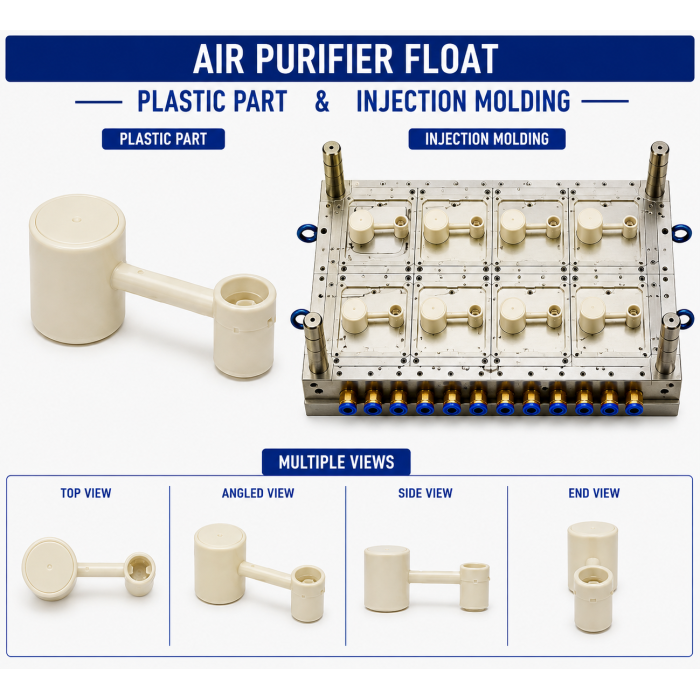
Air Purifier Plastic Float is a precision injection-moulded plastic buoyancy component used in air purifiers that incorporate a water reservoir, humidification system, condensate collection arrangement, or water-level sensing mechanism. The float moves according to the water level and can work with a sensor, switch, valve, or mechanical linkage to indicate or control the water condition.
The float can be designed according to the required buoyancy, dimensions, density, movement range, guide arrangement, stem interface, and sensing mechanism. Depending on the appliance design, it may be used independently or as part of a complete float assembly.
Renovator Appliances Ltd provides complete Air Purifier Plastic Float Mould and Moulding Services, including product development, mould design, precision mould manufacturing, mould trials, plastic injection moulding, dimensional inspection, buoyancy and movement testing, assembly validation, and bulk OEM production.
Key Features
The Air Purifier Plastic Float is designed to provide controlled buoyant movement in a water-containing assembly. Its geometry and material are selected to provide the required flotation characteristics while maintaining dimensional stability during repeated movement.
The float can incorporate stem interfaces, guide holes, locating features, snap-fit connections, retaining sections, sensor interfaces, or mechanical linkage provisions depending on the water-level mechanism.
The outer profile can be customized according to the available reservoir space and guide structure. Properly designed float geometry helps maintain smooth vertical or guided movement without excessive friction or interference with surrounding components.
Industrial Applications
The Air Purifier Plastic Float can be used in air-treatment appliances incorporating water-management or humidification functions.
Typical applications include:
Humidifying Air Purifiers
Air Purifier and Humidifier Combination Units
Water-Based Air Treatment Appliances
Smart Humidification Systems
Domestic Air Treatment Equipment
Residential Humidifying Appliances
Portable Air Treatment Systems
Commercial Air Treatment Equipment
Water-Level Monitoring Assemblies
OEM Air Purification and Humidification Products
The exact float design depends on the water reservoir, float guide, sensing mechanism, operating water level, required travel, and surrounding assembly.
Manufacturing Process
The Air Purifier Plastic Float is manufactured through a controlled plastic injection moulding process.
First, the float is designed according to the required buoyancy, water level range, movement path, guide arrangement, and sensing or control mechanism. Its dimensions and wall structure are developed to provide the required flotation and mechanical stability.
A suitable plastic material is selected according to the required buoyancy, moisture resistance, dimensional stability, mechanical strength, and operating temperature. The material is prepared according to its processing requirements and fed into the injection moulding machine.
The plastic is heated and injected into the precision mould cavity. The mould forms the float body, locating features, stem interface, guide opening, retaining features, and other required details.
After filling and packing, controlled cooling is applied to minimize shrinkage and warpage. The mould then opens and the finished float is ejected.
The moulded component is inspected for dimensions, surface quality, guide fitment, buoyancy, movement, flash, and overall assembly compatibility.
Mould Manufacturing Process
The Air Purifier Plastic Float Mould is designed according to the float dimensions, buoyancy requirements, guide arrangement, wall thickness, sensing interface, production quantity, and expected mould life.
The mould incorporates the required cavity, core, parting line, gating system, cooling channels, and ejection mechanism. Particular attention is given to the float geometry because dimensional variation can influence buoyancy, movement, and sensor alignment.
For float designs containing internal cavities, openings, stems, undercuts, or complex guide interfaces, suitable core inserts, slides, lifters, or mould inserts can be incorporated.
Mould components are manufactured using CNC machining, EDM, drilling, grinding, and precision finishing. After mould assembly, trial moulding is performed using the selected plastic material.
Trial components are checked for overall dimensions, weight, buoyancy, guide clearance, movement range, sensor-interface position, warpage, flash, surface finish, and complete assembly fitment before final production approval.
Raw Materials
The material for an Air Purifier Plastic Float should provide suitable buoyancy, water resistance, dimensional stability, and mechanical strength.
Depending on the application, PP, HDPE, POM, PBT, or suitable engineering thermoplastics can be considered. PP and HDPE can be suitable for lightweight water-contact float applications, while POM or PBT may be considered for more dimensionally demanding guided mechanisms.
Where the float is exposed to water for extended periods, the selected material should be compatible with the water conditions, cleaning requirements, operating temperature, and expected service life.
The final plastic grade should be selected according to the required buoyancy, water exposure, float travel, guide friction, sensor mechanism, dimensional tolerance, and customer specifications.
Quality Control
Quality control for the Air Purifier Plastic Float focuses on buoyancy, dimensional accuracy, smooth movement, and reliable operation of the complete float mechanism.
The finished float can be checked for:
Overall Length
Overall Diameter
Wall Thickness
Weight
Guide Dimensions
Stem or Interface Dimensions
Float Travel
Sensor-Interface Position
Surface Finish
Assembly Fitment
The moulded component is also inspected for flash, short shots, sink marks, cracks, warpage, burrs, weld lines, and other moulding defects.
Functional testing can be performed by placing the float in the actual water reservoir or test fixture and checking:
Buoyant movement
Travel range
Guide clearance
Rising and falling movement
Sensor or switch actuation
Retention
Repeated-cycle operation
Where required, buoyancy and water-level response can be validated according to the customer's specified operating conditions.
Production Capacity
Production capacity depends on the float size, product weight, mould cavity count, cycle time, plastic material, injection moulding machine capacity, mould complexity, and production efficiency.
Because floats are generally compact components, multi-cavity moulds can be considered for higher-volume production where the geometry and required precision permit it.
For example, an 8-cavity mould operating with a 20-second cycle has a theoretical output of approximately 1,440 pieces per hour before inspection, material handling, machine downtime, mould maintenance, and other production losses.
Final production capacity should be established according to the actual product weight, cavity count, cycle time, machine capacity, buoyancy requirements, and required monthly production quantity.
Buyer Guide
Before ordering an Air Purifier Plastic Float Mould and Moulding Service, the buyer should provide a 2D drawing, 3D CAD model, existing float sample, water reservoir, float guide, sensor, or complete water-level assembly.
Important specifications include float dimensions, target weight, buoyancy requirement, operating water level, travel range, guide dimensions, stem arrangement, sensor interface, water-contact conditions, operating temperature, plastic material, colour, surface finish, dimensional tolerances, and production quantity.
Providing the actual float guide, reservoir, sensor or switch, and mating assembly is recommended because the float must operate correctly with the complete water-level mechanism.
Why Choose Renovator?
Renovator Appliances Ltd provides an integrated manufacturing solution for customized plastic water-management, sensing, support, and internal appliance components used in air purifiers and other home appliances.
For the Air Purifier Plastic Float, our service covers the complete process from product development and float design to mould design, precision mould manufacturing, injection moulding, dimensional inspection, buoyancy testing, movement testing, sensor fitment validation, and bulk OEM production.
The float can be developed according to the customer's actual water-management assembly, including specific dimensions, buoyancy requirements, guide interfaces, sensor connections, material grade, colour, surface finish, and production quantity.
This integrated approach helps maintain consistency between the water reservoir, float, guide mechanism, sensor, mould, plastic material, and final air purifier assembly.
Frequently Asked Questions (FAQ)
1. What is an Air Purifier Plastic Float?
An Air Purifier Plastic Float is an injection-moulded plastic buoyancy component that moves with the water level and can be used for water-level sensing or control in air purifiers with humidification or water-based functions.
2. Which plastic materials are suitable for a Plastic Float?
Depending on the application, PP, HDPE, POM, PBT, or suitable engineering thermoplastics can be considered. Material selection depends on buoyancy, water resistance, dimensional stability, guide movement, temperature, and service life.
3. Can the Plastic Float be customized?
Yes. It can be customized according to dimensions, weight, buoyancy, guide arrangement, travel range, stem interface, sensor connection, colour, and surface finish.
4. Can the Plastic Float be designed for a water-level sensor?
Yes. The float can be designed to work with a mechanical switch, magnetic sensor, reed switch, Hall-effect sensing arrangement, or other specified water-level mechanism according to the appliance design.
5. Can Renovator manufacture both the Plastic Float mould and finished components?
Yes. Renovator can provide complete mould manufacturing and plastic injection moulding services, including mould trials, dimensional inspection, buoyancy testing, movement testing, sensor fitment validation, assembly checks, and bulk production according to customer requirements.
Air Purifier Plastic Parts
Mould Material : P20 Steel / H13 Steel / S136 Steel
Plastic Grade : Water Contact Grade / Chemical Resistant Grade / Engineering GradeProduct Material : PP / HDPE / POM / PBTMould Type : Single Cavity Mould / Multi Cavity MouldWeight : 10–100 gDimensions : 20–120 × 20–100 × 15–80 mm