- Home
- About us
- Plastic Products and Moulds+
- Plastic Injection Moulding Services
- Industrial Plastic Crates and Moulds
- Air Conditioner Plastic Parts And Moulds
- Printer Plastic Parts and Moulds
- Laptop Plastic Parts And Moulds
- Vacuum Cleaner Plastic Parts and Moulds
- Air Cooler Plastic Parts and Moulds
- Water Dispenser Plastic Parts and Moulds
- Washing Machine Plastic Parts And Moulds
- Water Purifier Plastic Parts and Moulds
- Robot Plastic Parts Mould and Moulding Services
- CPU Plastic Parts and Moulds
- Refrigerator Plastic Parts and Moulds
- Air Blower Plastic Parts Mould and Moulding Services
- Food Processor Plastic Parts and Moulds
- Lawn Mower Plastic Parts Mould and Moulding Services
- Microwave Oven Plastic Parts Mould and Moulding Services
- Monitor Plastic Parts and Moulds
- Mixer Grinder Plastic Parts Mould and Moulding Services
- Chimney Plastic Parts Mould and Moulding Services
- Geyser Plastic Parts Mould and Moulding Services
- Humidifier Plastic Parts Mould and Moulding Services
- Home Theatre Plastic Parts Mould and Moulding Services
- Steam Mop Plastic Parts Mould and Moulding Services
- Egg Boiler Plastic Parts Mould and Moulding Services
- Air Purifier Plastic Parts Mould and Moulding Services
- Room Heater Plastic Parts Mould and Moulding Services
- Air Fryer Plastic Parts Mould and Moulding Services
- Contact us
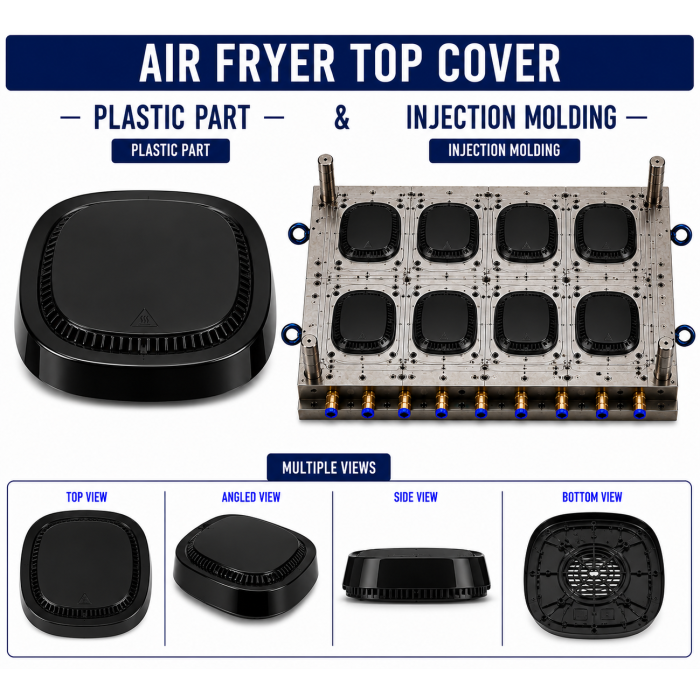
Air Fryer Plastic Top Cover Mould and Moulding Service
AFPTC
Rs. 200.00
/ Piece (1 Piece) Air Fryer Plastic Top Cover Mould and Moulding Service | Renovator Appliances Ltd
Product Overview
Renovator Appliances Ltd manufactures Air Fryer Plastic Top Covers and provides complete Plastic Injection Mould Design, Mould Manufacturing, Injection Moulding, and Moulding Services for digital air fryers, countertop air fryers, smart air fryers, compact kitchen appliances, and customized cooking appliances.
The Air Fryer Plastic Top Cover is an external or upper plastic housing component designed to cover and protect the upper section of an air fryer. It can enclose or support internal appliance components such as the control panel, display interface, ventilation structures, wiring areas, fan assembly, heating-system enclosure, and other internal mechanisms, depending on the appliance design.
The top cover contributes to the air fryer's overall appearance, structural protection, component positioning, ventilation management, user safety, and assembly integrity. Its geometry can include ventilation openings, control-panel cut-outs, mounting bosses, screw towers, snap-fits, locating ribs, air passages, decorative surfaces, and joining features.
Manufactured using precision plastic injection moulding technology, our Air Fryer Plastic Top Covers are designed for accurate dimensions, consistent wall thickness, structural rigidity, suitable heat performance, smooth surface quality, precise assembly fitment, and repeatable production.
We offer OEM and customized manufacturing solutions according to 2D drawings, 3D CAD models, existing samples, air fryer dimensions, internal component layouts, mounting requirements, ventilation requirements, material specifications, colour, texture, surface finish, and production volume.
Key Features
Protective Upper Housing
Designed to protect internal air fryer components from external impact, dust, handling, and general operating conditions.
Precision Assembly Fitment
Manufactured with accurate mounting points, locating features, screw bosses, and snap-fits for reliable assembly.
Ventilation Integration
Ventilation slots, openings, grills, or air passages can be incorporated according to the appliance's airflow requirements.
Heat-Appropriate Material
Suitable plastic grades can be selected according to the actual temperature exposure of the top-cover area.
Attractive Surface Finish
Available with smooth, matte, textured, glossy, or customized cosmetic surfaces.
OEM Customization
Overall dimensions, control-panel openings, ventilation pattern, mounting features, colour, material, texture, logo area, and surface finish can be customized.
| Feature | Description |
|---|---|
| Product | Air Fryer Plastic Top Cover |
| Manufacturing Process | Plastic Injection Moulding |
| Material Options | ABS, PP, PC/ABS, HIPS, PBT and engineering plastics |
| Function | Upper housing protection and component enclosure |
| Construction | Lightweight, rigid and durable |
| Design | Customized according to air fryer structure |
| Ventilation | Customized slots, openings and grills |
| Mounting | Screw bosses, snap-fits, clips and locating features |
| Surface | Smooth, matte, textured or glossy |
| Application | Air fryer upper housing |
| Customization | OEM & ODM manufacturing |
Industrial Applications
Our Air Fryer Plastic Top Covers are suitable for:
| Industry | Application |
|---|---|
| Air Fryer Industry | Upper housing and protective covers |
| Kitchen Appliances | External appliance housing |
| Small Home Appliances | Plastic enclosure components |
| Consumer Appliances | Decorative and structural covers |
| Food Preparation Equipment | Upper appliance housings |
| Countertop Appliances | Protective top enclosure |
| Smart Kitchen Appliances | Digital control housing structures |
| Electrical Appliances | Internal component protection |
| OEM Manufacturing | Customized plastic top cover production |
Manufacturing Process
Our Air Fryer Plastic Top Covers are manufactured using controlled and precision plastic injection moulding technology.
Product Design & Development
The top cover is developed according to customer drawings, 3D CAD models, existing samples, air fryer dimensions, internal component layouts, or complete appliance assembly requirements.
Important design parameters may include:
Overall cover length
Overall cover width
Cover height
Wall thickness
Corner radius
Draft angles
Control-panel opening
Display opening
Button openings
Ventilation slots
Air passages
Fan clearance
Heating-system clearance
Screw bosses
Mounting points
Snap-fit features
Locating ribs
Internal support ribs
Wiring clearance
Internal component clearance
Logo area
Surface texture
Colour
Operating temperature
Mould Design & Manufacturing
A precision injection mould is designed according to the top-cover geometry, selected plastic material, shrinkage characteristics, production volume, cavity configuration, injection machine specifications, cooling requirements, and ejection method.
The mould may incorporate:
Core and cavity
Parting line
Runner and gate system
Cooling channels
Ejection system
Guide pillars and bushes
Inserts
Venting
Draft angles
Slides
Lifters
Boss-forming cores
Ventilation-slot features
Snap-fit-forming sections
Rib-forming sections
Mounting-feature inserts
Material Selection
Material selection depends on the top cover's required heat resistance, rigidity, impact resistance, dimensional stability, surface appearance, and electrical-appliance requirements.
ABS is commonly considered for appliance housings because of its rigidity, dimensional accuracy, impact resistance, and surface finish.
PC/ABS may be selected where improved impact resistance and thermal performance are required.
PP can be considered for lightweight housing designs where its mechanical and thermal properties meet the application requirements.
HIPS may be suitable for selected rigid housing and cover applications.
PBT and suitable engineering plastics can be considered for areas requiring greater dimensional stability or thermal performance.
The final material should be selected according to the actual temperature exposure, mechanical requirements, internal component proximity, electrical safety requirements, and appliance design.
Injection Moulding Production
Plastic resin is fed into the injection moulding machine and heated to the required processing temperature.
The molten plastic is injected into the precision mould cavity under controlled pressure, speed, and temperature. The material fills the top-cover geometry, including ventilation structures, mounting bosses, ribs, snap-fits, control-panel sections, and other designed features.
Cooling & Ejection
The mould cooling system helps solidify the top cover while controlling shrinkage and maintaining dimensional stability.
After sufficient cooling, the mould opens and the ejection system removes the cover without damaging the cosmetic surfaces, mounting bosses, snap-fits, ventilation openings, or other critical features.
Finishing & Quality Inspection
After moulding, the top cover may undergo:
Gate trimming
Flash removal
Visual inspection
Dimensional inspection
Mounting-point inspection
Screw-boss inspection
Snap-fit inspection
Control-panel fitment checking
Ventilation-opening inspection
Internal clearance verification
Surface inspection
Colour checking
Texture inspection
Warpage inspection
Sink-mark inspection
Assembly compatibility testing
Mould Manufacturing Process
Renovator Appliances Ltd provides complete Air Fryer Plastic Top Cover Mould Manufacturing Services.
Mould Design
The mould is engineered according to the approved top-cover design with suitable core and cavity configuration, parting line, gate location, runner system, cooling channels, draft angles, ejection arrangement, venting, shrinkage allowance, slides, lifters, and inserts where required.
Special attention is given to large cosmetic surfaces, wall-thickness consistency, ventilation openings, screw bosses, snap-fits, ribs, mounting features, and warpage control.
CNC Machining
Mould plates, cavity components, core components, inserts, slides, and other tooling parts are precision-machined using CNC equipment according to the approved mould design.
EDM & Wire EDM
EDM and Wire EDM may be used for detailed ventilation slots, snap-fits, narrow openings, inserts, mounting features, and complex areas requiring high machining precision.
Cooling System
Cooling channels are designed to provide controlled mould temperature and support consistent cover dimensions, stable production cycles, reduced shrinkage variation, and reduced risk of warpage.
Ejection System
The ejection mechanism is designed according to the cover geometry to safely remove the moulded component while protecting cosmetic surfaces, bosses, ribs, snap-fits, and ventilation structures.
Mould Assembly & Trial
After machining and finishing, mould components are assembled and aligned. Trial moulding is conducted to evaluate:
Plastic filling
Gate performance
Cooling
Ejection
Shrinkage
Warpage
Cover dimensions
Wall thickness
Ventilation openings
Mounting bosses
Snap-fits
Control-panel fitment
Internal clearances
Surface quality
Colour and texture
Assembly compatibility
Final Mould Approval
Necessary tooling corrections, machining modifications, polishing, fitting, and finishing operations are completed before the mould is approved for regular injection moulding production.
Raw Materials
The final material depends on the top cover's required heat resistance, rigidity, impact strength, dimensional stability, appearance, and appliance safety requirements.
| Material | Description |
|---|---|
| ABS | Good rigidity, impact resistance, dimensional accuracy and surface finish |
| PC/ABS | Good impact resistance, rigidity and thermal performance |
| PP | Lightweight and suitable for selected housing applications |
| HIPS | Rigid thermoplastic option for selected appliance covers |
| PBT | Good dimensional stability and thermal performance |
| Flame-Retardant ABS | Considered where specific flame-retardancy requirements apply |
| Flame-Retardant PC/ABS | Suitable option for applications requiring specified flame-retardant performance |
| Heat-Resistant Engineering Plastics | Selected for specialized thermal requirements |
Final material selection should be based on the actual temperature exposure, proximity to heating components, electrical safety requirements, mechanical loading, dimensional requirements, surface finish, and applicable appliance standards.
Quality Control
Every Air Fryer Plastic Top Cover can undergo systematic quality inspection to maintain accurate dimensions, proper assembly fitment, structural integrity, and consistent cosmetic quality.
Quality checks may include:
Raw material verification
Overall cover length inspection
Overall cover width inspection
Cover height measurement
Wall thickness inspection
Corner-radius inspection
Control-panel opening inspection
Display opening inspection
Ventilation-slot inspection
Air-passage inspection
Screw-boss inspection
Mounting-point inspection
Snap-fit inspection
Locating-rib inspection
Internal clearance verification
Fan clearance checking
Heating-component clearance checking
Surface finish inspection
Colour consistency checking
Texture inspection
Warpage inspection
Flash and burr inspection
Sink mark inspection
Short-shot inspection
Crack and deformation inspection
Assembly compatibility testing
Final visual inspection
Production Capacity
Production capacity depends on:
Mould cavity count
Injection moulding machine capacity
Product weight
Plastic material
Cycle time
Cooling requirements
Top-cover geometry
Mould design
Machine utilization
Production efficiency
For example, a 1-cavity mould operating with a 45-second cycle time can theoretically produce approximately 80 pieces per hour:
1 cavity × 3600 ÷ 45 seconds = 80 pieces/hour
This is a theoretical production calculation. Actual output may vary due to machine downtime, material loading, mould changes, quality inspection, maintenance, rejection rate, operator efficiency, and other production factors.
The final production capacity is determined according to the top-cover design, mould cavity configuration, selected material, injection moulding machine specifications, cycle time, and required production schedule.
Buyer Guide
Before ordering an Air Fryer Plastic Top Cover Mould and Moulding Service, buyers should provide available product and technical information.
Recommended specifications include:
2D product drawing
3D CAD model
Existing top-cover sample
Product photographs
Air fryer model information
Overall cover dimensions
Wall thickness
Control-panel dimensions
Display opening dimensions
Button opening dimensions
Ventilation requirements
Fan clearance
Heating-component clearance
Internal component layout
Screw-boss requirements
Mounting-point requirements
Snap-fit requirements
Locating-rib requirements
Logo requirements
Surface finish
Texture requirements
Colour requirements
Operating temperature
Required plastic material
Flame-retardant requirement, where applicable
Monthly production quantity
Annual production quantity
Required mould cavity count
Complete air fryer assembly details
Providing complete specifications helps determine the appropriate top-cover geometry, mould construction, plastic material, cavity configuration, ventilation design, cooling system, ejection arrangement, injection machine capacity, and manufacturing process.
Why Choose Renovator Appliances Ltd?
Precision Injection Mould Design
Plastic Injection Mould Manufacturing
OEM & ODM Plastic Component Manufacturing
Customized Air Fryer Top Cover Development
Precision Appliance Housing Design
Heat-Appropriate Material Selection
Flame-Retardant Material Options
Customized Ventilation Design
Precision Screw-Boss and Snap-Fit Manufacturing
Customized Colour and Surface Finish
Textured and Decorative Surface Options
Controlled Injection Moulding Production
Strict Quality Control System
Prototype and Bulk Production Support
Customized Mould Solutions
High-Volume Production Support
Appliance Assembly Fitment Support
Integrated Moulding Services
Reliable B2B Manufacturing Solutions
Renovator Appliances Ltd provides an integrated manufacturing solution covering product development, mould design, mould manufacturing, mould trials, plastic injection moulding, quality inspection, and bulk production for customized Air Fryer Plastic Top Covers.
Frequently Asked Questions (FAQ)
Q1. What is an Air Fryer Plastic Top Cover?
An Air Fryer Plastic Top Cover is an injection-moulded plastic housing component used to cover and protect the upper section of an air fryer while supporting or enclosing components such as controls, displays, ventilation structures, and internal assemblies.
Q2. Which materials are used for Air Fryer Plastic Top Covers?
Common material options include ABS, PC/ABS, PP, HIPS, PBT, flame-retardant ABS, flame-retardant PC/ABS, and suitable heat-resistant engineering plastics. Material selection depends on temperature exposure, mechanical requirements, electrical safety, surface finish, and appliance design.
Q3. Can the Air Fryer Plastic Top Cover be customized?
Yes. We provide OEM and ODM customization according to overall dimensions, wall thickness, ventilation pattern, control-panel openings, mounting points, screw bosses, snap-fits, ribs, colour, material, texture, logo area, and surface finish.
Q4. How is an Air Fryer Plastic Top Cover manufactured?
The top cover is manufactured using precision plastic injection moulding. Plastic resin is melted and injected into a specially designed mould cavity, followed by controlled cooling, ejection, trimming, dimensional inspection, surface inspection, assembly fitment testing, and final quality inspection.
Q5. Does Renovator Appliances Ltd manufacture moulds for Air Fryer Plastic Top Covers?
Yes. Renovator Appliances Ltd provides complete plastic injection mould design, mould manufacturing, mould trials, mould correction, injection moulding, quality inspection, and customized bulk production services for Air Fryer Plastic Top Covers according to OEM requirements.
Air Fryer Plastic Parts
Mould Material : P20 Steel / H13 Steel / S136 Steel
Plastic Grade : Heat Resistant Grade / Flame Retardant Grade / Engineering GradeProduct Material : ABS / PP / PC-ABS / PBTMould Type : Single Cavity Mould / Multi Cavity MouldWeight : 200–900 gDimensions : 250–500 × 250–500 × 100–250 mm