INDUSTRIAL PRODUCT
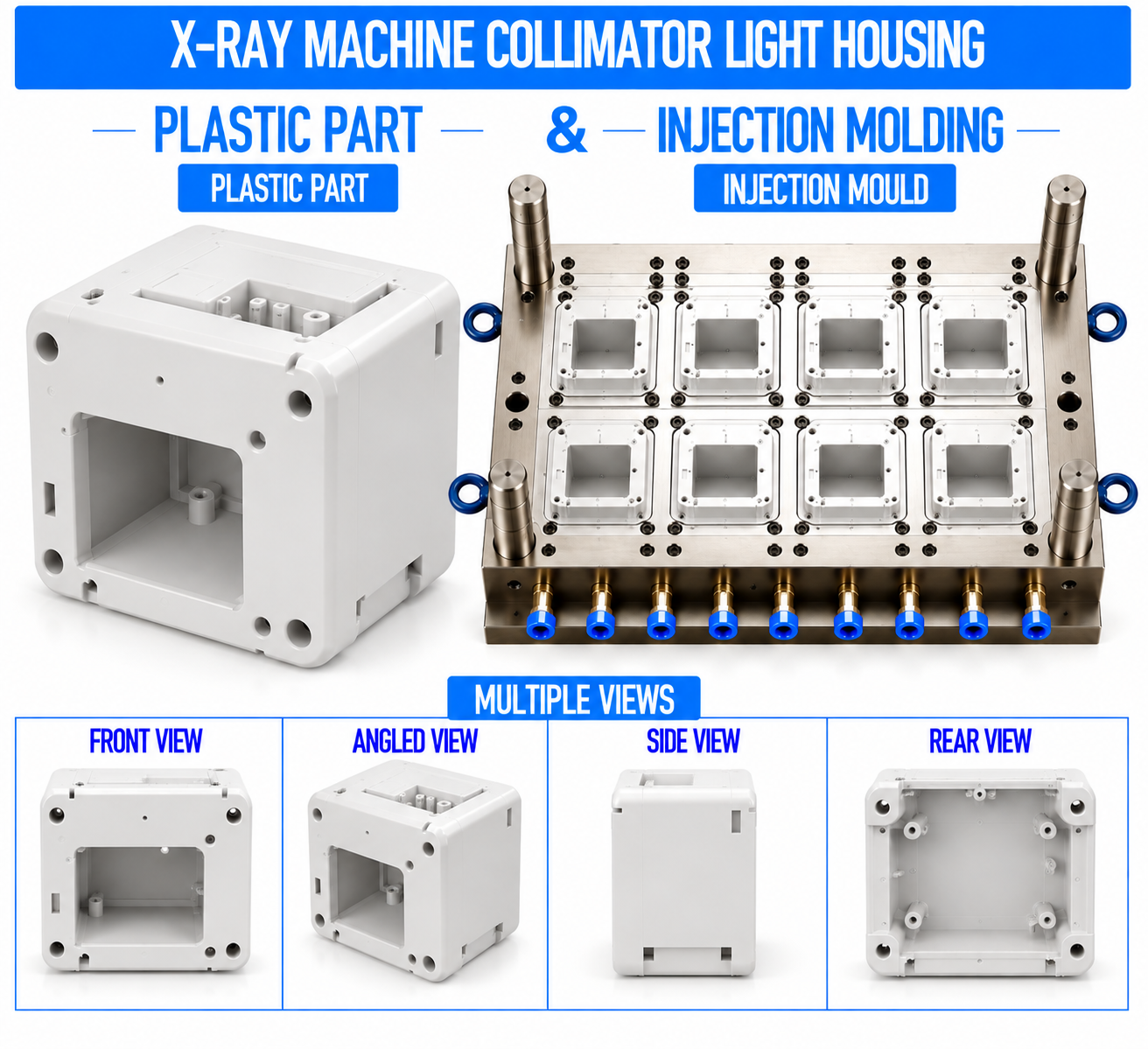
X-Ray Machine Plastic Collimator Light Housing Mould and Moulding Service
₹500.00
X-Ray Machine Plastic Collimator Light Housing Mould and Moulding Service | Renovator Appliances Ltd
Product Overview
Renovator Appliances Ltd manufactures X-Ray Machine Plastic Collimator Light Housing using precision Plastic Injection Moulding and customized mould manufacturing processes. The light housing is a plastic enclosure used within the collimator assembly to accommodate and protect the light source and associated optical or electrical components used for field-light positioning.
The housing is developed according to the light source dimensions, lamp or LED mounting arrangement, reflector or optical component interface, wiring clearance, heat dissipation requirements, collimator geometry, and mounting structure. Accurate moulding helps maintain the position and alignment of the light source relative to the collimator's specified light field.
The plastic light housing should not be assumed to provide radiation shielding or define the X-ray beam. Its final material, geometry, thermal performance, optical alignment, and complete assembly should be engineered and validated according to the equipment design and applicable requirements.
Key Features
Precision moulded collimator light housing
Customized light-source mounting cavity
Accurate optical-component alignment
Controlled internal light-source clearance
Reflector or lens mounting provisions
Cable and connector routing clearance
Ventilation or heat-management features where required
Reinforced mounting bosses and locating features
Controlled wall thickness
Compact and lightweight construction
Smooth internal and external surfaces
Customized fastening or snap-fit arrangements
Suitable for OEM and ODM production
Industrial Applications
| Application Area | Component Function |
|---|---|
| X-Ray Collimator Assembly | Houses and positions the collimator light-source components |
| X-Ray Tube Head | Supports the light-field illumination assembly |
| Diagnostic X-Ray Equipment | Provides a dedicated enclosure for the collimator light system |
| Mobile X-Ray Machines | Provides lightweight protection and mounting for light-source components |
| Fixed X-Ray Systems | Integrates the light housing with the collimator structure |
| OEM X-Ray Equipment | Customized housing according to specific collimator designs |
Manufacturing Process
1. Product Design & Development
The light housing is designed according to the complete collimator assembly and light-source arrangement. Important parameters include the light-source dimensions, mounting position, optical-axis alignment, reflector or lens interface, wiring path, heat clearance, fastening arrangement, and surrounding collimator structure.
The design also considers the distance and orientation between the light source and the specified illuminated field so that the housing does not interfere with the intended optical arrangement.
2. Plastic Mould Design
The injection mould is developed to reproduce the light housing cavity, mounting bosses, locating features, reflector or lens interfaces, cable openings, ventilation features, and collimator mounting surfaces accurately.
Parting lines, draft angles, gate positions, ejector locations, cooling channels, and shrinkage allowances are optimized according to the component geometry. Critical optical and mounting features receive particular attention to minimize dimensional variation and misalignment.
3. Mould Manufacturing
The mould is manufactured using precision machining, EDM, polishing, fitting, and assembly processes. P20, H13, S136, or another suitable mould steel can be selected according to production volume, plastic material, surface-finish requirements, and expected mould life.
Critical cavity dimensions and light-source mounting interfaces are inspected before production trials.
4. Injection Moulding
The selected plastic material is injection moulded under controlled processing conditions. Injection pressure, melt temperature, holding pressure, cooling time, and cycle parameters are adjusted according to the selected material and housing geometry.
Controlled moulding helps maintain the light-source mounting position, housing dimensions, optical-component interfaces, and collimator assembly fitment.
5. Finishing & Assembly Preparation
After moulding, gates, runners, flash, and excess material are removed. Light-source mounting areas, reflector or lens interfaces, cable openings, ventilation slots, and fastening points are checked for obstructions.
Where required, the moulded housing can be prepared for installation of the light source, optical components, wiring, connectors, or related collimator components.
6. Quality Inspection
Finished light housings are checked for overall dimensions, light-source mounting geometry, optical-component interface dimensions, mounting features, cable openings, internal clearance, wall thickness, flatness, warpage, surface condition, and flash.
Trial assembly can be performed with the light source and collimator components to verify mechanical fit and positional alignment.
Raw Materials
| Material / Component | Typical Selection Consideration |
|---|---|
| ABS | Suitable for rigid light-housing and enclosure applications |
| PC+ABS | Considered where improved impact resistance and dimensional stability are required |
| PC | Suitable where higher impact and temperature performance are required |
| PBT | Considered for applications requiring dimensional stability and mechanical performance |
| Flame-Retardant ABS | Used where specified flame-retardant properties are required |
| Flame-Retardant PC+ABS | Considered where flame performance and mechanical properties are required |
| Engineering Plastic | Selected according to thermal, mechanical, dimensional, and equipment requirements |
| P20 Steel | Suitable for general-purpose production moulds |
| H13 Steel | Suitable for demanding production conditions |
| S136 Steel | Suitable where corrosion resistance and high-quality mould surfaces are required |
Material selection should consider the light-source operating temperature, optical stability, dimensional requirements, electrical environment, heat dissipation, and applicable equipment specifications.
Quality Control
Renovator Appliances Ltd focuses on the following quality parameters during production:
Overall housing dimensions
Light-source mounting cavity dimensions
Light-source locating position
Optical-axis alignment
Reflector or lens interface accuracy
Mounting-boss dimensions
Screw-hole dimensions where applicable
Cable and connector opening dimensions
Internal component clearance
Ventilation opening accuracy
Wall thickness consistency
Flatness and warpage
Surface finish
Flash and burr inspection
Sink-mark inspection
Parting-line condition
Light-source assembly fitment
Collimator assembly fitment
Material-grade verification
Batch-to-batch dimensional consistency
Buyer Guide
Before ordering an X-Ray Machine Plastic Collimator Light Housing Mould and Moulding Service, buyers should provide:
Light housing CAD drawing or sample
Complete collimator assembly dimensions
Light-source type and dimensions
Light-source mounting arrangement
Reflector, lens, or optical-component dimensions
Required optical alignment
Cable and connector positions
Heat-generation and operating-temperature requirements
Ventilation requirements
Mounting and fastening details
Plastic material specification
Colour and surface-finish requirements
Expected production quantity
Required mould life
Prototype requirements
Providing the complete collimator assembly and light-source components helps establish accurate mechanical and optical interfaces between the housing, light source, reflector/lens, and surrounding collimator structure.
The housing should not be specified as an X-ray radiation-shielding component unless this function is separately engineered and validated. Final medical-equipment validation should address applicable mechanical, electrical, thermal, optical, radiation-safety, and regulatory requirements.
Why Choose Renovator Appliances Ltd?
Advanced Injection Moulding Facility
Renovator Appliances Ltd supports precision Plastic Injection Moulding for compact and detailed collimator light housings requiring accurate component interfaces and repeatable dimensions.
In-House Mould Manufacturing
In-house mould manufacturing supports precise cavity geometry, light-source mounting features, optical interfaces, cable openings, ventilation details, and collimator mounting structures.
OEM & ODM Manufacturing
Customized light housings can be manufactured according to customer drawings, samples, light-source specifications, optical requirements, and collimator assembly designs.
Quality Assurance
Dimensional inspection, mounting checks, optical-interface inspection, surface inspection, and trial assembly help maintain consistent light-housing quality.
Cost-Effective Manufacturing
Mould design, material selection, cavity configuration, and injection parameters can be optimized according to component complexity and production volume for efficient manufacturing.
Frequently Asked Questions
1. What is an X-Ray Machine Plastic Collimator Light Housing?
It is a moulded plastic enclosure designed to hold and protect the light-source and associated optical or electrical components used in an X-ray collimator.
2. Can the light housing include reflector or lens mounting features?
Yes. The mould can incorporate customized locating and mounting features for reflectors, lenses, optical elements, or other components according to the collimator design.
3. Can the housing include ventilation and cable openings?
Yes. Ventilation slots, cable passages, connector openings, mounting bosses, and other functional features can be incorporated into the mould according to the equipment requirements.
4. Does the plastic light housing provide radiation shielding?
Not automatically. Radiation shielding should not be assumed unless the material, thickness, geometry, and complete assembly have been specifically engineered, tested, and validated for that purpose.
5. Can Renovator Appliances Ltd manufacture both the light-housing mould and moulded parts?
Yes. Renovator Appliances Ltd supports component development, mould design, mould manufacturing, Plastic Injection Moulding, quality inspection, prototype production, and bulk OEM/ODM manufacturing.
- SKU
- REN-3A87F0A8294D49EECE7223EE