INDUSTRIAL PRODUCT
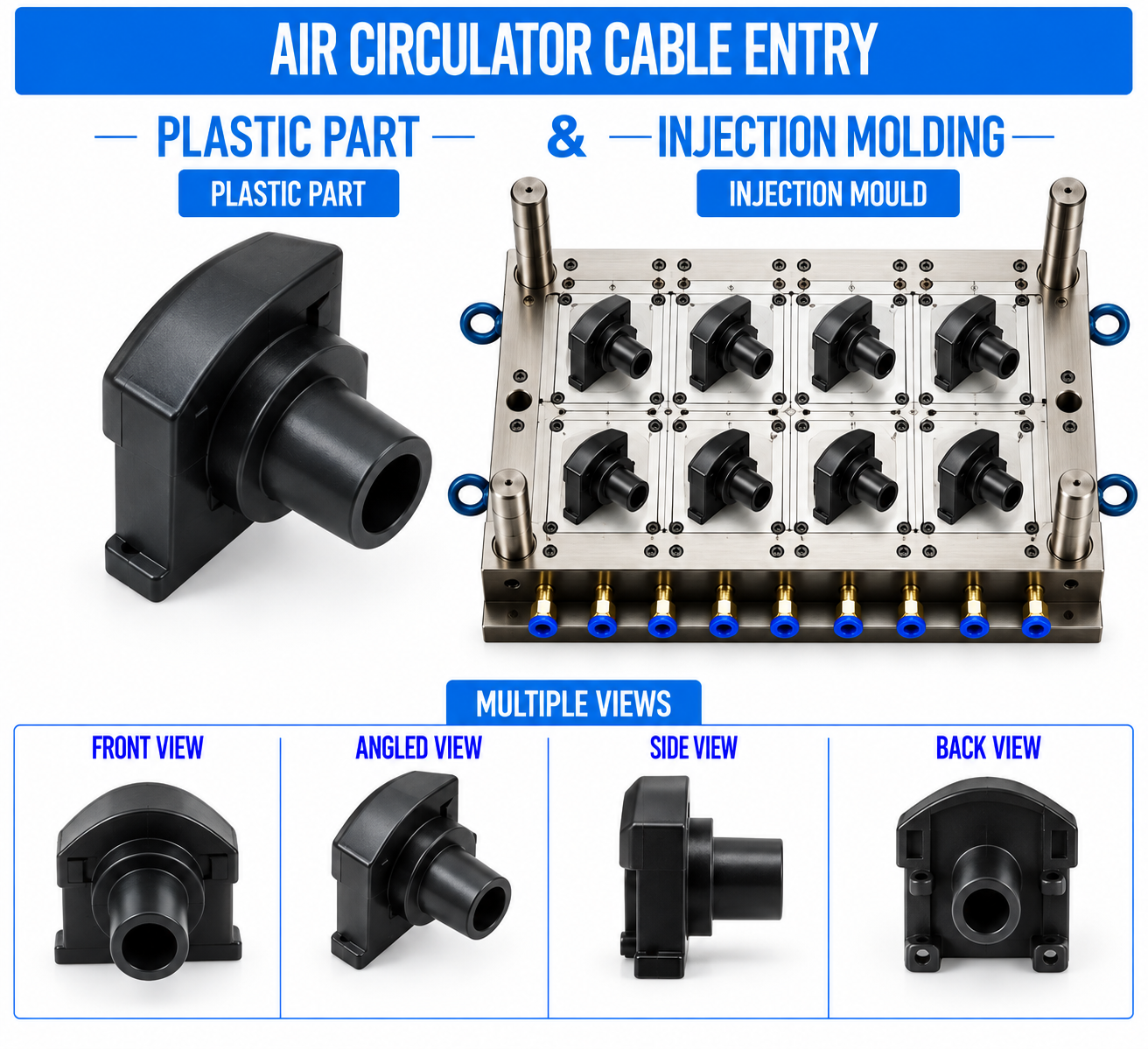
Air Circulator Plastic Cable Entry Mould and Moulding Service
₹100.00
Air Circulator Plastic Cable Entry Mould and Moulding Service | Renovator Appliances Ltd
Product Overview
Renovator Appliances Ltd manufactures Air Circulator Plastic Cable Entry components using precision Plastic Injection Moulding and custom mould manufacturing processes. The cable entry is designed to guide and protect power or internal wiring where the cable passes through the air circulator housing, base, rear cover, or control enclosure.
The component can incorporate a cable passage, retaining profile, locating features, strain-relief geometry, and housing mounting interface according to the equipment design. Accurate hole dimensions and smooth internal edges help prevent cable abrasion while maintaining secure cable positioning during assembly and operation.
Key Features
Precision cable passage geometry
Controlled cable entry diameter
Smooth internal edges to reduce cable abrasion
Secure cable retention and positioning
Housing-compatible mounting profile
Optional snap-fit or press-fit retention
Strain-relief features where required
Consistent wall thickness
Compact injection-moulded construction
Accurate fit with housing panels and covers
Suitable for repeated production
Customizable according to cable dimensions
Industrial Applications
| Application Area | Component Function |
|---|---|
| Air Circulator Fans | Guides power cables through the fan housing |
| Fan Base Assemblies | Provides protected cable entry into the base |
| Control Housing | Routes wiring into the control section |
| Rear Housing | Protects cable passage through the rear enclosure |
| Motor Wiring Area | Provides organized cable routing around the motor assembly |
| OEM Fan Assemblies | Customized cable-entry component for specific housing designs |
Manufacturing Process
1. Product Design & Development
The cable entry is developed according to the cable outer diameter, housing thickness, entry-hole dimensions, installation direction, retention method, and available internal clearance. Strain-relief requirements, cable bending radius, and proximity to moving or heated components are also considered during design.
2. Plastic Mould Design
The mould is designed to reproduce the cable passage, retaining features, locating tabs, grooves, and external profile accurately. Core geometry is selected according to the required cable opening, while draft angles, parting-line location, gate position, cooling, shrinkage allowance, and ejection are optimized for dimensional consistency.
3. Mould Manufacturing
The mould is manufactured using precision machining and mould-making techniques. P20, H13, S136, or another suitable mould steel can be selected according to production volume, material, surface-finish requirements, and expected mould life. Critical cavity and core dimensions are checked before production trials.
4. Injection Moulding
The selected plastic is processed under controlled injection moulding conditions. Melt temperature, injection pressure, injection speed, holding pressure, and cooling time are adjusted according to the material and component geometry. Proper process control helps maintain the cable-entry opening, retention features, and overall dimensional accuracy.
5. Finishing & Assembly Preparation
After moulding, gates, runners, flash, and excess material are removed. The cable passage is checked for sharp edges, flash, or obstructions that could damage insulation. Finished parts are prepared for installation into the air circulator housing or enclosure.
6. Quality Inspection
Finished cable entries are inspected for opening diameter, wall thickness, external dimensions, retention features, mounting profile, flash, warpage, surface finish, and housing fitment. Sample assemblies can be checked using the specified cable to verify insertion, retention, routing, and clearance.
Raw Materials
| Material / Component | Typical Selection Consideration |
|---|---|
| PP | Suitable for lightweight general-purpose cable-entry applications |
| Nylon / PA | Considered where higher mechanical strength and durability are required |
| ABS | Suitable for rigid housing-mounted cable-entry components |
| PBT | Considered where dimensional stability and electrical application requirements are important |
| PC+ABS | Suitable for applications requiring higher impact performance |
| Flame-Retardant Plastic | Considered where the electrical enclosure specification requires improved flame resistance |
| P20 Steel | Suitable for general-purpose production moulds |
| H13 Steel | Suitable for demanding production conditions |
| S136 Steel | Suitable where corrosion resistance and mould-surface quality are required |
Quality Control
Renovator Appliances Ltd applies dimensional and functional inspection to ensure reliable cable-entry performance. Key inspection areas include:
Cable opening diameter
Cable passage geometry
Housing mounting dimensions
Wall thickness
Retention features
Snap-fit engagement where applicable
Strain-relief geometry
Cable insertion fit
Cable retention
Internal-edge smoothness
Flash and burr inspection
Warpage
Surface finish
Housing fitment
Cable bending clearance
Heat and electrical-clearance requirements where applicable
Buyer Guide
When sourcing an Air Circulator Plastic Cable Entry, buyers should provide the cable outer diameter, housing-panel thickness, entry-hole dimensions, cable routing direction, mounting method, required retention force, material requirements, and production quantity.
The cable entry should be evaluated together with the actual cable and housing because the correct fit depends on cable diameter, insulation thickness, bending radius, and enclosure geometry. If the component also provides strain relief, the retention and bending load should be validated with the complete cable assembly.
Why Choose Renovator Appliances Ltd?
Advanced Injection Moulding Facility
We provide controlled Plastic Injection Moulding for consistent cable-entry dimensions, smooth passage geometry, and repeatable production quality.
In-House Mould Manufacturing
Our mould manufacturing capabilities support accurate cores, cable openings, retention features, mounting profiles, and detailed housing interfaces.
OEM & ODM Manufacturing
We support OEM and ODM requirements from component development and mould design through mould manufacturing, injection moulding, inspection, and production supply.
Quality Assurance
Critical cable-entry dimensions, retention features, housing fitment, flash, warpage, and cable-contact surfaces are inspected according to application requirements.
Cost-Effective Manufacturing
Optimized mould design, appropriate plastic selection, and controlled production processes help achieve reliable cable-entry components while supporting efficient large-volume manufacturing.
Frequently Asked Questions
1. What is an Air Circulator Plastic Cable Entry?
It is a plastic component used where a power or internal cable passes through the air circulator housing, helping guide, retain, and protect the cable at the entry point.
2. Can the cable entry include strain-relief features?
Yes. The component can be designed with retaining ribs, grooves, clamps, flexible sections, or other strain-relief features depending on the cable and housing design.
3. Which plastic is suitable for a cable-entry component?
PP, ABS, Nylon/PA, PBT, PC+ABS, and flame-retardant grades can be considered depending on mechanical load, temperature, electrical requirements, flexibility, and housing specifications.
4. Can the cable-entry dimensions be customized?
Yes. The cable opening, external profile, wall thickness, mounting features, retention method, and overall geometry can be customized according to the customer's cable and air circulator housing.
5. Can Renovator Appliances Ltd manufacture the mould and supply moulded cable-entry components?
Yes. Renovator Appliances Ltd can provide the complete service from component development and mould design to mould manufacturing, Plastic Injection Moulding, quality inspection, and OEM/ODM production.
- SKU
- REN-4DFA5ACC4A2EB319B812A49F