INDUSTRIAL PRODUCT
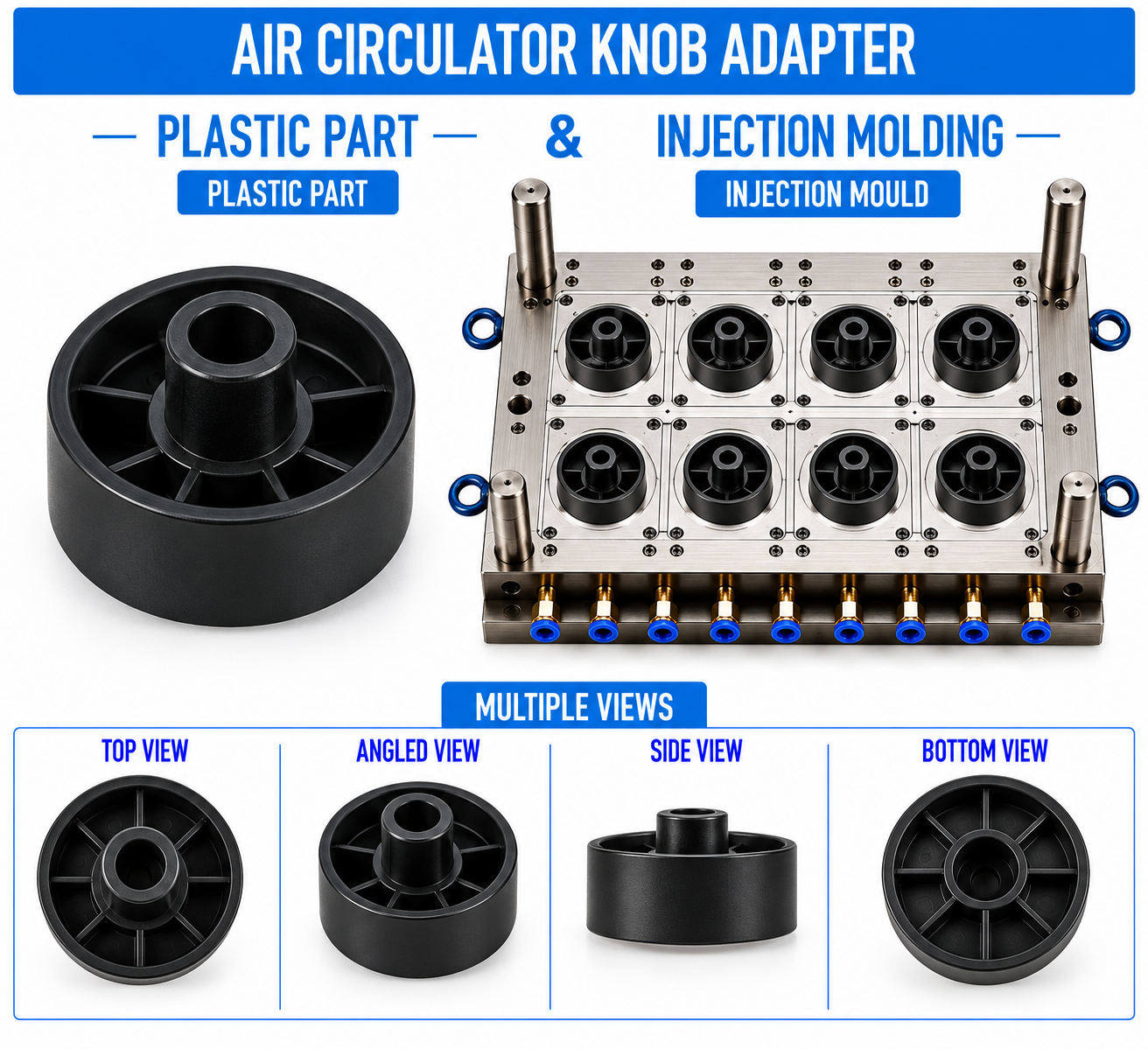
Air Circulator Plastic Knob Adapter Mould and Moulding Service
₹100.00
Air Circulator Plastic Knob Adapter Mould and Moulding Service | Renovator Appliances Ltd
Product Overview
Renovator Appliances Ltd manufactures Air Circulator Plastic Knob Adapter and provides precision Plastic Injection Moulding and mould manufacturing solutions for air circulator control assemblies. The knob adapter acts as an interface between the appliance control shaft and the external control knob, allowing the knob to engage securely with the shaft and transfer manual rotational force to the control mechanism.
The mould is developed according to the control-shaft diameter and profile, knob-side interface, adapter length, insertion depth, anti-rotation geometry, and available panel clearance. Accurate moulding of the internal and external interfaces is essential for secure engagement, correct knob alignment, and reliable torque transfer during repeated operation.
Key Features
Application-specific adapter geometry for air circulator control knobs
Accurate internal bore for the control shaft
Secure external interface with the control knob
Keyed, D-shaped, splined, or other anti-rotation profiles as required
Controlled insertion depth for proper shaft engagement
Reinforced hub area for reliable torque transfer
Accurate concentricity between inner and outer interfaces
Controlled wall thickness for dimensional stability
Suitable clearance from the control panel and surrounding components
Designed for repeated rotary operation
Custom locating ribs, shoulders, grooves, or retention features
Precision injection moulding for consistent OEM production
Industrial Applications
| Application Area | Component Function |
|---|---|
| Air Circulator Fans | Connects the external knob to the internal control shaft |
| Speed Control Assemblies | Transfers rotary movement to fan-speed controls |
| Timer Controls | Provides an interface for rotary timer knobs where applicable |
| Oscillation Controls | Supports manual operation of rotary oscillation controls |
| Table Air Circulators | Enables secure knob-to-shaft connection in compact control panels |
| Floor Air Circulators | Supports larger control interfaces and rotary mechanisms |
| OEM Fan Assemblies | Customized adapter production according to control-mechanism specifications |
Manufacturing Process
1. Product Design & Development
The knob adapter is designed around both the control shaft and the external knob. Key parameters include shaft diameter, shaft profile, adapter outer diameter, knob-side interface, insertion depth, retention method, rotational torque, axial positioning, and available panel clearance.
2. Plastic Mould Design
The injection mould is designed with precision cavity and core geometry for the internal shaft socket and external knob interface. Core alignment is particularly important because dimensional variation can affect concentricity and knob operation. Gate location, cooling, ejection, draft, and shrinkage allowance are optimized for consistent production.
3. Mould Manufacturing
The mould is manufactured using precision machining and mould-making processes. P20, H13, S136, or another suitable mould steel can be selected according to production volume, material characteristics, dimensional requirements, and expected mould life. Critical core and cavity dimensions are inspected before mould trials.
4. Injection Moulding
The selected plastic resin is injection moulded under controlled processing conditions. Injection pressure, melt temperature, injection speed, holding pressure, and cooling time are adjusted according to the resin and adapter geometry. Balanced filling and controlled cooling help maintain the shaft bore, outer interface, and concentricity.
5. Finishing & Assembly Preparation
After moulding, gates, runners, flash, and excess material are removed. The adapter is checked for clean internal and external interfaces, correct insertion depth, and smooth edges. It can then be prepared for installation between the control shaft and external knob.
6. Quality Inspection
The finished knob adapter is inspected for inner diameter, outer diameter, shaft-profile geometry, insertion depth, concentricity, retention features, surface finish, and assembly fitment. Functional tests can verify secure engagement, torque transfer, and smooth rotary operation.
Raw Materials
| Material / Component | Typical Selection Consideration |
|---|---|
| POM | Considered for low-friction, dimensional stability, and precise shaft-interface requirements |
| Nylon / PA | Considered where strength and wear resistance are required |
| Glass-Filled Nylon | Considered where increased stiffness and dimensional stability are required |
| ABS | Suitable for selected structural adapter applications requiring rigidity and good appearance |
| PP | Suitable for selected lightweight, lower-load applications |
| PC+ABS | Considered where increased impact and temperature performance are required |
| Flame-Retardant Plastic | Considered where enhanced fire-resistance properties are required |
| P20 Steel | Suitable for general-purpose production moulds |
| H13 Steel | Suitable for demanding production conditions |
| S136 Steel | Suitable where corrosion resistance and high-quality mould surfaces are required |
Quality Control
Renovator Appliances Ltd applies dimensional and functional controls throughout knob-adapter production. Key inspection areas include:
Internal shaft-bore diameter
Shaft-profile geometry
Outer knob-interface diameter and profile
Insertion depth
Retention and locating features
Concentricity and runout
Wall thickness
Hub strength
Surface finish
Flash and gate quality
Warpage and shrinkage
Shaft engagement
Knob engagement
Rotational torque transfer
Repeated-operation performance
Buyer Guide
When sourcing an Air Circulator Plastic Knob Adapter, buyers should provide the control-shaft dimensions and profile, external knob dimensions, adapter drawing or sample, required insertion depth, retention method, rotational torque requirement, panel clearance, material preference, and production quantity.
The internal and external interfaces should be designed as a matched assembly. The adapter must securely engage the shaft without excessive looseness while also providing reliable engagement with the external knob. For frequently operated controls, material selection and interface tolerances should be evaluated for wear and repeated torque transmission.
Why Choose Renovator Appliances Ltd?
Advanced Injection Moulding Facility
We provide controlled Plastic Injection Moulding for consistent production of knob adapters with accurate shaft and knob interfaces.
In-House Mould Manufacturing
Our mould manufacturing capabilities support precision internal bores, keyed profiles, D-shaped sockets, splines, shoulders, grooves, and customized retention features.
OEM & ODM Manufacturing
We support OEM and ODM requirements from adapter development and mould design through mould manufacturing, injection moulding, inspection, and production supply.
Quality Assurance
Critical shaft dimensions, knob interfaces, concentricity, insertion depth, retention, surface finish, and torque transfer are checked according to application requirements.
Cost-Effective Manufacturing
Optimized mould design, suitable engineering plastic selection, and controlled injection moulding processes help support economical production of customized knob adapters.
Frequently Asked Questions
1. What is an Air Circulator Plastic Knob Adapter used for?
It connects the external control knob to the appliance's control shaft and transfers the user's rotary movement to the internal control mechanism.
2. Can the adapter be manufactured for a D-shaped or keyed shaft?
Yes. D-shaped, keyed, splined, and other shaft-interface geometries can be incorporated according to the actual control-shaft design.
3. Which plastic materials can be used for a knob adapter?
POM, Nylon/PA, glass-filled nylon, ABS, PP, PC+ABS, and suitable flame-retardant grades can be considered depending on torque, wear, strength, temperature, and safety requirements.
4. How is secure knob-to-shaft engagement achiev
- SKU
- REN-ADD9AE6E784737164E9F98EF