INDUSTRIAL PRODUCT
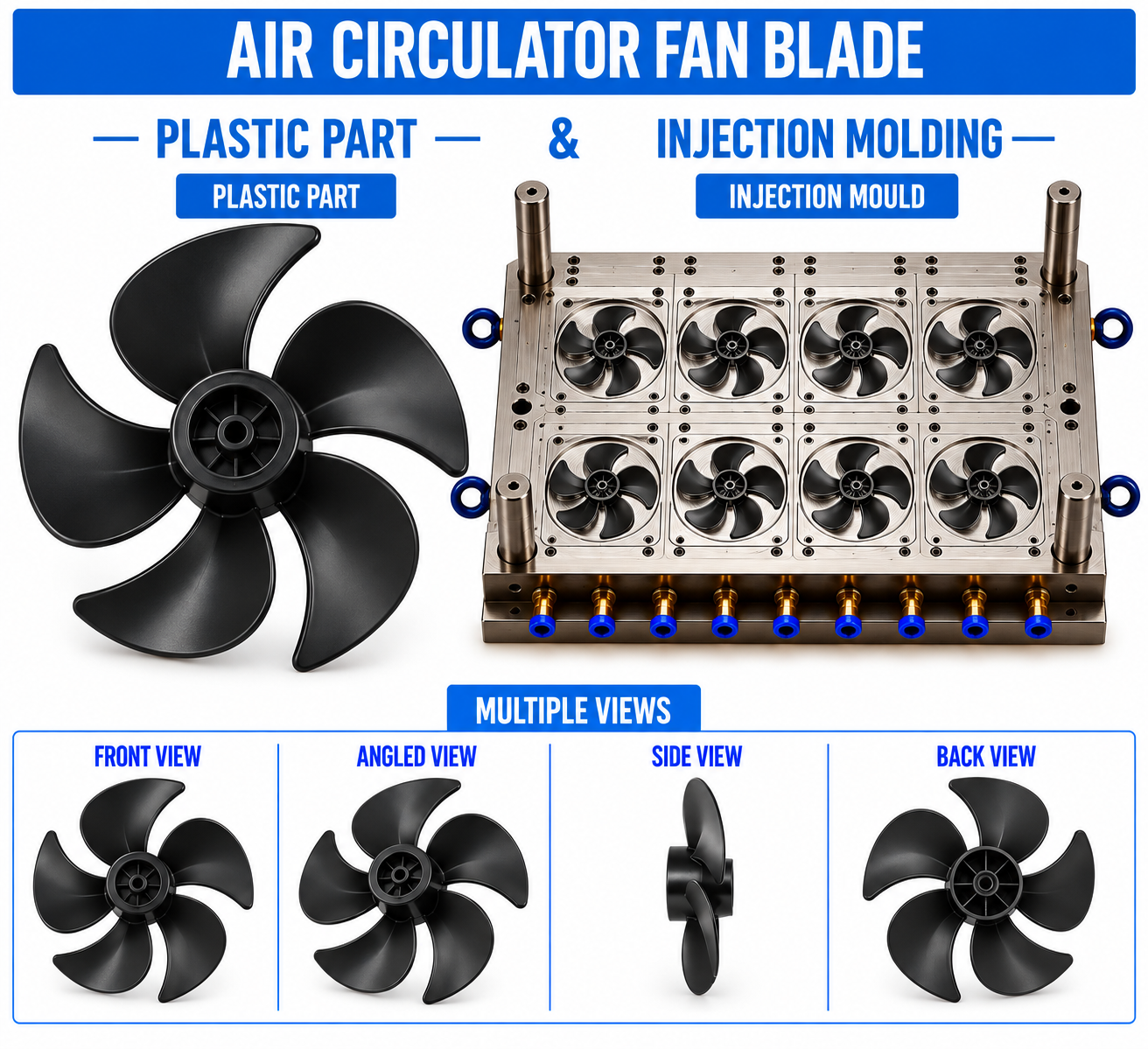
Air Circulator Plastic Fan Blade Mould and Moulding Service
₹500.00
Air Circulator Plastic Fan Blade Mould and Moulding Service | Renovator Appliances Ltd
Product Overview
Renovator Appliances Ltd manufactures Air Circulator Plastic Fan Blade Mould and Moulding Service for injection-moulded fan blades used in air circulator assemblies. The fan blade is designed to generate the required airflow by rotating around the motor shaft at the specified operating speed while maintaining accurate balance and reliable mechanical attachment.
The mould is developed according to the blade diameter, number and profile of blades, pitch, hub geometry, shaft interface, rotational direction, blade thickness, weight distribution, and required airflow characteristics. Precision injection moulding supports consistent blade geometry, dimensional stability, concentricity, and repeatable production quality.
Key Features
Application-specific fan blade design for air circulator assemblies
Accurate blade pitch and aerodynamic profile
Balanced blade geometry for stable rotation
Precisely moulded central hub and shaft interface
Controlled blade thickness for consistent performance
Reinforced hub area for reliable shaft connection
Accurate rotational alignment with the motor shaft
Controlled weight distribution to minimize imbalance
Smooth blade surfaces for consistent airflow
Suitable for OEM, ODM, and customized air circulator applications
Designed for repeatable high-volume injection moulding
Industrial Applications
| Application Area | Use of Fan Blade |
|---|---|
| Air Circulator Fan | Generates and directs airflow through rotation |
| Household Air Circulator | Provides the primary air-moving function |
| Commercial Air Circulator | Supports continuous airflow requirements |
| High-Airflow Fan Assembly | Uses optimized blade geometry for required air movement |
| Portable Air Circulator | Provides lightweight rotating airflow generation |
| OEM Fan Manufacturing | Enables consistent production of application-specific fan blades |
Manufacturing Process
1. Product Design & Development
The fan blade is developed according to the required airflow, rotational speed, fan diameter, number of blades, blade pitch, hub dimensions, shaft interface, and motor characteristics. Blade geometry and weight distribution are considered to support stable rotation and the required airflow performance.
2. Plastic Mould Design
The injection mould is designed around the blade profile, pitch, hub geometry, shaft socket, blade thickness, and parting-line requirements. Special attention is given to balanced filling, cooling, ejection, and shrinkage control because even small dimensional variations can affect blade balance and rotational performance.
3. Mould Manufacturing
The mould can be manufactured using P20, H13, or S136 Steel, depending on production volume, plastic grade, required surface finish, component complexity, and expected mould life. CNC machining, EDM, precision finishing, fitting, and mould trials are used to achieve the required blade and hub geometry.
4. Injection Moulding
The selected plastic is processed using controlled injection pressure, melt temperature, holding pressure, cooling time, and cycle parameters. Process control is important for maintaining uniform blade thickness, hub dimensions, pitch geometry, and weight consistency.
5. Finishing & Assembly Preparation
Moulded fan blades are inspected for flash, gate marks, warpage, sink marks, short shots, and surface defects. Gates are trimmed where required, and the shaft socket and hub area are checked for proper fitment.
6. Quality Inspection
Finished fan blades are checked for overall diameter, blade profile, pitch, hub dimensions, shaft interface, blade thickness, concentricity, and weight consistency. Rotational balance and assembly testing with the specified motor shaft can be performed to verify stable operation.
Raw Materials
| Material | Application Consideration |
|---|---|
| PP | Suitable for lightweight fan blades where the required strength and temperature conditions permit |
| ABS | Can be considered for rigid fan-blade applications requiring good dimensional stability and surface appearance |
| Nylon / PA | Suitable where increased mechanical strength and temperature resistance are required |
| Glass-Filled Nylon | Can be considered where higher stiffness and dimensional stability are required |
| PC+ABS | Suitable for selected applications requiring impact resistance and dimensional stability |
| POM | May be considered for specific precision hub or mechanical applications where its material characteristics are suitable |
The final material should be selected according to rotational speed, blade loading, temperature, impact requirements, vibration, environmental exposure, and the complete fan assembly's performance requirements.
Quality Control
Overall blade diameter inspection
Blade pitch and profile verification
Blade thickness inspection
Hub diameter and height inspection
Shaft-socket dimensional verification
Concentricity inspection
Blade-to-blade dimensional consistency
Weight consistency checks
Warpage and deformation inspection
Flash and gate-mark inspection
Surface-finish inspection
Static and dynamic balance testing where required
Motor shaft fitment testing
Rotational vibration verification
Batch-to-batch dimensional monitoring
Buyer Guide
When sourcing an Air Circulator Plastic Fan Blade, buyers should provide the required fan diameter, number of blades, rotational speed, blade pitch, airflow requirements, hub dimensions, shaft diameter and profile, rotational direction, plastic grade, and production quantity.
For new development, a 2D drawing, 3D CAD model, existing fan blade, motor assembly, or complete air circulator can be used as a reference. Blade balance should be verified with the actual motor and shaft because blade mass distribution and hub fitment directly affect rotational stability.
Why Choose Renovator Appliances Ltd?
Advanced Injection Moulding Facility
Renovator Appliances Ltd uses controlled injection moulding processes to manufacture fan blades with consistent blade geometry, hub dimensions, surface finish, and weight distribution.
In-House Mould Manufacturing
In-house mould manufacturing provides control over precision cavity geometry, cooling, ejection, mould fitting, and production trials for rotating fan components.
OEM & ODM Manufacturing
Customized fan blades can be developed according to OEM drawings, CAD models, existing samples, motor specifications, or defined airflow requirements.
Quality Assurance
Dimensional inspection, hub fitment checks, weight consistency, and rotational balance testing help maintain reliable fan-blade production quality.
Cost-Effective Manufacturing
Optimized mould design, material selection, cavity configuration, and controlled injection parameters support economical production for development and volume manufacturing.
Frequently Asked Questions
1. What is an Air Circulator Plastic Fan Blade used for?
It is the rotating airflow-generating component of the air circulator, designed to move air according to the required fan speed and blade geometry.
2. How is fan blade balance controlled?
Balance is supported through accurate blade geometry, consistent wall thickness, controlled weight distribution, precise hub moulding, and dimensional inspection. Static or dynamic balancing can also be performed according to the application.
3. Which plastic material is suitable for an air circulator fan blade?
PP, ABS, Nylon, Glass-Filled Nylon, PC+ABS, or other suitable engineering plastics may be considered depending on rotational speed, mechanical loading, temperature, impact, and dimensional requirements.
4. Can the fan blade hub be customized for a specific motor shaft?
Yes. The hub can be designed with the required bore, keyed profile, D-shaped interface, splined interface, press-fit, or other approved shaft connection.
5. Can the fan blade mould be manufactured for high-volume production?
Yes. Single-cavity or multi-cavity tooling can be considered according to blade size, moulding-machine capacity, production quantity, cycle time, balancing requirements, and tooling economics.
- SKU
- REN-FDA8F1D93C5D7ECA762F0440