INDUSTRIAL PRODUCT
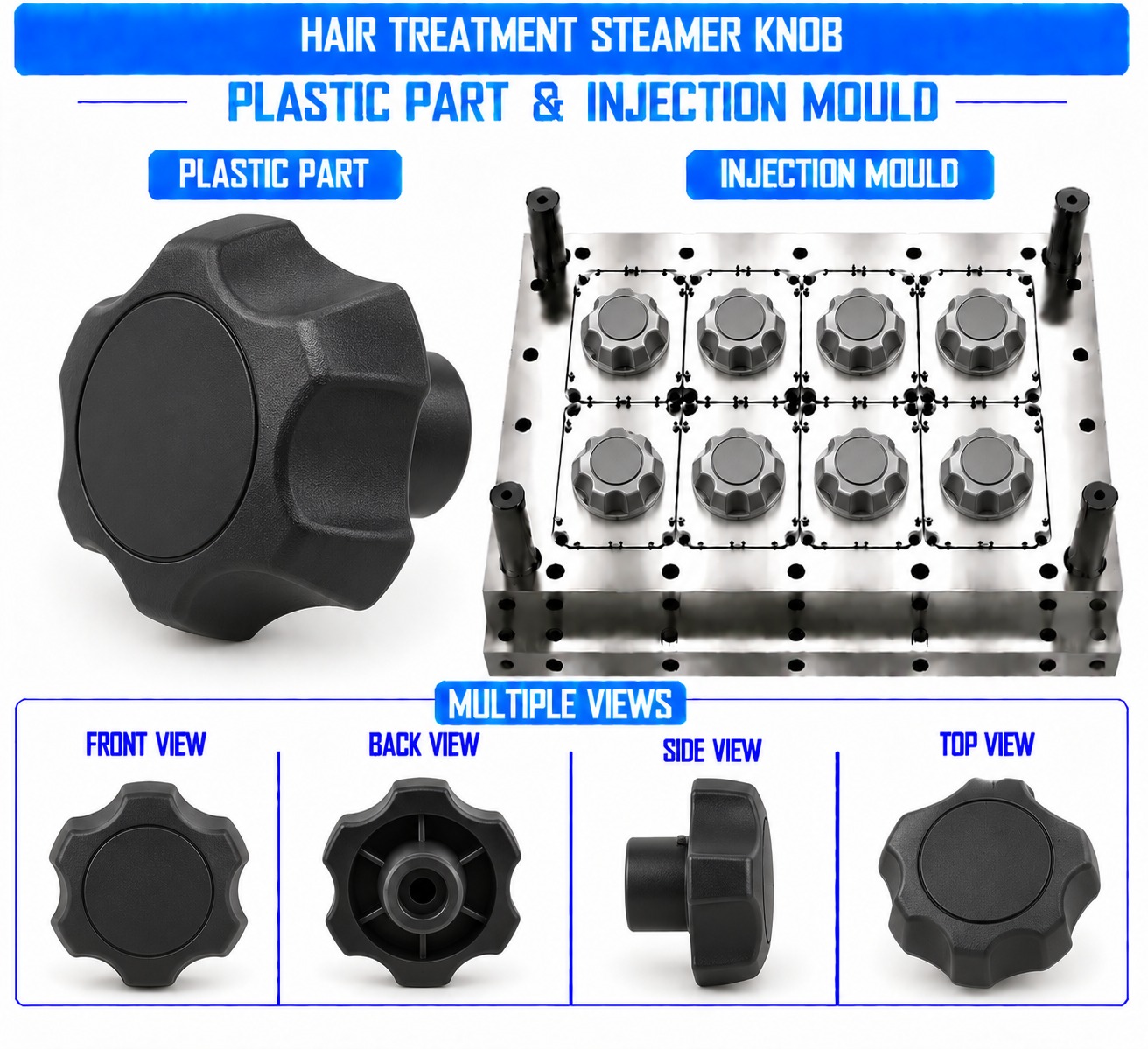
Hair Treatment Steamer Plastic Knob Mould and Moulding Service
₹50.00
Hair Treatment Steamer Plastic Knob Mould and Moulding Service | Renovator Appliances Ltd
Product Overview
The Hair Treatment Steamer Plastic Knob is a precision injection-moulded plastic component used as a manual operating interface for controlling functions of a hair treatment steamer. Depending on the equipment design, the knob can be used to operate temperature settings, steam control, timer functions, power selection, intensity adjustment, or other rotary controls.
The knob is designed according to the corresponding switch or control shaft, required rotation angle, shaft profile, mounting method, grip requirements, and control-panel layout. Accurate internal shaft engagement is important for reliable torque transfer and smooth operation without excessive looseness or unwanted rotation.
Renovator Appliances Ltd. provides Plastic Knob Mould and Moulding Service for OEM and ODM hair treatment steamers, with customized knob diameter, height, grip profile, shaft socket, indicator marking area, locking features, and surface finish.
Key Features
Precision injection-moulded plastic control knob
Designed for rotary control functions in hair treatment steamers
Suitable for temperature, timer, steam, intensity, and other manual controls
Accurate internal shaft socket for secure control engagement
Customized shaft profiles including application-specific mounting arrangements
Controlled rotational fit with the corresponding switch or control mechanism
Ergonomic outer grip for convenient user operation
Customized diameter, height, profile, and grip pattern
Suitable provision for pointer marks, symbols, scales, or printed indicators
Reinforced internal mounting section for improved durability
Controlled wall thickness for consistent moulding
Smooth rotational movement with suitable shaft clearance
Available in customized colour, texture, gloss, and surface finish
Suitable for repeated manual operation
Compatible with different control-panel configurations
Suitable for OEM and ODM hair-care equipment
Designed for consistent high-volume injection moulding
Industrial Applications
| Application Area | Use of Plastic Knob |
|---|---|
| Hair Treatment Steamers | Controls temperature, steam, timer, or operating functions |
| Professional Hair Steamers | Used as a manual rotary control interface |
| Hair Spa Equipment | Provides adjustment of treatment settings |
| Salon Hair-Care Equipment | Used for equipment control functions |
| Beauty Treatment Equipment | Provides manual adjustment of operating parameters |
| OEM Hair Treatment Equipment | Customized according to control-panel requirements |
Manufacturing Process
1. Product Design & Development
The plastic knob is developed according to the corresponding control switch, shaft, and control-panel assembly. Important design parameters include knob diameter, height, grip profile, shaft socket geometry, shaft dimensions, rotational angle, required torque, indicator position, and available panel clearance.
CAD drawings, 3D models, physical samples, or existing knob references can be used to develop the production-ready component.
2. Plastic Mould Design
The injection mould is designed according to the knob's external and internal geometry. Key mould-design considerations include:
Outer knob profile
Internal shaft socket
Shaft engagement depth
Anti-rotation features
Grip pattern
Indicator or pointer feature
Internal reinforcement
Parting-line position
Gate location
Ejection arrangement
Cooling-channel layout
Draft angles
Plastic shrinkage compensation
The mould design is optimized to maintain accurate shaft engagement and consistent external appearance.
3. Mould Manufacturing
The mould can be manufactured using suitable mould steels such as P20 Steel, H13 Steel, or S136 Steel, depending on production quantity, plastic grade, surface requirements, and expected mould life.
CNC machining, EDM, drilling, polishing, fitting, and mould assembly are performed to achieve accurate cavity and internal socket geometry.
4. Injection Moulding
The selected thermoplastic material is processed according to its recommended injection-moulding parameters. Molten plastic is injected into the mould cavity under controlled pressure and temperature.
Production parameters are controlled to maintain:
Accurate knob dimensions
Shaft-socket dimensions
Consistent wall thickness
Grip-profile definition
Indicator alignment
Internal feature integrity
Low warpage
Stable component dimensions
Consistent surface finish
Repeatable production quality
5. Finishing & Assembly Preparation
After moulding, the knobs are inspected and prepared for assembly. Gate marks, flash, and unwanted moulding residues are removed where required.
The knob is checked with the corresponding control shaft or switch to verify correct engagement, rotational fit, alignment, and clearance from the control-panel surface.
Where required, additional marking, printing, labelling, or decorative finishing can be considered according to the product design.
6. Quality Inspection
The finished plastic knob can be inspected for:
Overall diameter and height
External profile
Grip dimensions
Shaft-socket dimensions
Shaft engagement depth
Anti-rotation feature accuracy
Rotational fit
Indicator or pointer alignment
Panel clearance
Surface finish
Colour consistency
Flash and moulding defects
Sink marks
Short shots
Warpage and deformation
Raw Materials
| Plastic Material | Suitable Requirement |
|---|---|
| ABS | Suitable for rigid knobs with good appearance and dimensional stability |
| PP | Lightweight and suitable where flexibility is required |
| HIPS | Suitable for rigid control knobs and appliance components |
| PC+ABS | Suitable where toughness, rigidity, and appearance are required |
| POM | Suitable where low-friction characteristics and dimensional stability are important |
| PBT | Suitable for mechanical strength and dimensional stability |
| Nylon / PA | Suitable for mechanically stressed internal mounting features |
| Flame-Retardant Plastic | Suitable where specific flame-retardancy requirements apply |
Material selection depends on required grip strength, shaft engagement, rotational load, operating temperature, durability, surface finish, and overall equipment requirements.
Quality Control
Renovator Appliances Ltd. applies component-specific quality checks for the Hair Treatment Steamer Plastic Knob, including:
Raw Material Inspection: Verification of the specified plastic grade and material consistency
Mould Inspection: Checking cavity profile, shaft-socket geometry, ejection, cooling, and parting surfaces
Dimensional Inspection: Checking knob diameter, height, profile, and critical dimensions
Shaft Socket Inspection: Verifying socket dimensions, depth, and anti-rotation features
Fitment Inspection: Checking secure installation onto the corresponding control shaft
Rotation Inspection: Testing smooth and controlled rotary operation
Torque Transfer Inspection: Verifying that the knob transfers user input without slipping on the shaft
Indicator Inspection: Checking pointer or marking alignment where applicable
Panel Clearance Inspection: Ensuring the knob does not interfere with the control-panel surface
Visual Inspection: Checking flash, sink marks, short shots, burn marks, scratches, and other defects
Surface Inspection: Checking colour, texture, gloss, and grip finish
Batch Consistency: Maintaining consistent dimensions, fitment, appearance, and operation across production batches
Buyer Guide
Before ordering a Hair Treatment Steamer Plastic Knob Mould and Moulding Service, buyers should provide the available product information, including:
Knob diameter and height
Outer profile and grip requirements
Control shaft diameter
Shaft shape or profile
Shaft engagement depth
Anti-rotation arrangement
Required rotational angle
Approximate operating torque
Control-panel thickness and clearance
Pointer, marking, or indicator requirements
CAD drawing or 3D model
Existing sample or reference knob
Required plastic material or preferred grade
Operating temperature
Exposure to steam and moisture
Required colour and surface texture
Production quantity
Required mould life
Prototype or sample requirements
Providing accurate shaft and control-panel information helps in developing the mould with correct internal engagement, rotational fit, and external dimensions.
Why Choose Renovator Appliances Ltd?
Advanced Injection Moulding Facility
Renovator Appliances Ltd. provides controlled plastic injection moulding for precision control components such as knobs used in professional hair treatment equipment.
In-House Mould Manufacturing
In-house mould manufacturing provides better control over knob geometry, shaft sockets, grip features, ejection, cooling, and tooling modifications.
OEM & ODM Manufacturing
The plastic knob can be developed according to customer CAD files, technical drawings, physical samples, or customized OEM/ODM equipment requirements.
Quality Assurance
Dimensional, shaft-fit, rotational, torque-transfer, visual, and surface inspections help maintain reliable knob performance.
Cost-Effective Manufacturing
Optimized mould design, suitable cavity configuration, material selection, and controlled injection-moulding processes support economical production for prototypes and larger production quantities.
Frequently Asked Questions
1. What is a Hair Treatment Steamer Plastic Knob?
It is an injection-moulded plastic control component used to manually operate rotary functions such as temperature, timer, steam, or intensity settings on a hair treatment steamer.
2. Which plastic materials can be used for the plastic knob?
ABS, PP, HIPS, PC+ABS, POM, PBT, and Nylon/PA can be considered according to the required mechanical strength, shaft engagement, friction characteristics, temperature resistance, and appearance.
3. Which mould steel can be used for manufacturing the knob mould?
P20 Steel, H13 Steel, or S136 Steel can be selected according to production quantity, mould-life requirements, plastic material, surface finish, and tooling requirements.
4. Can the plastic knob be customized according to an existing control shaft?
Yes. The knob can be developed according to the shaft diameter, shaft profile, engagement depth, anti-rotation arrangement, rotational requirements, and control-panel design.
5. Can Renovator Appliances Ltd. manufacture both the mould and moulded plastic knob?
Yes. Renovator Appliances Ltd. can support the complete process from knob design and mould manufacturing to injection moulding and production of the finished plastic control knob.
- SKU
- REN-12598F80BD13E23C5F359D44