INDUSTRIAL PRODUCT
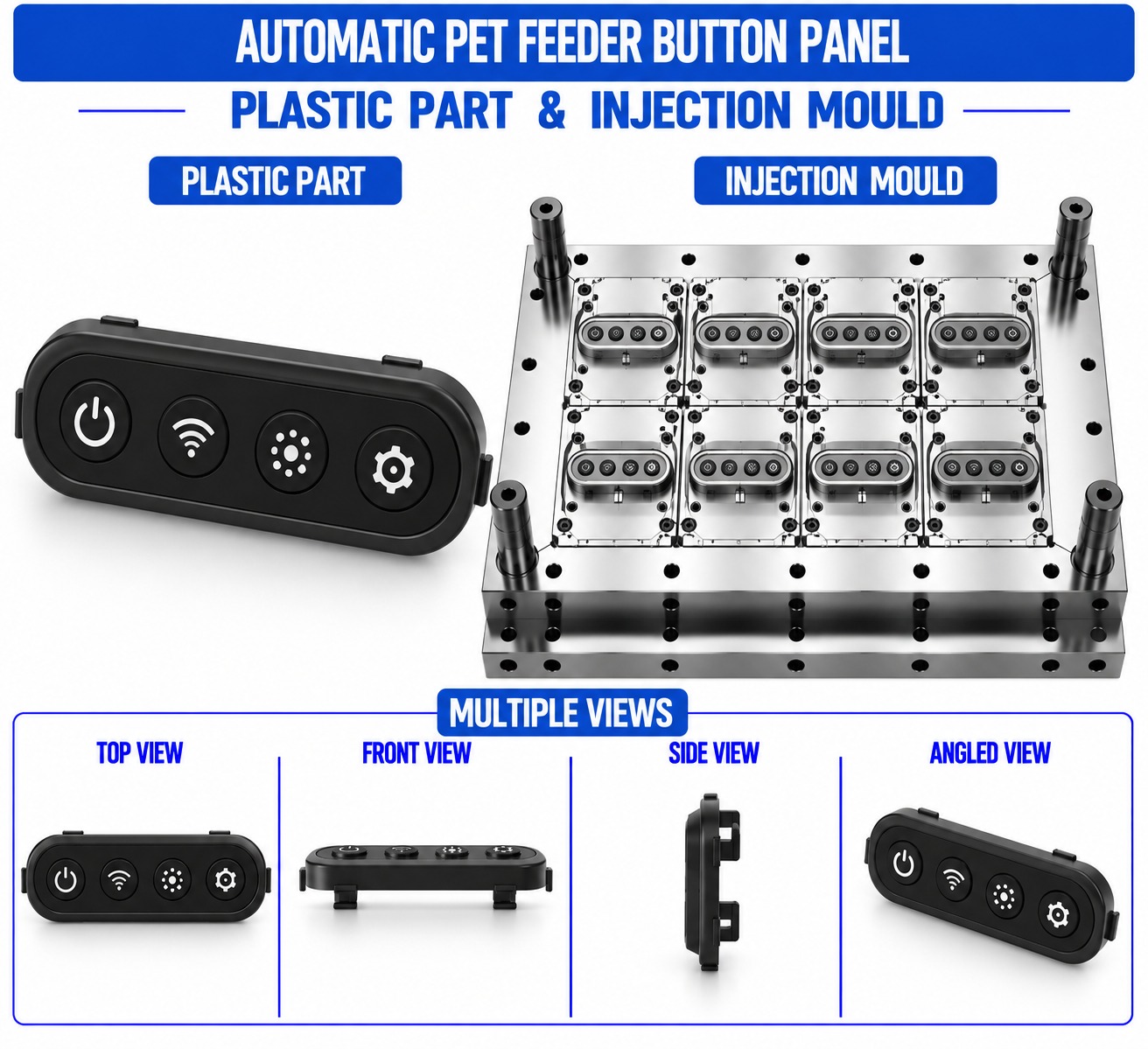
Automatic Pet Feeder Plastic Button Panel Mould and Moulding Service
₹100.00
Automatic Pet Feeder Plastic Button Panel Mould and Moulding Service
Product Overview
The Automatic Pet Feeder Plastic Button Panel is a precision-moulded plastic component designed to provide the user interface for operating an automatic pet feeder. It can accommodate multiple control buttons, function keys, indicators, or touch-control interfaces used for feeding schedules, portion settings, manual feeding, power functions, and other feeder operations.
Renovator Appliances Ltd. provides Automatic Pet Feeder Plastic Button Panel Mould and Moulding Service for OEM and ODM applications. The button panel can be developed according to the feeder housing, button layout, switch configuration, PCB arrangement, control-panel dimensions, mounting method, and required product appearance.
The component can incorporate button openings, flexible or rigid button structures, locating features, snap-fit clips, mounting tabs, screw bosses, reinforcing ribs, and other customized details to ensure accurate alignment and reliable operation of the control interface.
Key Features
Precision injection-moulded plastic button panel
Designed for automatic and smart pet feeder assemblies
Supports multiple operating buttons and control functions
Customized button layout and spacing
Accurate alignment with PCB-mounted switches
Suitable for push-button and tactile switch interfaces
Snap-fit, clip-fit, screw-fit, or tab-based mounting
Locating pins and alignment features
Retaining structures for secure assembly
Reinforcing ribs for improved rigidity
Controlled wall thickness for consistent moulding
Smooth and easy-to-clean surface
Customized button symbols, markings, texture, and colour
Suitable for repeated user operation
Accurate fit with control panel cover and feeder housing
Compatible with high-volume injection moulding
OEM and ODM customization available
Industrial Applications
| Application | Usage |
|---|---|
| Automatic Pet Feeders | Provides the operating button interface |
| Smart Pet Feeders | Supports user controls and feeding functions |
| Programmable Pet Feeders | Provides buttons for schedule and portion settings |
| Wi-Fi Pet Feeders | Integrates physical control buttons with electronic systems |
| Electronic Pet Feeders | Supports switches and user-control interfaces |
| Timed Food Dispensers | Provides manual and programmed feeding controls |
| App-Enabled Pet Feeders | Complements digital feeding controls |
| Commercial Pet Feeding Equipment | Suitable for repetitive-use control panels |
| OEM Pet Appliances | Manufactured according to customer specifications |
| ODM Pet Feeding Products | Customized for specific product designs |
Manufacturing Process
1. Product Design & Development
The button panel is designed according to the automatic pet feeder's control interface, PCB layout, switch positions, and outer housing. Critical parameters include button dimensions, spacing, travel clearance, wall thickness, mounting points, locating features, retaining structures, and surface profile.
The design is reviewed for proper draft angles, mouldability, uniform wall thickness, button alignment, switch accessibility, and reliable part ejection.
2. Plastic Mould Design
A dedicated injection mould is designed according to the button panel geometry and required production quantity. The mould includes cavity and core configuration, parting line, gate location, runner system, cooling channels, ejector arrangement, and suitable draft angles.
Special attention is given to small button openings, narrow ribs, locating features, clips, and visible surfaces to achieve accurate mould filling and consistent dimensional performance.
3. Mould Manufacturing
The mould can be manufactured using suitable tool steels such as P20 Steel, H13 Steel, or S136 Steel, depending on production volume, expected tool life, required surface finish, and component requirements.
CNC machining, EDM where required, precision fitting, polishing, mould assembly, and trial moulding are performed to achieve accurate cavity geometry and reliable component production.
4. Injection Moulding
The selected thermoplastic material is processed through a controlled injection moulding process. Molten plastic is injected into the mould cavity under controlled temperature, pressure, injection speed, and holding conditions.
Process parameters are optimized to achieve accurate button geometry and surface quality while minimizing flash, sink marks, warpage, short shots, weld-line issues, and dimensional variation.
5. Finishing & Assembly Preparation
After moulding, the button panel is removed from the mould and inspected for flash, gate marks, surface imperfections, and moulding defects. Excess material is trimmed where necessary.
The component can then be prepared for assembly with tactile switches, PCB assemblies, control panel covers, labels, symbols, and the automatic pet feeder housing.
6. Quality Inspection
Finished button panels are inspected for dimensional accuracy, button alignment, mounting fitment, switch compatibility, structural integrity, and surface appearance.
Critical dimensions such as button position, switch interface, mounting points, and locating features are checked to ensure reliable operation and consistent assembly.
Raw Materials
| Plastic Material | Typical Application |
|---|---|
| ABS | Rigid button panels requiring good appearance and dimensional stability |
| PC+ABS | Applications requiring improved impact resistance and structural performance |
| PP (Polypropylene) | Lightweight panels with good moisture and chemical resistance |
| PC | Higher-performance applications requiring strength and dimensional stability |
| HIPS | Selected rigid button-panel applications |
| PBT | Engineering applications requiring dimensional stability |
| Nylon / PA | Applications requiring increased mechanical strength |
| Glass-Filled Nylon | Higher-strength structural applications |
| Flame-Retardant Engineering Plastics | Applications requiring specific electrical or fire-performance properties, subject to the selected grade |
Quality Control
Renovator Appliances Ltd. applies dimensional, visual, and assembly inspections to maintain consistent button panel quality.
Key inspection parameters include:
Overall panel length, width, and height
Button diameter, width, and height
Button spacing and layout
Button opening dimensions
Button-to-switch alignment
PCB interface dimensions
Mounting-hole position
Screw-boss dimensions
Snap-fit and clip dimensions
Locating pin and slot accuracy
Retaining feature accuracy
Button travel clearance
Control panel cover fitment
Feeder housing fitment
Internal component clearance
Wall thickness consistency
Rib geometry
Surface finish and texture
Colour consistency
Marking or symbol alignment where applicable
Flash and gate quality
Warpage and dimensional distortion
Sink marks and short shots
Cracks and moulding defects
Assembly compatibility
Batch-to-batch consistency
Buyer Guide
When sourcing an Automatic Pet Feeder Plastic Button Panel Mould and Moulding Service, buyers should consider:
Button Layout – Provide the number, position, size, and spacing of all buttons.
Switch Configuration – Specify the type and location of PCB-mounted tactile switches or other operating mechanisms.
Panel Dimensions – Provide overall length, width, height, curvature, and profile requirements.
Mounting Method – Define screw, snap-fit, clip, hook, tab, or other attachment requirements.
Button Travel – Specify required clearance and operating travel for reliable switch activation.
Material Selection – Select ABS, PC+ABS, PP, PC, PBT, Nylon, HIPS, or another suitable plastic according to application requirements.
Electrical Environment – Specify any applicable material-performance requirements where the panel is installed near electrical components.
Surface Finish – Define gloss, matte, texture, colour, grain, and other appearance requirements.
Markings & Symbols – Specify printed, moulded, engraved, or labelled button symbols where required.
Dimensional Tolerances – Identify critical tolerances for button alignment, switch operation, and housing interfaces.
Production Quantity – Production volume should be considered when selecting single-cavity or multi-cavity tooling.
OEM/ODM Requirements – Provide CAD drawings, samples, PCB layouts, or technical specifications for customized development.
Why Choose Renovator Appliances Ltd.?
Advanced Injection Moulding Facility
Suitable injection moulding capabilities for producing accurate button panels with consistent dimensions, surface quality, and repeatability.
In-House Mould Manufacturing
Mould manufacturing support helps maintain control over cavity geometry, button features, mounting structures, tolerances, and tooling requirements.
OEM & ODM Manufacturing
Button panels can be developed according to customer CAD files, drawings, samples, PCB layouts, control-panel designs, and feeder housing specifications.
Quality Assurance
Dimensional, visual, fitment, and assembly inspections help ensure reliable button operation and integration with the complete feeder control system.
Cost-Effective Manufacturing
Optimized mould design, suitable material selection, cavity configuration, and injection moulding parameters can support economical manufacturing for development and bulk production.
Frequently Asked Questions
1. What is an Automatic Pet Feeder Plastic Button Panel?
It is a moulded plastic interface component that supports and positions the operating buttons used to control functions of an automatic pet feeder.
2. Which plastic materials can be used for the button panel?
ABS, PC+ABS, PP, PC, HIPS, PBT, Nylon/PA, Glass-Filled Nylon, and other application-specific engineering plastics can be considered based on strength, dimensional stability, appearance, environmental, and electrical requirements.
3. Can the button panel be customized according to our feeder design?
Yes. Button size, number, spacing, layout, mounting features, switch interfaces, ribs, clips, surface texture, colour, markings, and overall dimensions can be customized according to the product design.
4. Can Renovator manufacture both the mould and finished button panel?
Yes. The service can include injection mould design and manufacturing as well as production of the finished plastic button panel according to customer specifications.
5. Is the button panel suitable for bulk production?
Yes. The mould configuration can be selected according to production volume, component geometry, cycle requirements, and cost targets. Single-cavity or multi-cavity tooling can be considered as appropriate.
- SKU
- REN-B91CFE1A6A5E3E3004CDDCCA