INDUSTRIAL PRODUCT
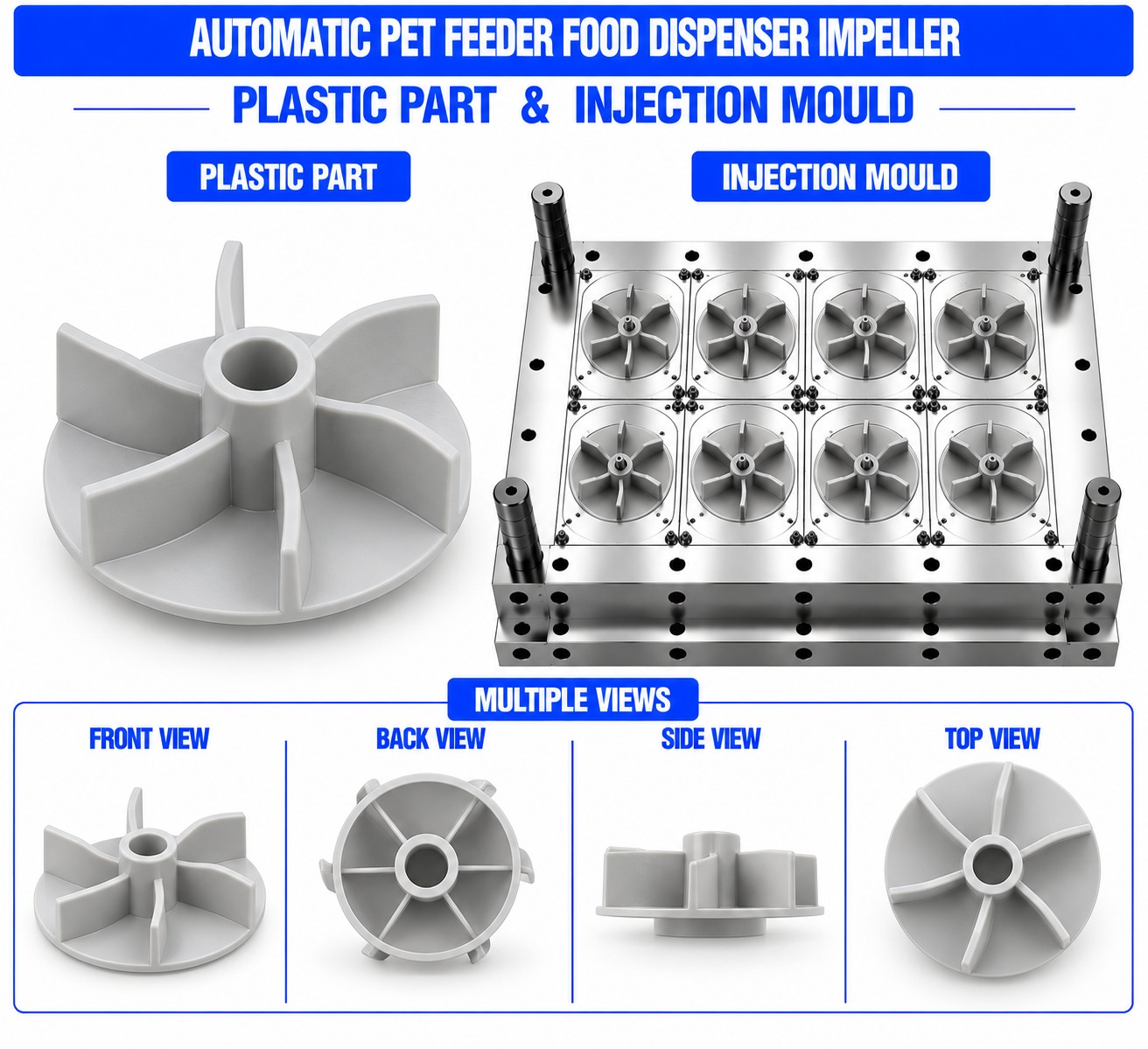
Automatic Pet Feeder Plastic Food Dispenser Impeller Mould and Moulding Service
₹100.00
Automatic Pet Feeder Plastic Food Dispenser Impeller Mould and Moulding Service | Renovator Appliances Ltd.
Product Overview
The Automatic Pet Feeder Plastic Food Dispenser Impeller is a precision-moulded plastic mechanical component used inside automatic pet feeders to control and move dry pet food from the storage tank toward the dispensing outlet. The impeller is designed to rotate within the dispensing mechanism and help deliver a controlled quantity of pet food during scheduled or manually activated feeding cycles.
The impeller geometry can be customized according to the feeder's food tank design, dispensing chamber, motor, gearbox, shaft arrangement, food particle size, and required dispensing quantity. Its blades, pockets, vanes, central hub, shaft interface, and rotational geometry can be engineered to support smooth food movement while reducing jamming and inconsistent dispensing.
Manufactured through precision injection moulding, the component can be produced with accurate rotational geometry, controlled wall thickness, dimensional stability, smooth surfaces, and precise shaft and mounting interfaces. Renovator Appliances Ltd. provides Automatic Pet Feeder Plastic Food Dispenser Impeller Mould and Moulding Service for OEM, ODM, customized, prototype, sampling, and bulk production requirements.
Key Features
Precision-moulded plastic impeller for automatic pet food dispensing
Designed for controlled movement of dry pet food
Application-specific blade, vane, or pocket geometry
Customized according to dispensing chamber dimensions
Accurate central hub and shaft interface
Compatible with customized motor or gearbox arrangements
Controlled rotational geometry
Lightweight construction with suitable structural strength
Smooth food-contact-oriented surfaces where applicable
Designed to reduce food accumulation and jamming
Controlled clearances between impeller and dispensing housing
Customized number and shape of blades or vanes
Accurate locating and alignment features
Reinforced hub and drive interface where required
Controlled wall thickness
Customized colour and surface finish
Selection of suitable plastic grade according to application
OEM and ODM manufacturing support
Prototype and sample development
Small-batch and bulk production capability
Consistent dimensional and functional quality
Industrial Applications
| Application | Usage |
|---|---|
| Automatic Pet Feeders | Rotates to move food toward the dispensing outlet |
| Smart Pet Feeders | Supports controlled food dispensing in connected feeders |
| Programmable Pet Feeders | Helps deliver measured food during scheduled cycles |
| Wi-Fi Pet Feeders | Used in electronically controlled dispensing mechanisms |
| Battery-Powered Pet Feeders | Supports motor-driven food dispensing |
| Electronic Food Dispensers | Transfers dry food through the dispensing chamber |
| Commercial Pet Feeding Equipment | Used in automated feeding mechanisms |
| OEM Pet Feeding Appliances | Customized for specific feeder designs |
Manufacturing Process
1. Product Design & Development
The Automatic Pet Feeder Plastic Food Dispenser Impeller is designed according to the dispensing chamber, food tank, motor, gearbox, shaft dimensions, rotation direction, food particle characteristics, and required dispensing quantity.
CAD modelling is used to develop the impeller blades, vanes or pockets, central hub, shaft connection, clearances, reinforcing features, and rotational profile. The geometry can be optimized to support smooth movement of dry pet food through the dispensing mechanism.
2. Plastic Mould Design
A precision injection mould is designed according to the impeller's rotational geometry, plastic material, dimensional tolerances, and production volume. Special attention is given to the central hub, shaft interface, blade geometry, parting line, draft angles, gate location, cooling system, and ejection arrangement.
3. Mould Manufacturing
The mould can be manufactured using suitable mould steels such as P20 Steel, H13 Steel, or S136 Steel, depending on the expected production volume, mould life, surface requirements, and application.
CNC machining, EDM, drilling, polishing, fitting, and mould assembly are used to produce accurate cavity and core geometry.
4. Injection Moulding
Selected plastic material is heated and injected into the mould cavity under controlled pressure, speed, and temperature. After filling, packing, and cooling, the impeller is ejected from the mould.
Process parameters are controlled to minimize warpage, sink marks, flash, short shots, weld-line problems, dimensional variation, and deformation of the blade or hub geometry.
5. Finishing & Assembly Preparation
After moulding, the impellers are inspected and prepared for integration with the dispensing mechanism. Gate marks and flash are removed where required.
The central hub, shaft interface, blade geometry, rotational clearance, and mounting features are checked to ensure proper compatibility with the feeder assembly.
6. Quality Inspection
Finished impellers are inspected for dimensional accuracy, blade profile, hub geometry, shaft fitment, rotational balance, structural integrity, and dispensing-system compatibility.
Functional testing can be performed according to the customer's specifications to evaluate rotation, food movement, clearance, and dispensing performance.
Raw Materials
| Plastic Material | Typical Application |
|---|---|
| PP (Polypropylene) | Lightweight impellers with good moisture and chemical resistance |
| POM / Acetal | Precision rotational components requiring low friction and dimensional stability |
| Nylon / PA | Mechanical applications requiring strength and wear resistance |
| Glass-Filled Nylon | Applications requiring higher stiffness and mechanical strength |
| ABS | Rigid impeller applications with appearance requirements |
| PC | Applications requiring higher impact resistance and rigidity |
| Food-Contact-Suitable Plastics | Considered where applicable requirements require suitable material selection |
| Engineering Plastics | Selected for demanding mechanical, wear, or dimensional requirements |
The final material should be selected according to rotational load, wear requirements, food-contact considerations where applicable, cleaning conditions, moisture exposure, temperature, motor torque, and applicable target-market requirements.
Quality Control
Renovator Appliances Ltd. can control important quality parameters including:
Raw material specification
Plastic grade and batch consistency
Mould cavity and core condition
Overall impeller dimensions
Blade or vane dimensions
Number and profile of blades
Central hub dimensions
Shaft bore or drive interface
Shaft fitment
Rotational alignment
Impeller concentricity
Blade-to-housing clearance
Wall thickness
Locating features
Mounting features
Reinforcing features
Surface finish
Flash and burr inspection
Gate mark inspection
Warpage and deformation
Sink marks
Short shots
Cracks and moulding defects
Rotational movement
Motor and gearbox compatibility
Food-flow performance
Food accumulation and jamming areas
Dispensing outlet alignment
Colour and appearance consistency
Assembly compatibility
Batch-to-batch dimensional consistency
Final visual and functional inspection
Buyer Guide
When sourcing an Automatic Pet Feeder Plastic Food Dispenser Impeller, buyers should consider:
Feeder model and dispensing mechanism
Impeller diameter and height
Dispensing chamber dimensions
Motor and gearbox specifications
Shaft diameter and drive arrangement
Rotation direction
Number of blades, vanes, or pockets
Blade profile
Required dispensing quantity
Type and approximate size of dry pet food
Food-flow requirements
Required rotational clearance
Plastic material and grade
Wear and mechanical requirements
Applicable food-contact requirements
Cleaning and moisture conditions
Operating temperature
Required dimensional tolerances
Colour and surface finish
Expected production quantity
Single-cavity or multi-cavity mould requirement
OEM/ODM customization requirements
Packaging requirements
Providing a 2D drawing, 3D CAD model, reference sample, dispensing mechanism dimensions, motor/shaft specifications, or approved product specification can help establish the mould and moulding requirements accurately.
Why Choose Renovator Appliances Ltd.?
Advanced Injection Moulding Facility
Controlled injection moulding processes support accurate and repeatable production of precision plastic mechanical components.
In-House Mould Manufacturing
In-house mould development helps maintain control over blade geometry, hub dimensions, shaft interfaces, and critical rotational features.
OEM & ODM Manufacturing
Customized impellers can be manufactured according to customer drawings, samples, feeder designs, dispensing requirements, and application-specific specifications.
Quality Assurance
Dimensional, visual, rotational, assembly, and functional parameters can be monitored throughout mould development and production.
Cost-Effective Manufacturing
Optimized mould design, appropriate cavity configuration, and efficient injection moulding processes can support economical production for prototype and volume requirements.
Frequently Asked Questions
1. What is an Automatic Pet Feeder Plastic Food Dispenser Impeller?
It is a rotating plastic component used inside an automatic pet feeder's dispensing mechanism to move dry pet food from the storage area toward the dispensing outlet.
2. Which plastic materials are suitable for the impeller?
PP, POM/Acetal, Nylon/PA, Glass-Filled Nylon, ABS, PC, and other application-appropriate engineering plastics can be considered. The final material depends on mechanical load, wear, moisture, cleaning, temperature, and applicable food-contact requirements.
3. Can the impeller blade design be customized?
Yes. The diameter, height, number of blades, blade profile, vane geometry, central hub, shaft interface, rotational clearance, and dispensing capacity can be customized according to the feeder mechanism.
4. Can Renovator manufacture both the impeller mould and plastic impeller?
Yes. Mould design and manufacturing can be combined with injection moulding production to provide an integrated mould-and-moulding solution.
5. Can these plastic impellers be produced in bulk?
Yes. Prototype, sample, small-batch, and bulk OEM/ODM production can be planned according to the required quantity, material, mould configuration, and product specifications.
- SKU
- REN-95071976BC53596C546C0FB3