INDUSTRIAL PRODUCT
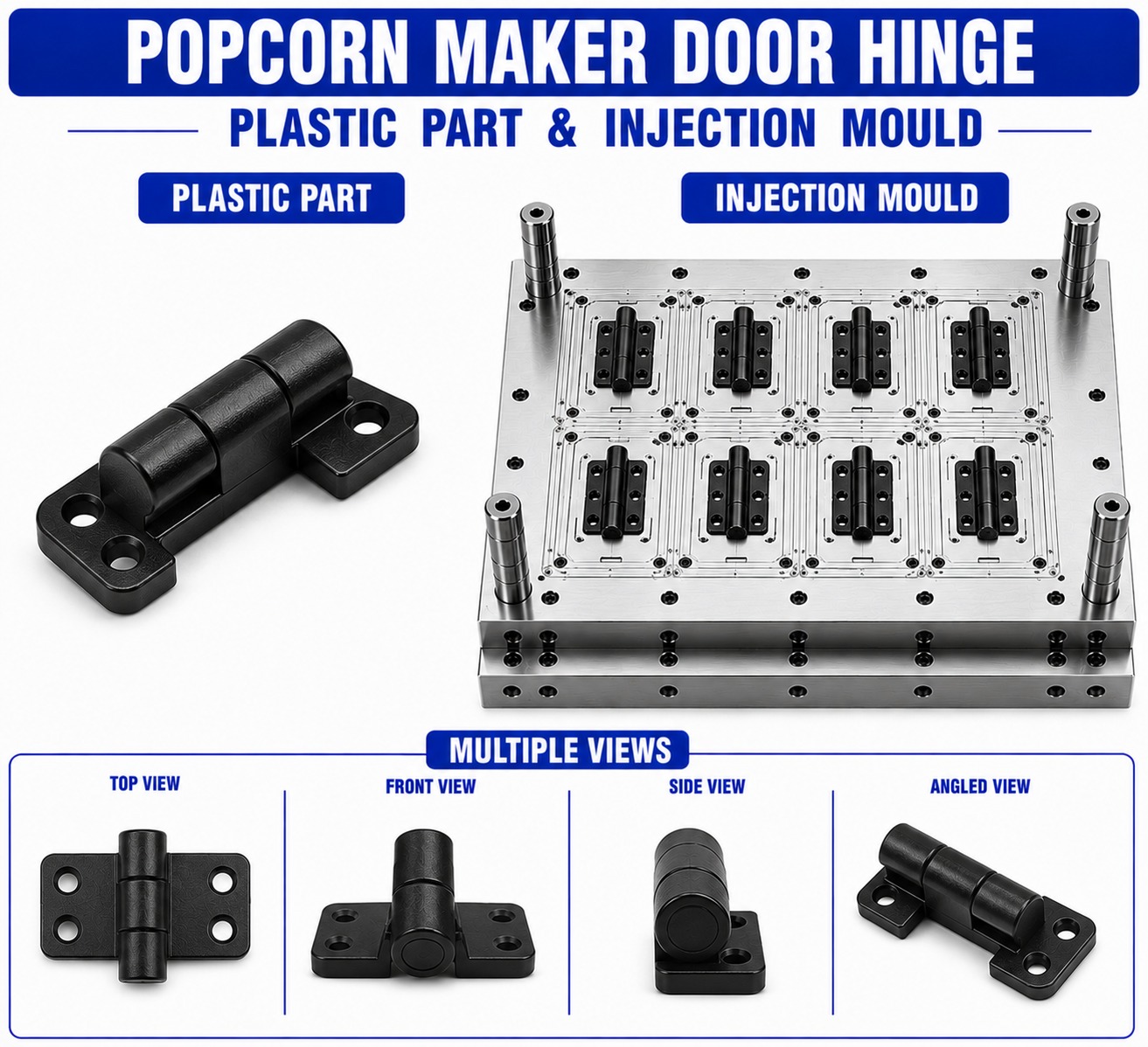
Popcorn Maker Plastic Door Hinge Mould and Moulding Service
₹40.00
Popcorn Maker Plastic Door Hinge Mould and Moulding Service | Renovator Appliances Ltd
Product Overview
Popcorn Maker Plastic Door Hinge Mould and Moulding Service is designed for manufacturing precision-moulded plastic door hinge components used in popcorn-making appliances. The door hinge provides the required pivoting or movement interface between the serving door and the main appliance structure, allowing controlled opening and closing.
The hinge can be customized according to the door weight, hinge geometry, pivot arrangement, mounting method, opening angle, clearances, and assembly requirements. Features such as hinge barrels, pin passages, mounting bosses, locating ribs, retaining clips, and mechanical stops can be incorporated according to the appliance design.
Renovator Appliances Ltd provides customized injection mould development and plastic moulding services for OEM, ODM, and bulk production of popcorn maker plastic components.
Key Features
Precision-moulded plastic door hinge design
Accurate hinge barrel and pivot geometry
Customized mounting and locating features
Suitable for different serving door configurations
Reinforcing ribs for structural support where required
Controlled hinge clearances for smooth movement
Integrated retaining clips or fixing features
Consistent dimensional accuracy
Customized colour and surface finish
Suitable for OEM and bulk production
Material selection based on mechanical and temperature requirements
Industrial Applications
| Application Area | Use |
|---|---|
| Popcorn Makers | Serving door hinge component |
| Electric Popcorn Machines | Door pivot and movement interface |
| Home Popcorn Appliances | Serving/access door mechanism |
| Commercial Popcorn Equipment | Repeated door opening and closing applications |
| Kitchen Appliances | Plastic hinge components |
| OEM Appliance Manufacturing | Customized hinge production |
Manufacturing Process
1. Product Design & Development
The required hinge dimensions, barrel diameter, pin arrangement, door weight, opening angle, mounting points, clearances, stops, and assembly interfaces are reviewed during product development. CAD drawings, physical samples, or technical specifications can be used for customized development.
2. Plastic Mould Design
An injection mould is designed according to the hinge geometry and selected plastic grade. Draft angles, parting lines, gate location, cooling channels, ejection system, shrinkage, and dimensional stability are considered to achieve consistent hinge components.
3. Mould Manufacturing
The mould can be manufactured using suitable tool steels such as P20 Steel, H13 Steel, or S136 Steel, depending on production volume, plastic material, dimensional requirements, surface finish, and expected mould life.
4. Injection Moulding
Selected plastic material is heated and injected into the mould cavity under controlled processing conditions. Injection pressure, melt temperature, cooling time, and cycle parameters are controlled to achieve consistent hinge geometry and dimensional accuracy.
5. Finishing & Assembly Preparation
After moulding, gates and flash are removed. Required trimming, marking, or secondary operations can be carried out. Hinge barrels, pivot passages, mounting features, and retaining elements are checked before assembly.
6. Quality Inspection
Finished hinges are inspected for dimensions, pivot alignment, wall thickness, mounting features, surface finish, warpage, and compatibility with the serving door and appliance body.
Raw Materials
| Material | Typical Application |
|---|---|
| Nylon | Hinges requiring good mechanical strength and wear resistance |
| Glass-Filled Nylon | Higher stiffness and structural loading applications |
| PBT | Applications requiring dimensional and thermal stability |
| ABS | Rigid appliance hinge applications |
| PC+ABS | Applications requiring impact resistance and dimensional stability |
| PP | Lightweight hinge applications |
| Heat-Resistant Engineering Plastic | Applications exposed to elevated temperatures, subject to validation |
| Flame-Retardant Plastic | Applications requiring specified flame-retardant properties, where applicable |
The final material should be selected according to door weight, opening and closing cycles, hinge loading, friction or wear, operating temperature, moisture exposure, and proximity to heated components. Material suitability should be validated against the actual appliance operating conditions.
Quality Control
Raw Material Inspection: Plastic grade, colour, and material consistency are verified.
Mould Inspection: Cavity condition, parting line, cooling system, and ejection mechanism are inspected.
Dimensional Inspection: Hinge barrel, pin passage, mounting points, wall thickness, and critical dimensions are measured.
Alignment Inspection: Hinge axis and mating interfaces are checked for correct alignment.
Movement Inspection: Opening and closing movement is checked for proper clearance and smooth operation.
Visual Inspection: Parts are checked for flash, short shots, sink marks, scratches, burn marks, bubbles, and warpage.
Fitment Inspection: The hinge is checked against the serving door and appliance body.
Functional Inspection: Retention, pivot movement, mounting strength, and other required hinge functions are evaluated.
Packaging Inspection: Finished components are packed to minimize deformation, scratches, and handling damage.
Buyer Guide
When sourcing a Popcorn Maker Plastic Door Hinge Mould and Moulding Service, buyers should consider:
Door weight and loading conditions
Required hinge dimensions
Hinge barrel and pin dimensions
Required opening angle
Number of opening and closing cycles
Mounting and fixing arrangement
Required clearances
Operating temperature
Required plastic grade
Surface finish and colour
Mould material and expected production volume
Single-cavity or multi-cavity mould requirements
Monthly or annual production quantity
OEM, ODM, or customized manufacturing requirements
Why Choose Renovator Appliances Ltd?
Advanced Injection Moulding Facility
Injection moulding capabilities support consistent production of precision plastic hinge components for kitchen and electrical appliances.
In-House Mould Manufacturing
In-house mould development and manufacturing provide better control over hinge geometry, dimensional accuracy, cooling, and ejection requirements.
OEM & ODM Manufacturing
Customized door hinges can be developed according to customer drawings, CAD files, physical samples, and technical specifications.
Quality Assurance
Inspection of raw materials, moulds, dimensions, alignment, movement, appearance, fitment, and functional features helps maintain consistent production quality.
Cost-Effective Manufacturing
Optimized mould design and controlled injection moulding processes can support economical production for prototype development and bulk OEM requirements.
Frequently Asked Questions
1. What is Popcorn Maker Plastic Door Hinge Mould and Moulding Service?
It is a customized mould manufacturing and injection moulding service for producing plastic hinge components used to connect and provide controlled movement to the serving door of a popcorn maker.
2. Which plastic material is suitable for a door hinge?
Nylon, Glass-Filled Nylon, PBT, ABS, PC+ABS, PP, and suitable heat-resistant engineering plastics can be considered depending on door weight, cycle requirements, wear, temperature, and mechanical loading.
3. Can the door hinge dimensions be customized?
Yes. Hinge barrel dimensions, pin passage, mounting points, ribs, stops, clearances, opening angle, colour, and surface finish can be customized according to the appliance design.
4. Can the hinge be designed for repeated opening and closing?
Yes. The hinge geometry and material can be selected and developed according to the expected door weight, movement, number of cycles, loading, friction, and operating environment.
5. Which mould materials can be used?
P20 Steel, H13 Steel, and S136 Steel can be selected according to production volume, plastic material, dimensional requirements, surface finish, and expected mould life.
- SKU
- REN-B2313E83438C16561D4FFC17