INDUSTRIAL PRODUCT
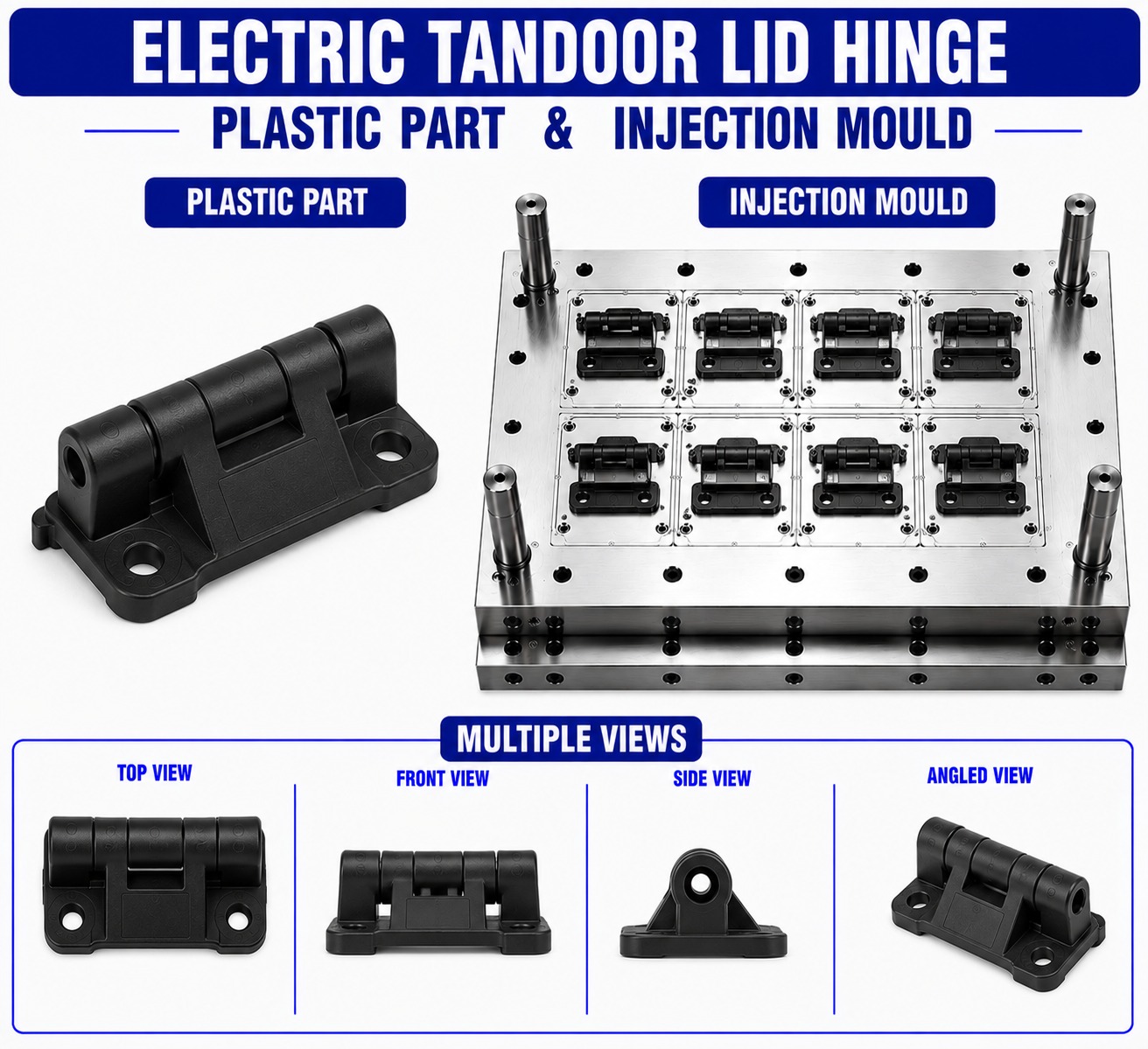
Electric Tandoor Plastic Lid Hinge Mould and Moulding Service
₹50.00
Electric Tandoor Plastic Lid Hinge Mould and Moulding Service | Renovator Appliances Ltd
Product Overview
Electric Tandoor Plastic Lid Hinge is a precision-molded plastic component designed to support the opening, closing, positioning, and controlled movement of the lid of an electric tandoor. The hinge provides a defined connection between the lid and the main appliance body while helping maintain proper alignment during repeated operation.
Renovator Appliances Ltd provides Electric Tandoor Plastic Lid Hinge Mould and Moulding Service for OEM and customized electric tandoor applications. The hinge can be developed with hinge barrels, pin passages, locating features, mounting bosses, reinforcing ribs, stops, and retention features according to the appliance design.
Because the lid hinge may be exposed to heat, repeated movement, and mechanical loading, material selection and hinge geometry should be validated according to the actual operating temperature, lid weight, opening/closing cycles, and assembly requirements.
Key Features
Designed for electric tandoor lid opening and closing mechanisms.
Supports controlled movement and positioning of the lid.
Accurate hinge barrel and pin interface geometry.
Mounting bosses, fixing holes, ribs, stops, and locating features can be customized.
Reinforcing ribs can be incorporated to improve structural strength.
Designed for consistent alignment between lid and appliance body.
Suitable for repeated opening and closing applications when the selected material and design are properly validated.
Smooth moulded surfaces can support proper hinge movement and assembly.
Colour, surface finish, and external geometry can be customized.
Suitable for OEM, ODM, and customized electric tandoor manufacturing.
Industrial Applications
| Application | Use |
|---|---|
| Electric Tandoors | Lid hinge and movement mechanism |
| Electric Ovens | Hinged lid or door support applications |
| OTG Appliances | Lid and door hinge components |
| Kitchen Cooking Appliances | Hinged cover support |
| Countertop Heating Appliances | Lid positioning and movement |
| OEM Appliance Manufacturing | Customized plastic hinge production |
Manufacturing Process
1. Product Design & Development
The lid hinge is designed according to the lid weight, hinge-pin dimensions, opening angle, mounting arrangement, available installation space, and required movement. Hinge barrel geometry, pin clearance, mechanical stops, and reinforcing features are considered during product development.
2. Plastic Mould Design
A precision injection mould is designed according to the hinge geometry and selected plastic material. Parting line, gate location, draft angles, ejection system, cooling channels, wall thickness, and shrinkage allowance are considered to achieve accurate and repeatable moulding.
3. Mould Manufacturing
The mould can be manufactured using suitable mould steels such as P20 Steel, H13 Steel, or S136 Steel, depending on production volume, durability, dimensional requirements, and surface-finish requirements.
CNC machining, EDM, drilling, polishing, mould fitting, and trial moulding can be carried out as required.
4. Injection Moulding
The selected engineering or heat-resistant plastic is processed through an injection moulding machine. Injection temperature, pressure, holding pressure, cooling time, and cycle parameters are controlled to achieve consistent dimensions and structural quality.
5. Finishing & Assembly Preparation
After moulding, components are inspected and trimmed where required. Flash, excessive gate marks, sharp edges, sink marks, and other moulding imperfections are controlled before the hinge is prepared for assembly.
6. Quality Inspection
Finished hinges are checked for critical dimensions, hinge-pin fit, mounting features, alignment, surface quality, and mechanical integrity. Sample components can also be evaluated with the lid and appliance body to verify movement and fitment.
Raw Materials
| Material | Typical Use |
|---|---|
| PBT | Suitable where dimensional stability and thermal performance are required |
| Nylon (PA) | Can be selected for mechanical strength and repeated movement applications |
| Glass-Filled Nylon | Suitable for reinforced hinge structures requiring increased rigidity |
| PC+ABS | Used where impact strength and dimensional stability are required |
| ABS | Suitable where operating temperature remains within the material's validated range |
| PP | Can be considered for suitable lower-load hinge applications |
| Heat-Resistant Engineering Plastic | Suitable for applications involving elevated temperatures |
| Flame-Retardant Plastic | Can be selected where enhanced resistance to ignition or flame propagation is required |
The final material should be selected according to the actual lid weight, hinge loading, operating temperature, repeated-cycle requirements, surrounding heat exposure, and appliance design. Plastic suitability near heating components should always be validated for the actual operating conditions.
Quality Control
Renovator Appliances Ltd follows controlled inspection procedures for Electric Tandoor Plastic Lid Hinge production:
Raw Material Inspection: Plastic grade and incoming material quality are checked according to production requirements.
Mould Inspection: Cavity condition, hinge geometry, ejection system, and critical mould dimensions are inspected.
Dimensional Inspection: Hinge barrel diameter, pin passage, mounting holes, locating features, and critical dimensions are verified.
Visual Inspection: Components are checked for flash, cracks, sink marks, short shots, burn marks, warpage, and other surface defects.
Fitment Inspection: Sample parts can be assembled with the hinge pin, lid, and appliance body to check alignment and movement.
Functional Inspection: Opening and closing movement can be evaluated according to customer-defined requirements.
Thermal Suitability Review: Material and hinge performance should be validated against actual operating temperatures and heat exposure.
Packaging Inspection: Finished components are appropriately packed to prevent deformation, scratches, and handling damage.
Buyer Guide
When sourcing an Electric Tandoor Plastic Lid Hinge, buyers should consider:
Lid Weight: Provide the approximate lid weight and load transferred through the hinge.
Hinge Pin: Share hinge-pin diameter, length, material, and required clearance.
Mounting Details: Provide screw-hole positions, bosses, slots, or other fixing requirements.
Opening Angle: Specify the required lid opening angle and any mechanical stopping arrangement.
Operating Temperature: Provide expected continuous and peak temperature exposure.
Material Requirement: Select a suitable engineering, heat-resistant, or reinforced plastic based on application conditions.
Cycle Requirement: Consider the expected number of opening and closing cycles.
Assembly Clearance: Maintain appropriate clearances between moving hinge components and nearby hot or electrical parts.
Production Quantity: Select mould configuration according to expected production volume.
Why Choose Renovator Appliances Ltd?
Advanced Injection Moulding Facility
Renovator Appliances Ltd supports precision plastic component manufacturing using controlled injection moulding processes for appliance and functional mechanical components.
In-House Mould Manufacturing
Our mould manufacturing capability supports customized plastic lid hinge designs with application-specific hinge geometry, mounting features, and dimensional requirements.
OEM & ODM Manufacturing
We support OEM and ODM requirements from product development and mould manufacturing through injection moulding and production supply.
Quality Assurance
Dimensional, visual, fitment, and functional inspections help maintain consistent quality for molded hinge components.
Cost-Effective Manufacturing
Optimized mould design, appropriate material selection, and repeatable injection moulding processes can support economical production for customized electric tandoor lid hinge components.
Frequently Asked Questions
1. What is an Electric Tandoor Plastic Lid Hinge?
It is a molded plastic hinge component used to connect and support the lid of an electric tandoor while allowing controlled opening and closing movement.
2. Which materials can be used for a plastic lid hinge?
Depending on the application, PBT, Nylon, Glass-Filled Nylon, PC+ABS, ABS, PP, or suitable heat-resistant engineering plastics may be considered. The final material should be selected based on load, temperature, and cycle requirements.
3. Can the Electric Tandoor Plastic Lid Hinge be customized?
Yes. Hinge barrel dimensions, pin diameter, mounting holes, bosses, ribs, stops, locating features, colour, and overall geometry can be customized according to the appliance design.
4. Can Renovator manufacture the hinge mould?
Yes. Renovator Appliances Ltd provides mould manufacturing and injection moulding services for customized Electric Tandoor Plastic Lid Hinge requirements.
5. What information is required to manufacture the hinge?
A 2D drawing, 3D CAD model, sample component, lid weight, hinge-pin dimensions, mounting details, opening angle, operating temperature, material requirement, production quantity, and fitment requirements are useful for accurate development.
- SKU
- REN-67F3F1CC523B5F7F7AFF2C59