INDUSTRIAL PRODUCT
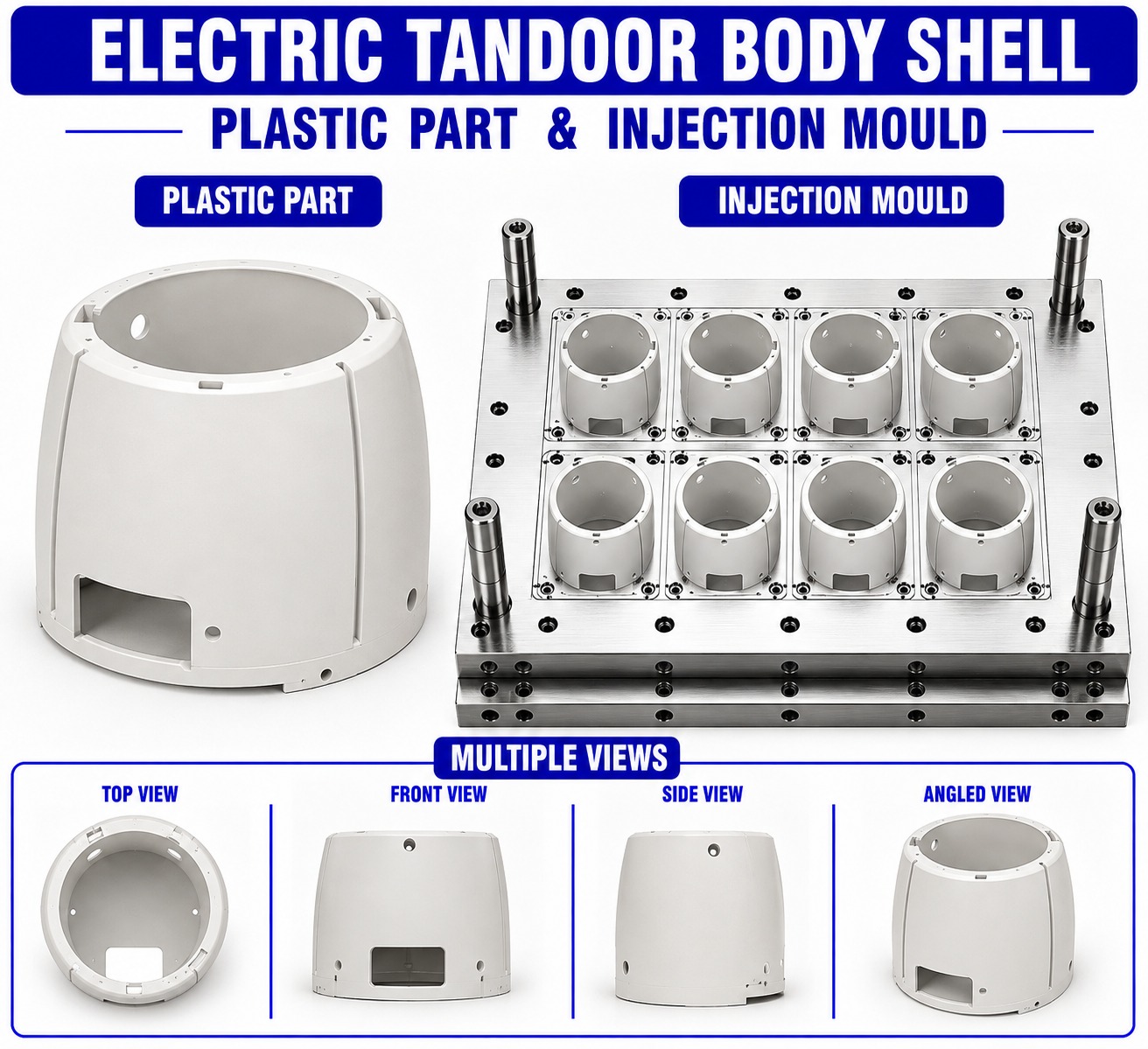
Electric Tandoor Plastic Body Shell Mould and Moulding Service
₹500.00
Electric Tandoor Plastic Body Shell Mould and Moulding Service | Renovator Appliances Ltd
Product Overview
Electric Tandoor Plastic Body Shell Mould and Moulding Service is designed for manufacturing customized plastic outer body shells used in electric tandoors and related kitchen heating appliances. The body shell forms the main external enclosure of the appliance and can accommodate or support the control panel, lid assembly, ventilation components, handles, internal supports, wiring passages, and other associated parts.
Renovator Appliances Ltd. provides customized mould development and injection moulding solutions according to required body dimensions, appliance geometry, wall thickness, mounting arrangement, ventilation openings, control-panel integration, colour, texture, and surface-finish requirements.
The body shell can be developed with mounting bosses, screw posts, ribs, locating features, snap-fits, cable-entry provisions, ventilation openings, and interfaces for other appliance components. Since an electric tandoor operates around heat-generating components, the plastic grade should be selected and validated according to the actual temperature exposure and location of the body shell.
Key Features
Customized Electric Tandoor Plastic Body Shell production
Designed according to the overall appliance enclosure geometry
Accurate integration with control panels, lid assemblies, and internal components
Customized mounting bosses, screw posts, ribs, clips, and locating features
Provisions for ventilation and cable routing where required
Consistent wall thickness and dimensional accuracy
Customized colour, texture, gloss, and surface finish
Suitable structural support for associated appliance components
Designed for proper fitment with mating enclosure parts
Suitable for OEM, ODM, and customized appliance manufacturing
Material selection based on thermal, mechanical, electrical, and appearance requirements
Injection moulding suitable for repeatable batch production
Industrial Applications
| Application | Usage |
|---|---|
| Electric Tandoors | Main external appliance body |
| Electric Ovens | Outer enclosure and body shell |
| OTG Appliances | Plastic external housing |
| Kitchen Heating Appliances | Main plastic enclosure |
| Countertop Cooking Appliances | External body construction |
| OEM Appliance Manufacturing | Customized plastic body shell production |
Manufacturing Process
1. Product Design & Development
The required body-shell dimensions, overall appliance geometry, component interfaces, mounting arrangement, ventilation openings, wall thickness, surface finish, and assembly requirements are reviewed. The design can be developed according to a customer sample, technical drawing, or 3D CAD model.
2. Plastic Mould Design
A precision injection mould is designed according to the body shell geometry. Parting line, wall thickness, ribs, bosses, mounting points, gate locations, cooling channels, draft angles, and ejection arrangement are carefully considered to support stable moulding and dimensional consistency.
3. Mould Manufacturing
The mould is manufactured using suitable mould steel such as P20 Steel, H13 Steel, or S136 Steel depending on production volume, surface-finish requirements, material selection, and expected mould life. CNC machining, EDM, drilling, grinding, polishing, mould fitting, and trial processes can be carried out as required.
4. Injection Moulding
The selected plastic material is processed through an injection moulding machine. Injection pressure, melt temperature, holding pressure, cooling time, and other moulding parameters are controlled according to the selected material and body-shell design.
5. Finishing & Assembly Preparation
After moulding, gates and runners are removed and the body shells are visually inspected. Required trimming, marking, surface finishing, or other secondary operations can be carried out according to the product specification.
6. Quality Inspection
Finished body shells are inspected for overall dimensions, wall thickness, mounting features, ventilation openings, surface appearance, warpage, and fitment with corresponding appliance components.
Raw Materials
| Material | Application / Benefit |
|---|---|
| ABS | Suitable for rigid and aesthetically finished appliance body shells |
| PP | Lightweight option for suitable enclosure applications |
| HIPS | Suitable for economical rigid appliance housings |
| PC+ABS | Suitable where improved impact and dimensional performance are required |
| PC | Can be considered where higher impact performance is required |
| PBT | Suitable for applications requiring dimensional stability and heat resistance |
| Flame-Retardant Plastic | Can be considered where enhanced flame-retardant characteristics are required |
| Heat-Resistant Engineering Plastic | Can be selected for body-shell areas exposed to elevated temperatures |
The final plastic grade should be selected according to the actual operating temperature, proximity to heating elements, mechanical loading, impact requirements, electrical environment, ventilation conditions, and applicable product requirements.
Quality Control
Raw Material Inspection: Material grade, colour, and batch consistency are checked before production.
Mould Inspection: Cavity, core, parting surfaces, ejector system, cooling channels, and critical mould details are inspected.
Dimensional Inspection: Overall length, width, height, wall thickness, mounting points, and critical interface dimensions are checked.
Assembly Fitment Inspection: The body shell is checked for proper fitment with control panels, lids, bases, covers, handles, and other mating components.
Mounting Feature Inspection: Screw bosses, clips, ribs, locating points, and fixing features are checked according to the design.
Ventilation Opening Inspection: Required air vents, slots, or openings are inspected for dimensional accuracy.
Visual Inspection: Flash, sink marks, warpage, scratches, weld lines, colour variation, and other surface defects are inspected.
Surface Finish Inspection: Texture, gloss, colour consistency, and overall appearance are checked where applicable.
Packaging Inspection: Finished body shells are packed carefully to minimize scratches, deformation, and handling damage.
Buyer Guide
When sourcing Electric Tandoor Plastic Body Shell Mould and Moulding Service, buyers should provide the required body-shell dimensions, appliance layout, mounting arrangement, ventilation requirements, control-panel interface, lid/base interface, material preference, colour, surface finish, and expected production quantity.
A physical sample, technical drawing, or 3D CAD model can be used for accurate mould development. Buyers should also provide information about the location of heating elements and the expected temperature around the body shell so that an appropriate material grade can be evaluated.
For large body-shell components, proper consideration of wall thickness, ribs, draft angles, shrinkage, mould flow, cooling, and warpage control is important for achieving consistent production results.
Why Choose Renovator Appliances Ltd?
Advanced Injection Moulding Facility
Renovator Appliances Ltd. provides injection moulding solutions for customized appliance body shells and other electric tandoor plastic components.
In-House Mould Manufacturing
Mould development and manufacturing support help maintain coordination between large-part geometry, mould design, cooling requirements, component fitment, and production.
OEM & ODM Manufacturing
Body shells can be customized according to customer drawings, samples, dimensions, appliance layouts, colours, textures, and assembly specifications.
Quality Assurance
Dimensional, visual, fitment, mounting-feature, and process inspections help maintain consistent body-shell quality across production batches.
Cost-Effective Manufacturing
Optimized mould design, suitable cavity configuration, controlled injection moulding parameters, and efficient production planning can support economical manufacturing for volume requirements.
Frequently Asked Questions
1. What is an Electric Tandoor Plastic Body Shell?
It is the main moulded plastic outer enclosure of an electric tandoor that provides the external body structure and interfaces with components such as the control panel, lid, base, ventilation parts, and internal assemblies.
2. Which plastic materials can be used for the body shell?
ABS, PP, HIPS, PC+ABS, PC, PBT, flame-retardant plastics, and suitable heat-resistant engineering plastics can be considered according to the appliance's thermal, mechanical, electrical, and appearance requirements.
3. Can the body shell be customized according to our appliance design?
Yes. Overall dimensions, mounting points, ventilation openings, control-panel interfaces, ribs, bosses, clips, colour, texture, and surface finish can be customized according to the appliance design.
4. Which mould steel can be used for manufacturing the body-shell mould?
P20 Steel, H13 Steel, and S136 Steel can be considered depending on component size, production volume, required mould life, surface-finish requirements, material selection, and mould design.
5. Can Renovator manufacture both the body-shell mould and moulded plastic components?
Yes. Renovator Appliances Ltd. can provide customized mould development and injection moulding support for Electric Tandoor Plastic Body Shell production.
- SKU
- REN-CC5A6B4824EFA4558C62D006