INDUSTRIAL PRODUCT
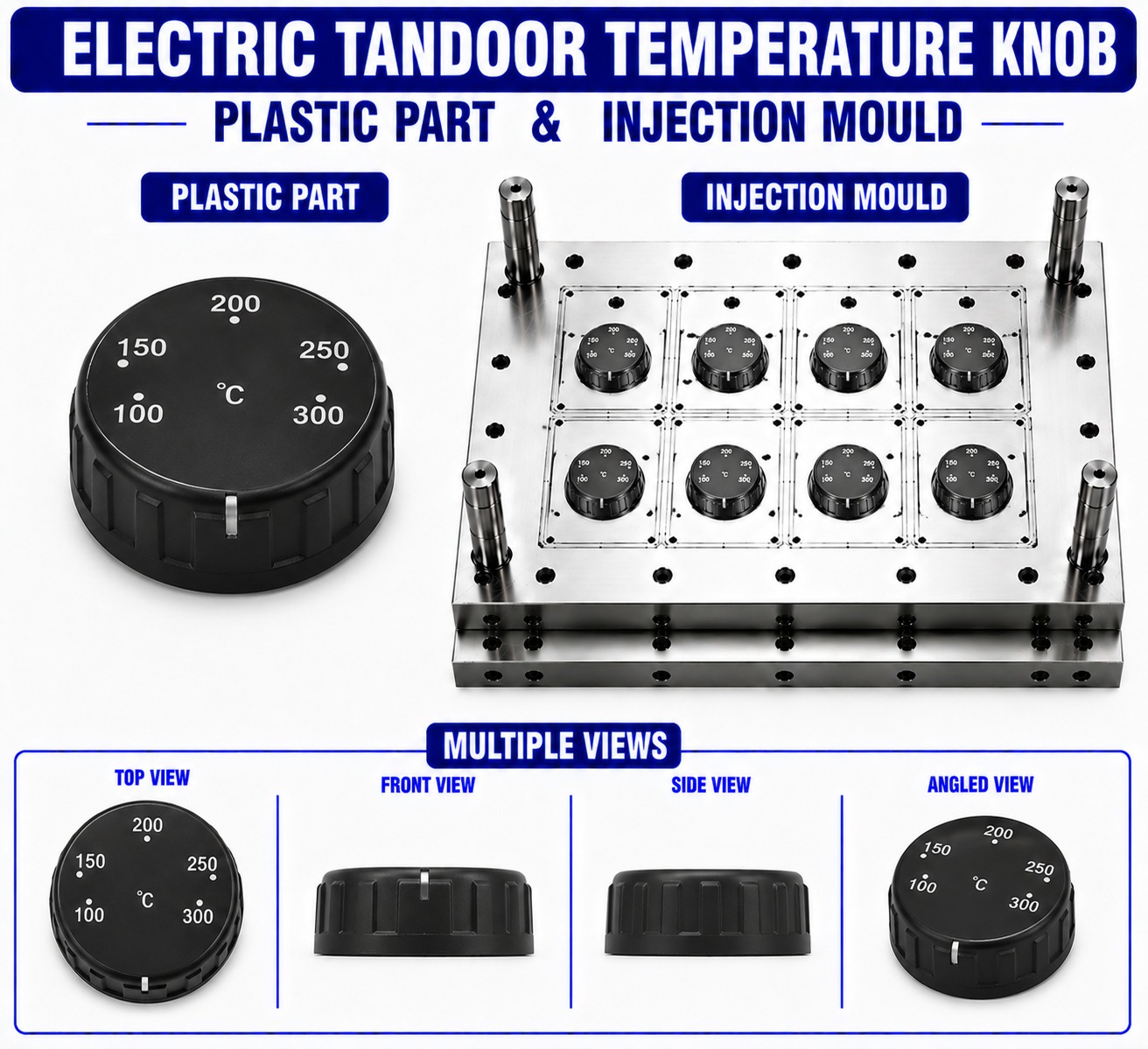
Electric Tandoor Plastic Temperature Knob Mould and Moulding Service
₹20.00
Electric Tandoor Plastic Temperature Knob Mould and Moulding Service | Renovator Appliances Ltd
Product Overview
Electric Tandoor Plastic Temperature Knob Mould and Moulding Service is designed for manufacturing durable and accurately moulded plastic temperature control knobs used in electric tandoors and related heating appliances. The temperature knob provides a user-friendly interface for adjusting the desired cooking temperature through a thermostat or temperature-control mechanism.
Renovator Appliances Ltd. provides customized plastic mould development and injection moulding solutions for temperature knobs according to the required diameter, height, shaft interface, rotation angle, marking arrangement, colour, surface finish, and assembly requirements. The component can be developed with suitable internal fitting features such as D-shaped holes, keyed profiles, slots, ribs, or other customized interfaces for secure engagement with the control shaft.
Material selection can be customized according to the knob's operating environment, especially where the component is positioned near heated surfaces. Dimensional accuracy, rotational fit, appearance, and repeatable production are considered during mould and moulding development.
Key Features
Customized Electric Tandoor Plastic Temperature Knob production
Accurate shaft and knob interface for proper assembly
Ergonomic outer profile for comfortable manual operation
Suitable provisions for temperature markings and indicators
Consistent dimensions and repeatable moulding quality
Customized colour, texture, gloss, and surface finish
Internal ribs, slots, keyways, or locating features can be incorporated
Strong retention and secure fit on the control shaft
Suitable for OEM, ODM, and customized appliance manufacturing
Material selection based on temperature, mechanical, and application requirements
Injection moulding process suitable for consistent batch production
Industrial Applications
| Application | Usage |
|---|---|
| Electric Tandoors | Temperature adjustment and control |
| OTG Appliances | Temperature control interface |
| Electric Ovens | Thermostat or temperature-control knob |
| Heating Appliances | Manual temperature adjustment |
| Kitchen Appliances | Rotary control applications |
| OEM Appliance Manufacturing | Customized temperature knob production |
Manufacturing Process
1. Product Design & Development
The required temperature knob dimensions, shaft interface, outer profile, markings, rotation requirements, and assembly details are reviewed. The component design can be customized according to the appliance control mechanism.
2. Plastic Mould Design
A precision injection mould is designed according to the knob geometry. Important areas such as the internal shaft interface, retaining features, wall thickness, parting line, gate location, cooling arrangement, and ejection system are considered.
3. Mould Manufacturing
The mould is manufactured using suitable mould steel such as P20 Steel, H13 Steel, or S136 Steel depending on production volume, surface requirements, and application needs. CNC machining, EDM, drilling, grinding, polishing, and mould fitting processes are used as required.
4. Injection Moulding
The selected plastic material is processed through an injection moulding machine. Controlled injection pressure, temperature, cooling time, and moulding parameters help achieve consistent knob dimensions and surface quality.
5. Finishing & Assembly Preparation
After moulding, runners or gates are removed and the components are visually checked. Additional processes such as printing, laser marking, hot stamping, or other marking methods can be considered when required for temperature indicators or branding.
6. Quality Inspection
Finished knobs are inspected for dimensions, shaft fitment, rotational interface, appearance, markings, surface defects, and consistency before packing.
Raw Materials
| Material | Application / Benefit |
|---|---|
| ABS | Suitable for rigid and aesthetically finished control knobs |
| PP | Lightweight option with good chemical resistance |
| HIPS | Suitable for economical rigid appliance components |
| PC+ABS | Suitable where improved impact and dimensional performance are required |
| PBT | Suitable for applications requiring dimensional stability and heat resistance |
| Nylon / PA | Suitable for stronger mechanical interfaces |
| Heat-Resistant Engineering Plastic | Can be selected for applications exposed to elevated temperatures |
| Flame-Retardant Plastic | Can be considered where the appliance design requires enhanced flame-retardant characteristics |
The final material should be selected according to the actual operating temperature, distance from heating elements, shaft mechanism, required strength, electrical environment, and applicable product requirements.
Quality Control
Raw Material Inspection: Material grade and batch consistency are checked before production.
Mould Inspection: Mould cavities, core details, ejectors, parting surfaces, and cooling arrangements are inspected.
Dimensional Inspection: Outer diameter, height, shaft opening, internal profile, and critical dimensions are checked.
Fitment Inspection: Knob-to-shaft engagement and retention are evaluated according to the assembly design.
Rotational Inspection: The knob's rotation and interface with the temperature-control mechanism are checked.
Visual Inspection: Surface finish, colour, flash, sink marks, warpage, scratches, and other visible defects are inspected.
Marking Inspection: Temperature indicators, symbols, or printed markings are checked where applicable.
Packaging Inspection: Finished components are packed to minimize scratches, deformation, and handling damage.
Buyer Guide
When sourcing Electric Tandoor Plastic Temperature Knob Mould and Moulding Service, buyers should provide the required knob dimensions, shaft diameter/profile, rotation angle, temperature marking arrangement, colour, surface finish, material preference, and estimated annual or batch quantity.
For accurate mould development, a sample component, drawing, 3D CAD model, or reference dimensions can be used. Buyers should also specify the operating temperature around the knob so that an appropriate plastic material can be considered.
For high-volume production, cavity selection and mould design can be optimized according to the required production quantity and cycle requirements.
Why Choose Renovator Appliances Ltd?
Advanced Injection Moulding Facility
Renovator Appliances Ltd. provides injection moulding solutions for customized plastic appliance components with controlled production parameters.
In-House Mould Manufacturing
Mould development and manufacturing support help maintain better coordination between component design, mould geometry, and production requirements.
OEM & ODM Manufacturing
Customized temperature knobs can be developed according to customer drawings, samples, specifications, branding, and assembly requirements.
Quality Assurance
Dimensional, visual, fitment, and functional checks help maintain consistent component quality across production batches.
Cost-Effective Manufacturing
Optimized mould design, suitable cavity selection, and repeatable injection moulding processes can help achieve economical production for both initial and volume requirements.
Frequently Asked Questions
1. What is an Electric Tandoor Plastic Temperature Knob?
It is a moulded plastic control component used to manually adjust the temperature setting of an electric tandoor through its thermostat or temperature-control mechanism.
2. Which plastic materials can be used for the temperature knob?
ABS, PP, HIPS, PC+ABS, PBT, Nylon, and suitable heat-resistant engineering plastics can be considered depending on the application's temperature, mechanical, and surface-finish requirements.
3. Can the temperature knob be customized according to our design?
Yes. The knob can be customized according to required dimensions, shaft profile, colour, markings, surface texture, grip design, and assembly interface.
4. Which mould steel can be used for manufacturing the knob mould?
P20 Steel, H13 Steel, and S136 Steel can be considered depending on production volume, surface-finish requirements, mould life, and application needs.
5. Can Renovator manufacture both the mould and plastic temperature knobs?
Yes. Renovator Appliances Ltd. can provide mould development and injection moulding support for customized Electric Tandoor Plastic Temperature Knob production.
- SKU
- REN-DE29E8202F57B797B2F85D3E