INDUSTRIAL PRODUCT
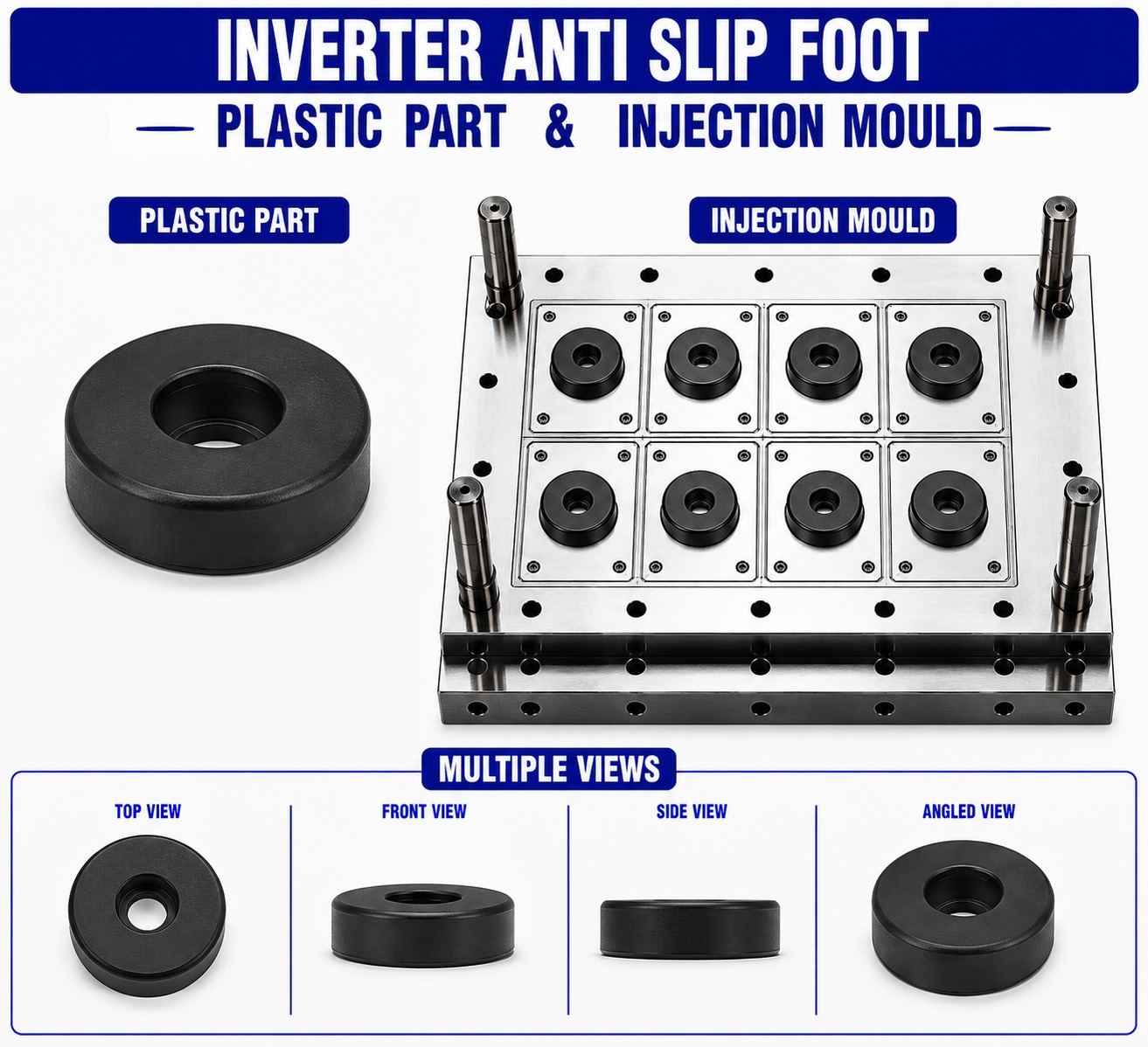
Inverter Plastic Anti Slip Foot Mould and Moulding Service
₹20.00
Inverter Plastic Anti Slip Foot Mould and Moulding Service | Renovator Appliances Ltd
Product Overview
The Inverter Plastic Anti Slip Foot is a support component designed to provide stable contact between the inverter enclosure and the installation surface. It helps maintain proper ground clearance, supports the inverter body, and can reduce unwanted movement or sliding during handling and normal operation.
Renovator Appliances Ltd. provides Inverter Plastic Anti Slip Foot Mould and Moulding Service for OEM and customized inverter applications. The foot can be developed with suitable mounting holes, locating features, ribs, retention elements, and a textured or grip-oriented contact surface according to the enclosure design.
Depending on the application, the component can be produced as a rigid plastic foot or designed with a suitable flexible/elastic contact material where additional anti-slip characteristics are required. Material selection should be validated according to the inverter weight, surface condition, vibration, temperature, and expected service environment.
Key Features
Supports the inverter enclosure from the installation surface
Helps maintain required ground clearance
Designed to improve stability and reduce unwanted movement
Can be customized according to inverter enclosure geometry
Available with mounting holes, slots, clips, or locating features
Reinforcing ribs can be incorporated for improved structural support
Contact surface can be designed with suitable grip-oriented texture
Suitable for different inverter sizes and enclosure configurations
Can be manufactured in customized colours and dimensions
Suitable for OEM and high-volume production requirements
Industrial Applications
| Application | Usage |
|---|---|
| Inverter Manufacturing | Supporting and stabilizing inverter enclosures |
| Solar Inverters | Providing stable base contact |
| UPS Systems | Supporting electrical enclosure assemblies |
| Power Backup Systems | Maintaining ground clearance and stability |
| Power Electronics Equipment | Base support and positioning |
| Electrical Control Equipment | Anti-slip enclosure support |
| OEM Electrical Products | Customized support foot applications |
Manufacturing Process
1. Product Design & Development
The anti-slip foot is developed according to the inverter enclosure dimensions, overall equipment weight, mounting arrangement, installation surface, required ground clearance, and expected operating conditions. Load-bearing areas, mounting features, contact geometry, and retention details are considered during product development.
2. Plastic Mould Design
A precision mould is designed according to the final foot geometry. Cavity configuration, parting line, gate location, ejection arrangement, cooling channels, shrinkage allowance, and critical mounting dimensions are considered for consistent production.
3. Mould Manufacturing
The mould can be manufactured using suitable tool steels such as P20 Steel, H13 Steel, or S136 Steel depending on production volume, material selection, surface requirements, and expected mould life. CNC machining, EDM, grinding, polishing, and mould fitting are carried out as required.
4. Injection Moulding
The selected material is heated and injected into the mould cavity under controlled processing conditions. Injection pressure, melt temperature, cooling time, and cycle parameters are optimized according to the selected material and component design.
5. Finishing & Assembly Preparation
After moulding, the components are checked for gate vestiges, flash, surface condition, and mounting features. Any required trimming or finishing is performed before the parts are prepared for assembly.
6. Quality Inspection
Finished anti-slip feet are inspected for dimensions, mounting accuracy, appearance, structural consistency, contact surface condition, and fitment with the intended inverter enclosure.
Raw Materials
| Material | Suitable Characteristics |
|---|---|
| PP (Polypropylene) | Lightweight and suitable for general base support applications |
| ABS | Provides good rigidity and dimensional stability |
| Nylon / PA | Suitable for applications requiring higher mechanical strength |
| Glass-Filled Nylon | Suitable for higher load-bearing and dimensional stability requirements |
| PBT | Suitable for engineering and electrical applications |
| PC+ABS | Provides a balance of strength, impact resistance, and dimensional stability |
| TPE / TPU | Suitable where a flexible and grip-oriented contact surface is required |
| EPDM / Suitable Elastomer | Can be considered for flexible anti-slip contact applications subject to design and environmental requirements |
| Flame-Retardant Plastic | Can be selected where enhanced flame-resistance characteristics are required |
The final material or material combination should be selected according to inverter weight, static and dynamic loading, floor/surface condition, temperature, vibration, chemical exposure, and required grip characteristics.
Quality Control
Renovator Appliances Ltd. can implement multiple inspection stages for consistent Inverter Plastic Anti Slip Foot production:
Raw Material Inspection: Verification of material grade, specification, and batch consistency.
Mould Inspection: Checking cavity condition, mould alignment, ejection, and cooling performance.
Dimensional Inspection: Verification of overall dimensions, mounting holes, height, contact area, and critical locating features.
Visual Inspection: Checking for flash, sink marks, short moulding, cracks, warpage, burn marks, and surface defects.
Fitment & Functional Inspection: Checking mounting, enclosure fitment, ground clearance, stability, and contact performance as applicable.
Packaging Inspection: Proper packing to prevent deformation, contamination, and damage during storage and transportation.
Buyer Guide
When sourcing an Inverter Plastic Anti Slip Foot, buyers should provide the inverter weight, foot dimensions, mounting method, required ground clearance, mounting-hole dimensions, installation surface, number of feet per unit, material preference, colour, and expected production quantity.
For accurate mould development, an existing sample, 2D drawing, 3D CAD model, or technical specification can be provided. If the foot is expected to withstand significant static or dynamic loads, the design and material should be validated against the actual loading and operating conditions.
For applications requiring higher grip, buyers should also specify whether the anti-slip function will be achieved through rigid textured plastic, a flexible elastomeric material, or a separate bonded/contact layer.
Why Choose Renovator Appliances Ltd?
Advanced Injection Moulding Facility
Our injection moulding capabilities support production of customized plastic support components in different sizes, geometries, and material grades.
In-House Mould Manufacturing
Our mould manufacturing capability supports customized anti-slip foot mould development according to customer drawings, samples, and enclosure requirements.
OEM & ODM Manufacturing
We support OEM and ODM production based on customer CAD models, drawings, samples, specifications, and application requirements.
Quality Assurance
Dimensional, visual, material, fitment, and functional inspections help maintain consistent component quality throughout production.
Cost-Effective Manufacturing
Optimized mould design, appropriate material selection, cavity planning, and controlled injection moulding processes help support economical production for prototype and volume requirements.
Frequently Asked Questions
1. What is an Inverter Plastic Anti Slip Foot?
It is a support component fitted to the bottom of an inverter enclosure to provide ground clearance, improve stability, and help reduce unwanted movement on the installation surface.
2. Which materials can be used for an anti-slip foot?
PP, ABS, Nylon, Glass-Filled Nylon, PBT, PC+ABS, TPE, TPU, and suitable elastomeric materials can be considered depending on the required load, flexibility, grip, temperature, and environmental conditions.
3. Can the anti-slip foot be customized?
Yes. Dimensions, mounting holes, height, contact surface, ribs, locating features, retention details, colour, and other design parameters can be customized according to the inverter enclosure.
4. Can a flexible material be used for better anti-slip performance?
Yes. Where additional grip or cushioning is required, a suitable flexible material such as TPE or TPU can be considered, subject to the product design and operating environment.
5. Does Renovator provide mould manufacturing and injection moulding services?
Yes. Renovator Appliances Ltd. provides mould development and moulding services for customized Inverter Plastic Anti Slip Foot requirements, subject to final product design and technical specifications.
- SKU
- REN-C4DC0C52670C9660C837AA58