INDUSTRIAL PRODUCT
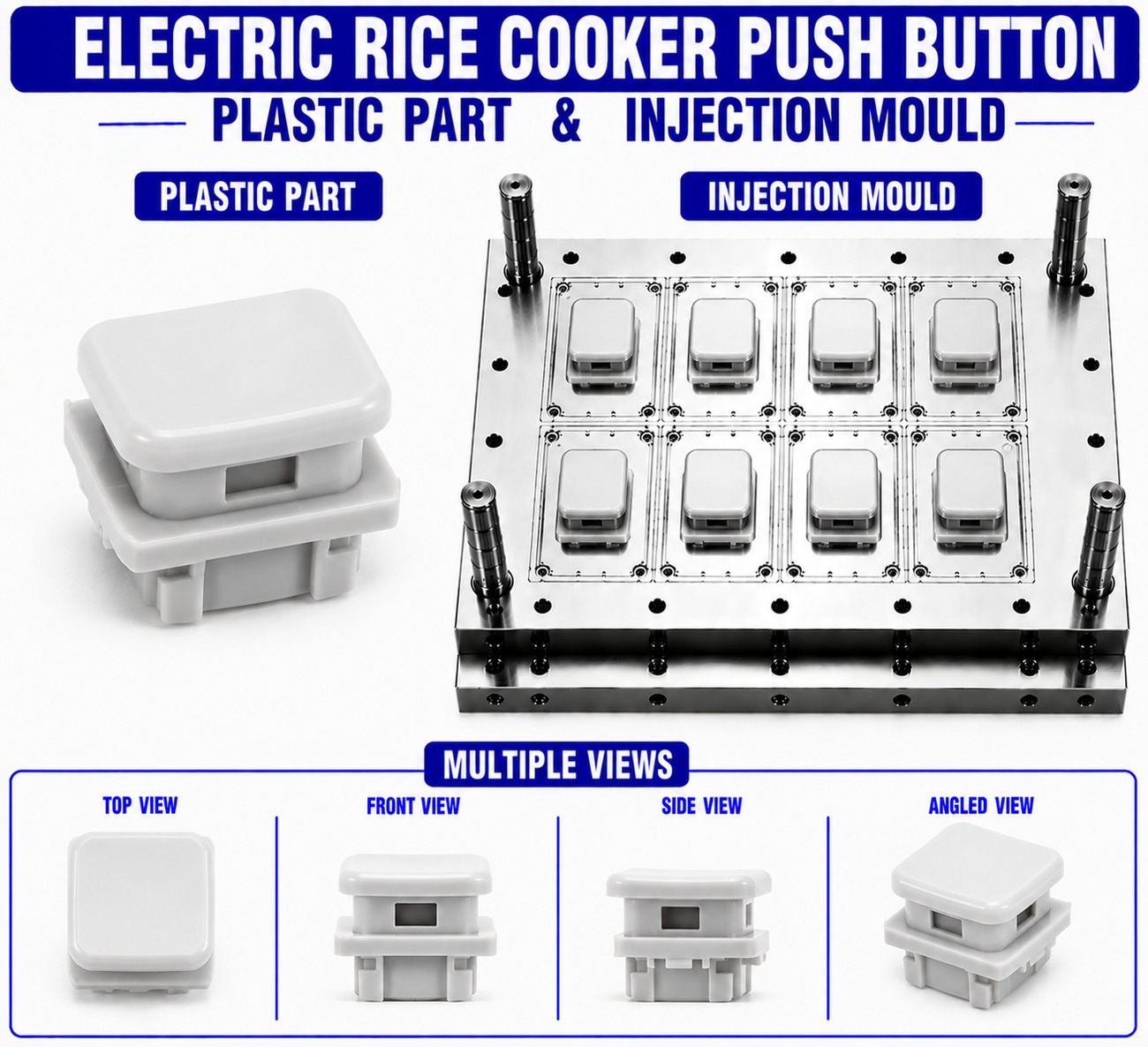
Electric Rice Cooker Plastic Push Button Mould and Moulding Service
₹20.00
Electric Rice Cooker Plastic Push Button Mould and Moulding Service | Renovator Appliances Ltd
Product Overview
Renovator Appliances Ltd offers Electric Rice Cooker Plastic Push Button Mould and Moulding Service for manufacturing precision plastic push buttons used in electric rice cooker control and operating assemblies. The push button provides a convenient user interface for activating, selecting, or controlling specific functions of the cooker according to the appliance design.
The component can be developed with an ergonomic pressing surface, guided travel, retaining tabs, locating features, snap-fits, ribs, and suitable mounting arrangements. Injection moulding enables consistent dimensions, smooth operation, repeatable appearance, and efficient production for OEM, ODM, replacement, and bulk manufacturing requirements.
Key Features
Precision moulded plastic push button for electric rice cookers
Designed for convenient user operation
Ergonomic pressing surface for comfortable use
Controlled movement and return arrangement
Accurate mounting and locating features
Snap-fits, clips, tabs, ribs, and guide features can be incorporated
Smooth and controlled surface finish
Available in customized shapes, colours, textures, and dimensions
Can be designed for integration with switches, control panels, or internal mechanisms
Suitable for OEM, ODM, replacement, and bulk production
Industrial Applications
| Application | Use of Push Button |
|---|---|
| Electric Rice Cookers | Provides a user-operated control interface |
| Automatic Rice Cookers | Used for selecting or activating cooker functions |
| Multi-Function Cookers | Supports customized control-button arrangements |
| Household Cooking Appliances | Provides mechanical input for appliance controls |
| Commercial Rice Cookers | Can be developed for repeated operating cycles |
| Kitchen Appliances | Used as a customized operating button |
Manufacturing Process
1. Product Design & Development
The push button is developed according to the switch mechanism, control panel, required button travel, pressing force, available space, and mounting arrangement. The design can include guide surfaces, retaining tabs, snap-fits, ribs, and locating features.
2. Plastic Mould Design
The injection mould is designed according to the button geometry, wall thickness, draft angles, parting line, gate location, cooling system, and ejection requirements. Critical operating and guide surfaces are considered for smooth and consistent movement.
3. Mould Manufacturing
The mould is precision-machined using suitable mould steel such as P20, H13, or S136 depending on production volume, plastic material, dimensional requirements, surface-finish expectations, and required mould life.
4. Injection Moulding
The selected plastic material is heated and injected into the mould cavity under controlled processing conditions. After cooling, the mould opens and the finished push button is ejected.
5. Finishing & Assembly Preparation
Moulded buttons are trimmed and visually finished as required. Pressing surfaces, guide features, retaining elements, and switch interfaces are checked before assembly preparation.
6. Quality Inspection
Finished push buttons are inspected for dimensional accuracy, button travel interface, surface appearance, fitment, and overall moulding consistency.
Raw Materials
| Material | Typical Suitability |
|---|---|
| ABS | Suitable for rigid push buttons with a good surface finish |
| PP | Useful for lightweight components requiring flexibility and chemical resistance |
| PC+ABS | Suitable where improved impact and thermal performance are required |
| PBT | Can be considered where dimensional stability and heat resistance are important |
| Nylon / PA | Suitable for applications requiring increased mechanical strength |
| PC | Can be considered where higher impact and temperature resistance are required |
| Flame-Retardant Plastic | Can be selected where enhanced flame-retardant properties are required |
The final plastic grade should be selected according to the push button's operating cycle, pressing requirements, temperature exposure, surrounding electrical components, and applicable product specifications.
Quality Control
Raw Material Inspection: Incoming plastic material is checked for grade and quality.
Mould Inspection: Cavity condition, parting surfaces, ejection system, and critical mould features are inspected.
Dimensional Inspection: Button dimensions, guide features, mounting points, and critical clearances are checked.
Visual Inspection: Components are checked for flash, sink marks, short shots, warpage, scratches, and surface defects.
Fitment & Functional Inspection: The button is checked for proper fit, movement, alignment, and interaction with the corresponding switch or control mechanism.
Packaging Inspection: Finished buttons are packed appropriately to minimize scratches, deformation, and transportation damage.
Buyer Guide
When sourcing an Electric Rice Cooker Plastic Push Button, buyers should provide a product drawing, 3D CAD model, physical sample, required dimensions, plastic grade, colour, surface finish, switch type, button travel, mounting method, and expected production quantity.
For buttons used repeatedly during appliance operation, buyers should also specify the expected operating cycles, pressing requirements, surrounding temperature, and available assembly clearances. These details help determine the appropriate plastic material and mould design.
Why Choose Renovator Appliances Ltd?
Advanced Injection Moulding Facility
We provide precision injection moulding solutions for rice cooker push buttons and other household appliance plastic components with controlled and repeatable production.
In-House Mould Manufacturing
Our mould-making capability supports customized mould development according to button geometry, operating features, mounting requirements, and production volume.
OEM & ODM Manufacturing
We support OEM and ODM requirements with customized dimensions, materials, colours, textures, surface finishes, and control-interface designs.
Quality Assurance
Raw materials, moulds, dimensions, appearance, movement interfaces, and fitment can be inspected to maintain consistent production quality.
Cost-Effective Manufacturing
Optimized mould design and efficient injection moulding processes support economical manufacturing for development batches and larger production requirements.
Frequently Asked Questions
1. What is an Electric Rice Cooker Plastic Push Button?
It is a moulded plastic operating component used to provide a mechanical user interface for controlling or activating functions of an electric rice cooker.
2. Which plastic materials can be used for a rice cooker push button?
ABS, PP, PC+ABS, PBT, Nylon/PA, PC, and suitable flame-retardant plastics can be considered according to the mechanical, thermal, and application requirements.
3. Can the push button be customized?
Yes. Button dimensions, shape, pressing surface, colour, texture, surface finish, guide features, retaining elements, and mounting arrangements can be customized according to the customer's design.
4. Can Renovator Appliances Ltd manufacture both the mould and plastic push button?
Yes. The service can include customized mould design and manufacturing followed by injection moulding production of the push button.
5. Is the plastic push button suitable for bulk production?
Yes. Injection moulding is suitable for repeat production where consistent dimensions, appearance, fitment, and operating characteristics are required.
- SKU
- REN-7C2B73C03C8228476781A4B0