INDUSTRIAL PRODUCT
Hair Straightener Plastic Internal Bracket Mould and Moulding Service
₹50.00
Hair Straightener Plastic Internal Bracket Mould and Moulding Service | Renovator Appliances Ltd
Product Overview
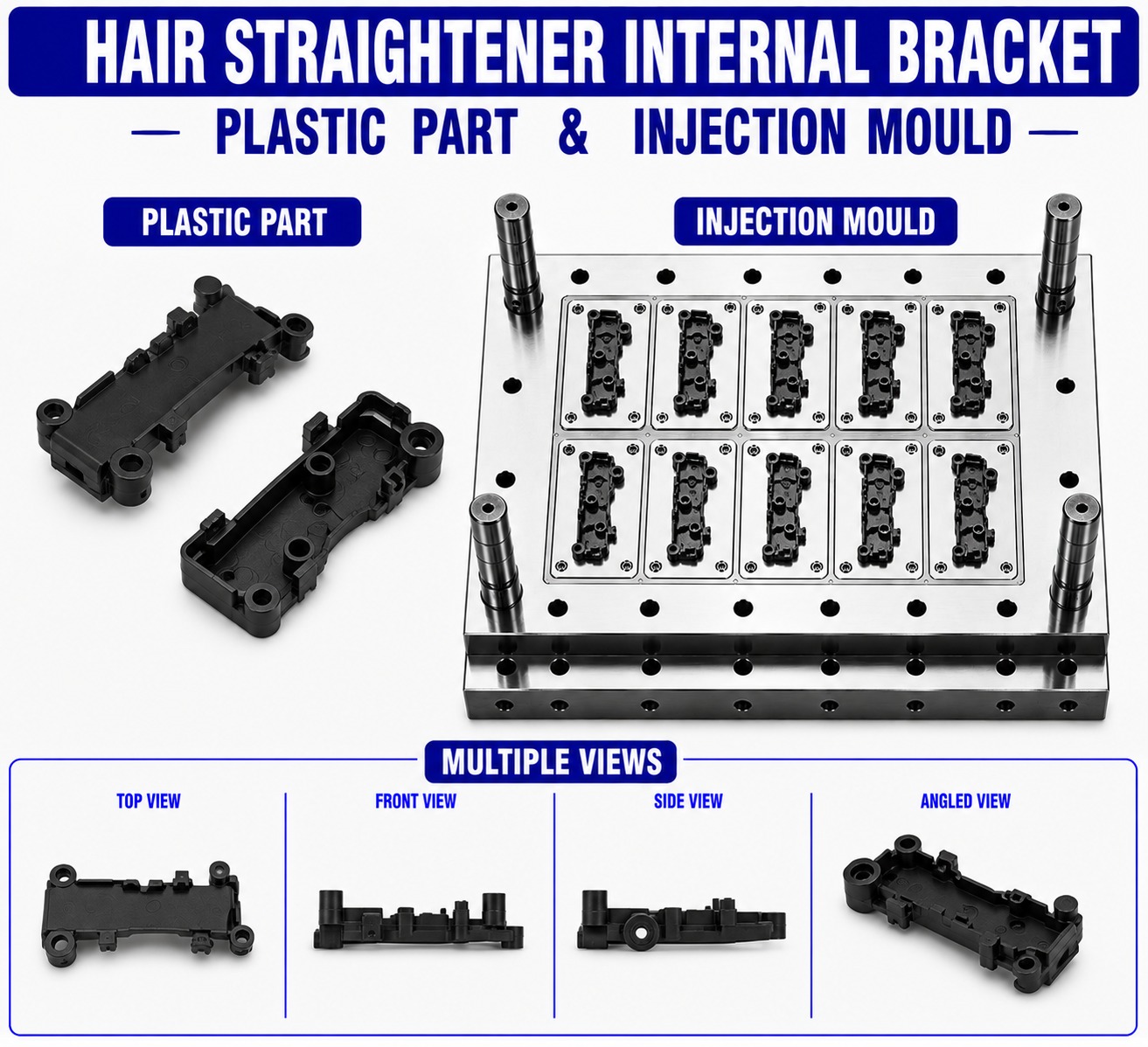
Hair Straightener Plastic Internal Bracket Mould and Moulding Service is designed for manufacturing precision plastic brackets used inside hair straighteners to support, position, and secure internal components. The internal bracket can provide structural support for electrical, heating, control, hinge, wiring, or other internal assemblies while maintaining accurate component alignment within the appliance housing.
The bracket can be customized with mounting bosses, screw posts, locating pins, ribs, clips, slots, snap-fits, and cable-routing features according to the internal architecture of the hair straightener. Renovator Appliances Ltd provides customized mould development and injection moulding solutions for OEM, ODM, and bulk production requirements.
Key Features
Precision-moulded internal support bracket
Designed for secure positioning of internal hair straightener components
Can incorporate mounting bosses, ribs, clips, slots, and locating features
Supports accurate alignment of internal assemblies
Lightweight construction with suitable structural rigidity
Customized geometry according to appliance design
Consistent dimensions and wall thickness
Suitable for screw-fit, snap-fit, or other assembly methods
Available in different plastic grades, colours, and finishes
Suitable for prototype development and high-volume production
Industrial Applications
| Application Area | Use |
|---|---|
| Hair Straighteners | Internal component support and positioning |
| Ceramic Hair Straighteners | Structural support for internal assemblies |
| Professional Hair Styling Equipment | Internal mounting and alignment |
| Electric Hair Care Appliances | Support for electrical and mechanical components |
| Personal Care Appliances | Internal plastic structural components |
| Hair Styling Devices | Component retention and positioning |
| OEM Hair Straightener Manufacturing | Customized internal bracket production |
| Replacement Components | Replacement internal support brackets |
Manufacturing Process
1. Product Design & Development
The internal bracket is designed according to the appliance housing, component locations, screw positions, available space, and required load-bearing points. Interfaces with heating, electrical, hinge, wiring, and other assemblies are considered during product development.
2. Plastic Mould Design
A dedicated injection mould is developed with suitable cavity geometry, parting line, gates, runners, cooling channels, and ejection arrangements. Functional details such as bosses, ribs, clips, locating pins, and slots are incorporated into the mould design.
3. Mould Manufacturing
The mould is manufactured using suitable tool steel such as P20 Steel, H13 Steel, or S136 Steel. Material selection depends on production quantity, expected mould life, dimensional requirements, and required surface finish.
4. Injection Moulding
The selected thermoplastic material is heated and injected into the mould cavity under controlled processing conditions. After cooling and solidification, the mould opens and the internal bracket is ejected.
5. Finishing & Assembly Preparation
Required gate trimming, flash removal, visual finishing, and secondary operations are completed. The bracket is prepared for assembly with the hair straightener's internal components.
6. Quality Inspection
Finished brackets are checked for critical dimensions, mounting-hole positions, locating features, warpage, surface quality, and fitment with mating components.
Raw Materials
| Plastic Material | Typical Suitability |
|---|---|
| ABS | General-purpose internal appliance brackets |
| PP | Lightweight applications requiring suitable flexibility |
| HIPS | Cost-effective rigid internal components |
| PC+ABS | Strength and dimensional stability requirements |
| PC | Higher strength and temperature-related applications |
| PBT | Electrical appliance and dimensionally stable components |
| Nylon | Applications requiring higher mechanical strength |
| Glass-Filled Nylon | Higher rigidity and structural support requirements |
| Flame-Retardant Plastic | Applications requiring enhanced flame-resistance characteristics, subject to specification |
Material selection should be finalized according to mechanical loading, temperature exposure, electrical environment, dimensional stability, flexibility requirements, and the actual operating conditions inside the hair straightener.
Quality Control
Raw Material Inspection: Plastic grade, colour, and material consistency are verified before production.
Mould Inspection: Cavity condition, ejection system, parting surfaces, and critical mould dimensions are inspected.
Dimensional Inspection: Overall dimensions, mounting holes, bosses, locating features, wall thickness, and critical interfaces are checked.
Visual Inspection: Components are checked for flash, sink marks, short moulding, burn marks, warpage, scratches, and other moulding defects.
Fitment & Functional Inspection: Bracket alignment, mounting stability, component retention, and fit with mating parts are evaluated.
Packaging Inspection: Finished brackets are packed to reduce scratches, deformation, contamination, and handling damage.
Buyer Guide
When sourcing Hair Straightener Plastic Internal Bracket Mould and Moulding Service, buyers should provide:
Internal bracket drawing or 3D CAD model
Location and dimensions of mounting points
Required screw, clip, or snap-fit arrangement
Components that the bracket needs to support
Required plastic material or grade
Expected temperature exposure
Required colour and surface finish
Estimated production quantity
Prototype or physical sample, if available
These details help determine the appropriate bracket geometry, plastic grade, mould construction, cavity configuration, and injection moulding process.
Why Choose Renovator Appliances Ltd?
Advanced Injection Moulding Facility: Supports precision manufacturing of customized internal plastic appliance components.
In-House Mould Manufacturing: Mould development can be coordinated with the bracket's functional geometry and assembly requirements.
OEM & ODM Manufacturing: Supports customized designs based on customer drawings, samples, and technical specifications.
Quality Assurance: Dimensional, visual, material, and fitment inspections help maintain consistent production quality.
Cost-Effective Manufacturing: Optimized moulding solutions support economical prototype and bulk production requirements.
Frequently Asked Questions
1. What is a Hair Straightener Plastic Internal Bracket?
It is a moulded plastic structural component installed inside a hair straightener to support, position, or secure internal electrical, heating, mechanical, or wiring assemblies.
2. Which materials can be used for the internal bracket?
ABS, PP, HIPS, PC+ABS, PC, PBT, Nylon, Glass-Filled Nylon, and suitable flame-retardant plastics can be considered depending on strength, temperature, electrical, and dimensional requirements.
3. Can the internal bracket be customized?
Yes. The bracket can be customized with mounting bosses, screw posts, ribs, clips, slots, locating pins, snap-fits, and other features according to the appliance's internal design.
4. Can Renovator manufacture both the mould and the plastic bracket?
Yes. Renovator Appliances Ltd provides mould development, mould manufacturing, and injection moulding services for customized Hair Straightener Plastic Internal Bracket requirements.
5. What information is required for mould development?
A 3D CAD file, technical drawing, physical sample, assembly details, material requirements, expected operating conditions, and production quantity can be provided for mould and manufacturing evaluation.
- SKU
- REN-BE9AC536F7978A91872425DF