INDUSTRIAL PRODUCT
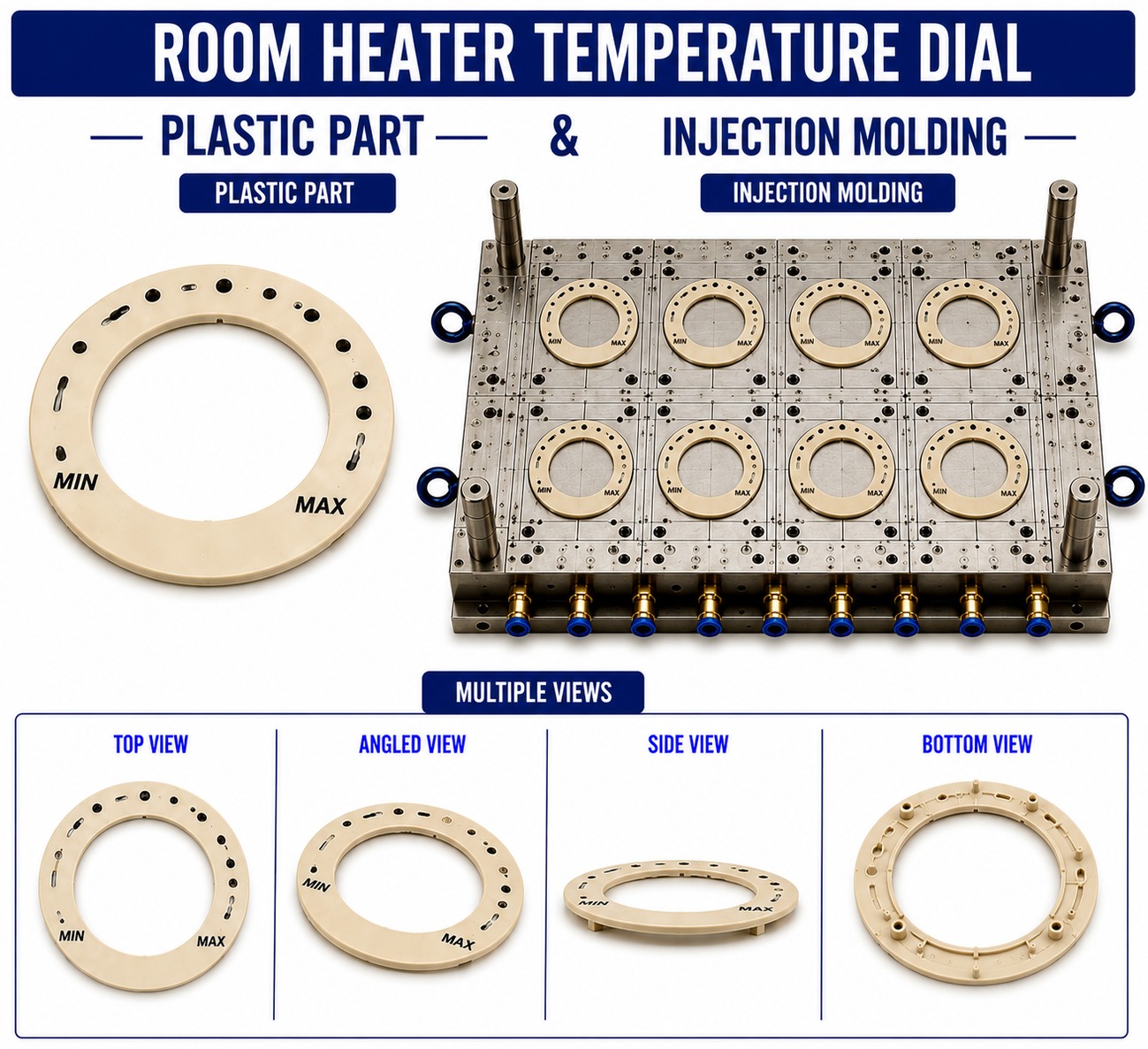
Room Heater Plastic Temperature Dial Mould and Moulding Service
₹50.00
Room Heater Plastic Temperature Dial Mould and Moulding Service | Renovator Appliances Ltd
Product Overview
Renovator Appliances Ltd manufactures high-quality Room Heater Plastic Temperature Dials and provides complete Plastic Injection Mould Design, Mould Manufacturing, and Moulding Services for electric room heaters, fan heaters, ceramic heaters, portable heating appliances, and customized temperature control equipment.
The Room Heater Plastic Temperature Dial is a user-interface component used to indicate or adjust the temperature setting of a room heater. Depending on the heater design, the dial may be integrated with a thermostat knob, rotary control assembly, temperature indicator, printed scale, pointer, or selector mechanism. It can help users identify the selected temperature or heating level through clearly defined markings and a precise control interface.
Manufactured using advanced plastic injection moulding technology, our Room Heater Plastic Temperature Dials are designed for dimensional accuracy, clear visual markings, smooth control operation, secure fitment, consistent appearance, and reliable long-term performance. We offer OEM and customized manufacturing solutions according to customer drawings, CAD files, 3D models, samples, dimensions, and technical specifications.
Key Features
Clear Temperature Indication
Designed with visible temperature scales, numerical markings, pointer features, or customized indicators for easy identification of the selected setting.
Precision Control Fitment
Manufactured with an accurate central mounting profile or shaft interface for secure integration with the thermostat or temperature control mechanism.
Ergonomic Operation
Can be designed with grooves, ribs, raised edges, or textured surfaces for comfortable adjustment and controlled rotation.
Durable Plastic Construction
Manufactured using suitable thermoplastic materials that provide good mechanical strength, dimensional stability, and resistance to routine handling and wear.
Attractive Surface Finish
Available in smooth, matte, glossy, textured, or customized surface finishes according to the appliance design.
OEM Customization
Available in customized diameters, thicknesses, markings, indicator layouts, colours, textures, mounting profiles, and branding requirements.
| Feature | Description |
|---|---|
| Material Selection | Thermoplastic materials suitable for temperature control components |
| Design | Customized temperature dial and indicator configuration |
| Function | Temperature indication and/or adjustment interface |
| Construction | Lightweight, durable, and precision-moulded plastic |
| Application | Room heater temperature control systems |
| Customization | OEM and ODM manufacturing support |
Industrial Applications
Our Room Heater Plastic Temperature Dials are widely used in:
| Industry | Application |
|---|---|
| Room Heater Industry | Temperature indication and control |
| Home Appliances | Temperature adjustment interfaces |
| Electrical Appliances | Control dial components for electric heaters |
| Ceramic Heater Industry | Temperature setting indicators |
| Portable Heating Equipment | User-operated temperature adjustment |
| Commercial Heating | Temperature control interfaces for selected equipment |
| Temperature Control Equipment | Rotary temperature indication components |
| OEM Manufacturing | Customized plastic temperature dials |
Manufacturing Process
Our Room Heater Plastic Temperature Dials are manufactured using controlled and precision plastic injection moulding technology.
Product Design & Development
The dial is developed using customer drawings, CAD files, 3D models, or existing samples. Important design parameters may include outer diameter, thickness, central bore, mounting profile, pointer position, temperature scale, marking layout, grip geometry, wall thickness, and thermostat compatibility.
Mould Design & Manufacturing
A precision injection mould is designed according to the temperature dial geometry, selected material, production volume, shrinkage requirements, and injection moulding machine specifications. Advanced tooling processes may include:
CNC machining
EDM machining
Wire EDM cutting
Surface grinding
Precision polishing
Insert machining
Drilling and fitting
Advanced mould finishing
Material Selection
A suitable plastic grade is selected according to mechanical strength, wear resistance, dimensional stability, operating temperature, surface appearance, and application conditions.
Injection Moulding Production
Plastic resin is heated and converted into molten material inside the injection moulding machine. The molten plastic is injected into the precision mould cavity under controlled temperature, pressure, and speed to form the required temperature dial.
Cooling & Ejection
The mould cooling system helps solidify the dial while controlling shrinkage and maintaining dimensional accuracy. After sufficient cooling, the mould opens and the dial is ejected through the mould ejection system.
Finishing & Quality Inspection
Finished temperature dials undergo trimming, visual inspection, dimensional checking, mounting profile verification, marking inspection, surface inspection, and assembly fitment testing.
Mould Manufacturing Process
Renovator Appliances Ltd provides complete Room Heater Plastic Temperature Dial Mould Manufacturing Services.
Mould Design
The mould is engineered with suitable cavity and core configuration, parting line, gate location, runner system, cooling channels, draft angles, ejection arrangement, central mounting features, grip details, and shrinkage allowance.
CNC Machining
Mould plates, cavity components, core components, inserts, and other tooling parts are precision-machined using CNC equipment according to the approved mould design.
EDM & Wire EDM
EDM and Wire EDM processes may be used for detailed internal mounting profiles, fine indicator features, intricate markings, and other areas requiring high machining precision.
Cooling System
Cooling channels are designed to provide controlled mould temperature and support consistent dial dimensions, surface finish, and production cycle performance.
Ejection System
The ejection mechanism is designed to remove the temperature dial without damaging the indicator area, grip features, central mounting profile, or visible surfaces.
Mould Assembly & Trial
After machining and finishing, mould components are assembled and aligned. Trial moulding is performed to evaluate filling, cooling, ejection, shrinkage, warpage, dimensions, mounting fitment, surface quality, and appearance.
Final Mould Approval
Necessary mould corrections, modifications, and finishing operations are completed before the mould is approved for regular injection moulding production.
Raw Materials
The appropriate plastic material depends on the temperature dial's mechanical requirements, wear resistance, operating temperature, dimensional stability, appearance, and heater design.
| Material | Description |
|---|---|
| ABS | Good impact resistance, dimensional accuracy, and surface finish |
| PP | Lightweight and suitable for many general appliance applications |
| PC+ABS | High strength, dimensional stability, and improved heat performance |
| Nylon (PA6/PA66) | Good mechanical strength and wear resistance for selected applications |
| POM | Suitable for precision control components requiring good dimensional stability and low friction |
| HIPS | Rigid material suitable for selected appliance control components |
| Flame-Retardant ABS | Considered where specific flame-performance requirements apply |
| Engineering Plastics | Selected for specialized mechanical and thermal requirements |
Final material selection should be based on the actual operating temperature, control mechanism, component location, heater design, and applicable technical or safety requirements.
Quality Control
Every Room Heater Plastic Temperature Dial can undergo systematic quality inspection to maintain accurate dimensions, clear indication, secure fitment, and consistent appearance.
Raw material verification
Overall diameter inspection
Thickness measurement
Central bore inspection
Shaft or mounting profile verification
Mounting depth inspection
Pointer position checking
Temperature scale inspection
Numerical and symbol marking inspection
Grip feature inspection
Surface finish inspection
Colour consistency checking
Warpage inspection
Flash and burr inspection
Sink mark inspection
Short-shot inspection
Crack and deformation inspection
Shaft fitment verification
Rotary operation checking where applicable
Final visual quality inspection
Production Capacity
Production capacity depends on mould cavity count, injection moulding machine capacity, component weight, plastic material, cycle time, cooling requirements, mould design, and overall production efficiency.
For example, an 8-cavity mould operating with a 20-second cycle time can theoretically produce approximately 1,440 pieces per hour before accounting for machine downtime, material handling, quality inspection, mould maintenance, and other production factors.
Actual production capacity is finalized according to the temperature dial design, mould cavity configuration, selected material, injection moulding machine specifications, and required production schedule.
Buyer Guide
Before ordering a Room Heater Plastic Temperature Dial Mould and Moulding Service, buyers should provide the available product and technical information for accurate mould and component development.
Recommended specifications include:
Product drawing or 3D CAD model
Existing temperature dial sample, if available
Overall dial diameter
Overall thickness
Central bore diameter
Shaft or mounting profile
Mounting depth
Pointer or indicator design
Temperature scale range
Numerical or symbol marking requirements
Grip pattern, if applicable
Colour requirements
Surface finish requirements
Printing or marking requirements
Required plastic material
Monthly or annual production quantity
Required mould cavity count
Room heater model or thermostat assembly details
Providing complete specifications helps determine the appropriate dial geometry, mould construction, material, injection machine capacity, cavity configuration, and manufacturing process.
Why Choose Renovator Appliances Ltd?
Precision Injection Mould Manufacturing
OEM & ODM Plastic Components
Advanced Plastic Injection Moulding Technology
Customized Room Heater Temperature Dial Manufacturing
Precision Indicator and Scale Design
Accurate Shaft and Mounting Profile Development
Ergonomic Control Interface Design
Suitable Engineering Plastic Material Selection
Customized Marking and Surface Finish Options
Strict Quality Control System
Prototype and Bulk Production Support
High Production Capability
Competitive Manufacturing Solutions
Reliable Delivery Support
Renovator Appliances Ltd provides an integrated manufacturing solution covering product development, mould design, mould manufacturing, mould trials, plastic injection moulding, quality inspection, and bulk production for customized Room Heater Plastic Temperature Dials.
Frequently Asked Questions (FAQ)
Q1. What is a Room Heater Plastic Temperature Dial?
A Room Heater Plastic Temperature Dial is a plastic control or indication component used to display and/or adjust the temperature setting of a room heater. It can include temperature scales, pointer markings, and a mounting interface for the control mechanism.
Q2. Which materials are used for Room Heater Plastic Temperature Dials?
Common material options include ABS, PP, PC+ABS, Nylon, POM, HIPS, flame-retardant ABS, and engineering-grade thermoplastics, depending on required mechanical strength, wear resistance, dimensional stability, temperature resistance, and application requirements.
Q3. Can Room Heater Plastic Temperature Dials be customized?
Yes. We provide OEM customization according to diameter, thickness, central bore, mounting profile, pointer design, temperature scale, markings, colour, texture, surface finish, branding, and customer drawings or samples.
Q4. How are Room Heater Plastic Temperature Dials manufactured?
They are manufactured using precision plastic injection moulding technology. Plastic resin is melted and injected into a specially designed mould cavity, followed by cooling, ejection, finishing, dimensional inspection, and mounting fitment verification.
Q5. Do you manufacture moulds for Room Heater Plastic Temperature Dials?
Yes. Renovator Appliances Ltd provides complete plastic injection mould design, mould manufacturing, mould trials, mould correction, and injection moulding services for Room Heater Plastic Temperature Dials according to OEM and customized production requirements.
- SKU
- REN-84BA4C6FCFA5ECD8D90A6730