INDUSTRIAL PRODUCT
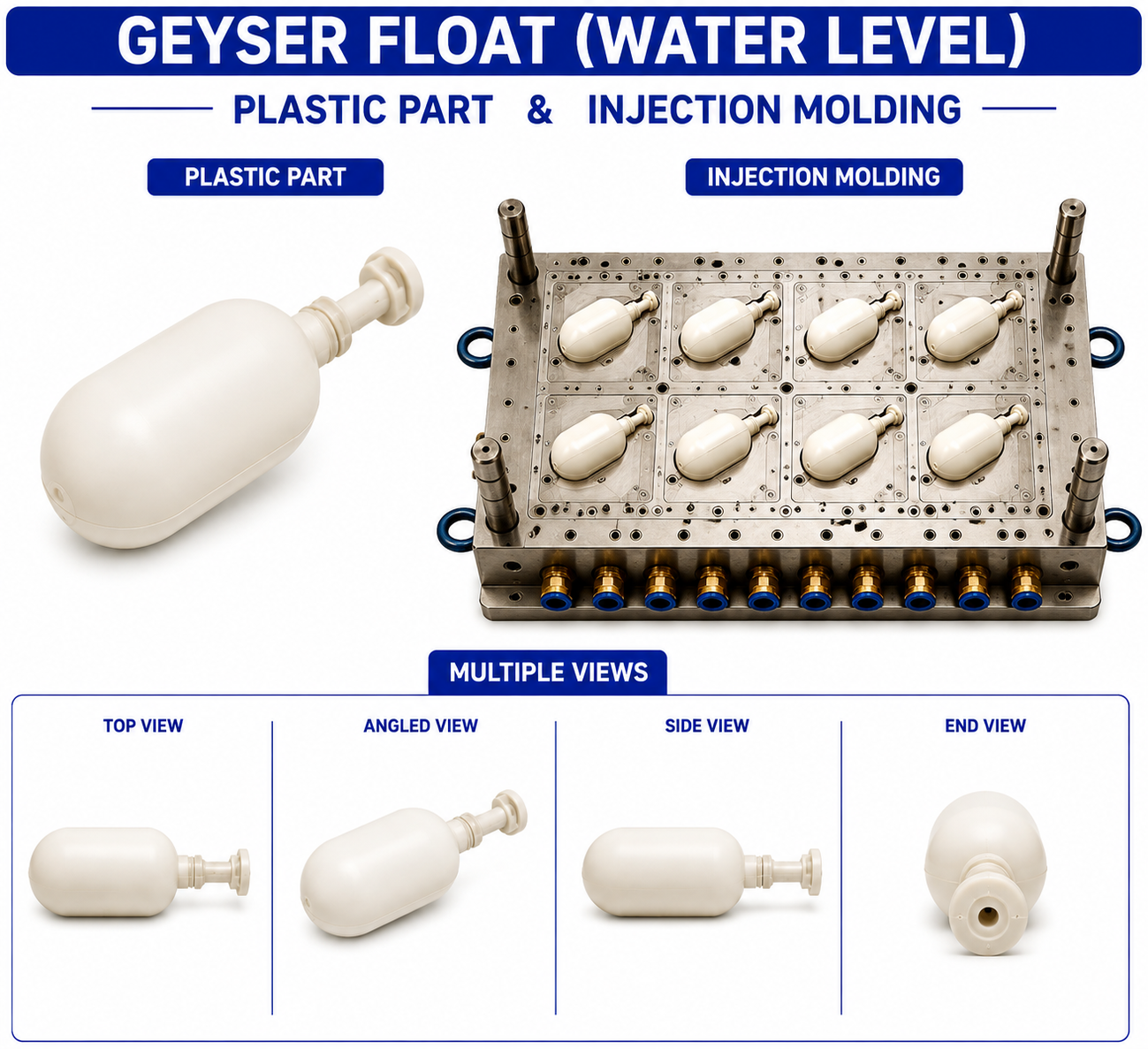
Geyser Plastic Float Mould and Moulding Service
₹50.00
Geyser Plastic Float Mould and Moulding Service | Renovator Appliances Ltd
Product Overview
Geyser Plastic Float Mould and Moulding Service is designed for manufacturing precision plastic floats used in geysers, water heaters, and related water-level control or sensing mechanisms. A plastic float is generally designed to move according to changes in water level and can be integrated with a float stem, guide mechanism, valve assembly, or water-level sensing system, depending on the specific appliance design.
Using advanced plastic injection moulding technology, the Geyser Plastic Float can be manufactured with consistent dimensions, controlled weight, smooth surface finish, and repeatable production quality. Customized moulds can be developed according to the required float dimensions, buoyancy requirements, material, mounting arrangement, and application.
What is a Geyser Plastic Float?
A Geyser Plastic Float is a lightweight moulded plastic component designed to provide buoyancy within a water-related mechanism. As the water level changes, the float can move vertically or along a designated path and transfer this movement to an associated mechanism.
The exact shape and construction depend on the geyser's internal design. The float may include a central stem opening, mounting section, guide feature, locking mechanism, or connecting point.
Key Features
Precision injection moulded construction
Lightweight and buoyant design
Consistent dimensions
Smooth surface finish
Suitable for water-level mechanisms
Good dimensional stability
Customizable shape and size
Compatible with float stem assemblies
Suitable for high-volume production
Available in suitable water-resistant plastic grades
Industrial Applications
Geyser Plastic Floats can be used in:
Electric geysers
Storage water heaters
Instant water heaters
Domestic water heating systems
Commercial water heaters
Water-level sensing mechanisms
Float-operated mechanisms
Water control assemblies
Appliance internal control systems
Function of a Geyser Plastic Float
The primary function of a plastic float is to provide buoyancy and controlled movement in response to water-level changes.
When the water level rises or falls, the float moves accordingly within its designed operating path. This movement can be transferred through a float stem or another mechanism to support water-level monitoring or control, depending on the specific geyser design.
How is the Geyser Plastic Float Manufactured?
The Geyser Plastic Float is manufactured through a controlled plastic injection moulding process:
1. Product Design Analysis
The required float dimensions, buoyancy characteristics, wall thickness, internal structure, connecting features, and operating conditions are analyzed.
2. Material Selection
A suitable plastic material is selected based on buoyancy, water resistance, dimensional stability, mechanical strength, temperature resistance, and application requirements.
3. Material Preparation
Plastic granules are prepared according to the recommended processing parameters for the selected material.
4. Plastic Melting
The plastic material is heated inside the injection moulding machine until it reaches the required molten state.
5. Injection
The molten plastic is injected into the precision mould cavity under controlled pressure and speed.
6. Filling and Packing
The mould cavity is filled completely, followed by appropriate holding pressure to achieve consistent dimensions and minimize shrinkage-related variation.
7. Cooling
Cooling channels within the mould remove heat from the component, allowing the plastic to solidify and maintain its required shape.
8. Ejection
Once adequately cooled, the mould opens and the finished plastic float is removed using the mould ejection system.
9. Inspection
The finished floats are inspected for dimensions, weight, appearance, surface quality, fitment, and other specified requirements.
How is the Plastic Float Mould Made?
The mould used to manufacture the Geyser Plastic Float is developed through precision mould-making processes.
1. Product Drawing and 3D Model Analysis
The product drawing or 3D CAD model is evaluated for dimensions, wall thickness, draft angles, parting line, internal features, shrinkage, and ejection requirements.
2. Mould Design
A complete mould design is prepared, including the core, cavity, runner, gate, cooling channels, ejector system, guide pillars, bushes, and mould plates.
3. Mould Steel Selection
Mould steel is selected according to production volume, required durability, product material, and expected mould life. Common options include:
P20 Steel
H13 Steel
S136 Steel
4. CNC Machining
CNC machining is used to manufacture the core, cavity, plates, and other precision mould components.
5. EDM Machining
EDM machining may be used for detailed internal features, narrow sections, grooves, and complex geometries requiring high precision.
6. Drilling and Grinding
Cooling passages, ejector holes, guide holes, and other required features are manufactured through precision drilling and grinding.
7. Mould Assembly
The core, cavity, ejector system, guide components, cooling system, and other mould parts are assembled and aligned.
8. Mould Trial
The completed mould is tested on an injection moulding machine to evaluate filling, cooling, ejection, dimensions, appearance, and product performance.
9. Final Correction and Approval
Any required corrections identified during the mould trial are completed before the mould is released for regular production.
Raw Materials
Suitable materials for manufacturing a Geyser Plastic Float may include:
PP (Polypropylene)
HDPE (High-Density Polyethylene)
ABS
Engineering Grade Plastic
Water-Resistant Plastic Grades
Heat-Resistant Plastic Grades, where required
Material selection should be based on the required buoyancy, water exposure, operating temperature, chemical compatibility, mechanical strength, and dimensional stability.
Quality Control
Quality control for the Geyser Plastic Float may include:
Dimensional inspection
Product weight verification
Buoyancy or floatation testing, where specified
Water-resistance evaluation
Visual inspection
Surface finish inspection
Wall-thickness verification
Fitment inspection
Flash inspection
Warpage inspection
Material verification
Batch-to-batch consistency checks
Production Capacity on Injection Moulding Machine
Production capacity depends on the machine size, mould cavity count, product weight, plastic material, cycle time, cooling time, and machine operating efficiency.
For example, a 4-cavity mould operating with a 30-second cycle time can theoretically produce approximately 480 pieces per hour. Actual output may vary because of machine downtime, material handling, mould maintenance, quality inspection, and other production factors.
For large-volume requirements, multi-cavity moulds can be designed to increase output and improve production efficiency.
Customization Options
The Geyser Plastic Float can be customized according to:
Overall dimensions
Diameter
Height
Wall thickness
Internal cavity
Float volume
Stem opening
Connecting features
Guide features
Locking mechanism
Product weight
Plastic material
Colour
Surface finish
Mould cavity configuration
Buyer Guide
Before ordering a Geyser Plastic Float Mould and Moulding Service, buyers should provide the required 2D drawing, 3D CAD model, physical sample, product dimensions, material specification, buoyancy requirements, application details, and estimated production quantity.
The float design should be validated according to the actual water-level mechanism to ensure the required buoyancy, movement, fitment, and functional performance.
Why Choose Renovator Appliances Ltd.?
Renovator Appliances Ltd. provides customized plastic mould manufacturing and injection moulding solutions for geyser and home appliance components. We can develop Geyser Plastic Float moulds according to specific product drawings, dimensions, material requirements, float characteristics, mould configuration, and production volume.
Our manufacturing process focuses on precision mould development, consistent injection moulding, dimensional accuracy, reliable fitment, repeatable production, and quality-controlled manufacturing.
Product Attributes
| Attribute | Specification |
|---|---|
| Product Name | Geyser Plastic Float |
| Manufacturing Process | Plastic Injection Moulding |
| Application | Geyser & Water Heater |
| Mould Material | P20 Steel / H13 Steel / S136 Steel |
| Product Material | PP / HDPE / ABS / Engineering Grade Plastic |
| Mould Type | Single Cavity / Multi Cavity / Hot Runner |
| Product Type | Float & Water-Level Mechanism Component |
| Float Type | Customized |
| Colour | As Per Requirement |
| Surface Finish | Standard / Custom |
| Customization | Available |
Frequently Asked Questions
1. What is a Geyser Plastic Float?
A Geyser Plastic Float is a lightweight plastic component designed to provide buoyancy and controlled movement within a water-level control or sensing mechanism used in certain geyser and water heater designs.
2. Which plastic material is suitable for a geyser float?
Materials such as PP and HDPE may be suitable for many float applications, while other engineering or specialized grades can be considered according to temperature, water exposure, buoyancy, mechanical, and dimensional requirements.
3. Can the Geyser Plastic Float be customized?
Yes. The float can be customized according to its dimensions, internal structure, stem connection, buoyancy requirements, material, colour, surface finish, and mounting arrangement.
4. Is injection moulding suitable for high-volume float production?
Yes. Injection moulding provides repeatable dimensions and efficient cycle times, making it suitable for regular and high-volume production. Multi-cavity moulds can be used where increased output is required.
5. What information is required to manufacture the plastic float mould?
A 2D product drawing, 3D CAD model, physical sample, dimensions, material specification, required buoyancy, application details, and expected production quantity are useful for accurate mould design and manufacturing.
- SKU
- REN-38803ECF823DEAAA7A5BC116