INDUSTRIAL PRODUCT
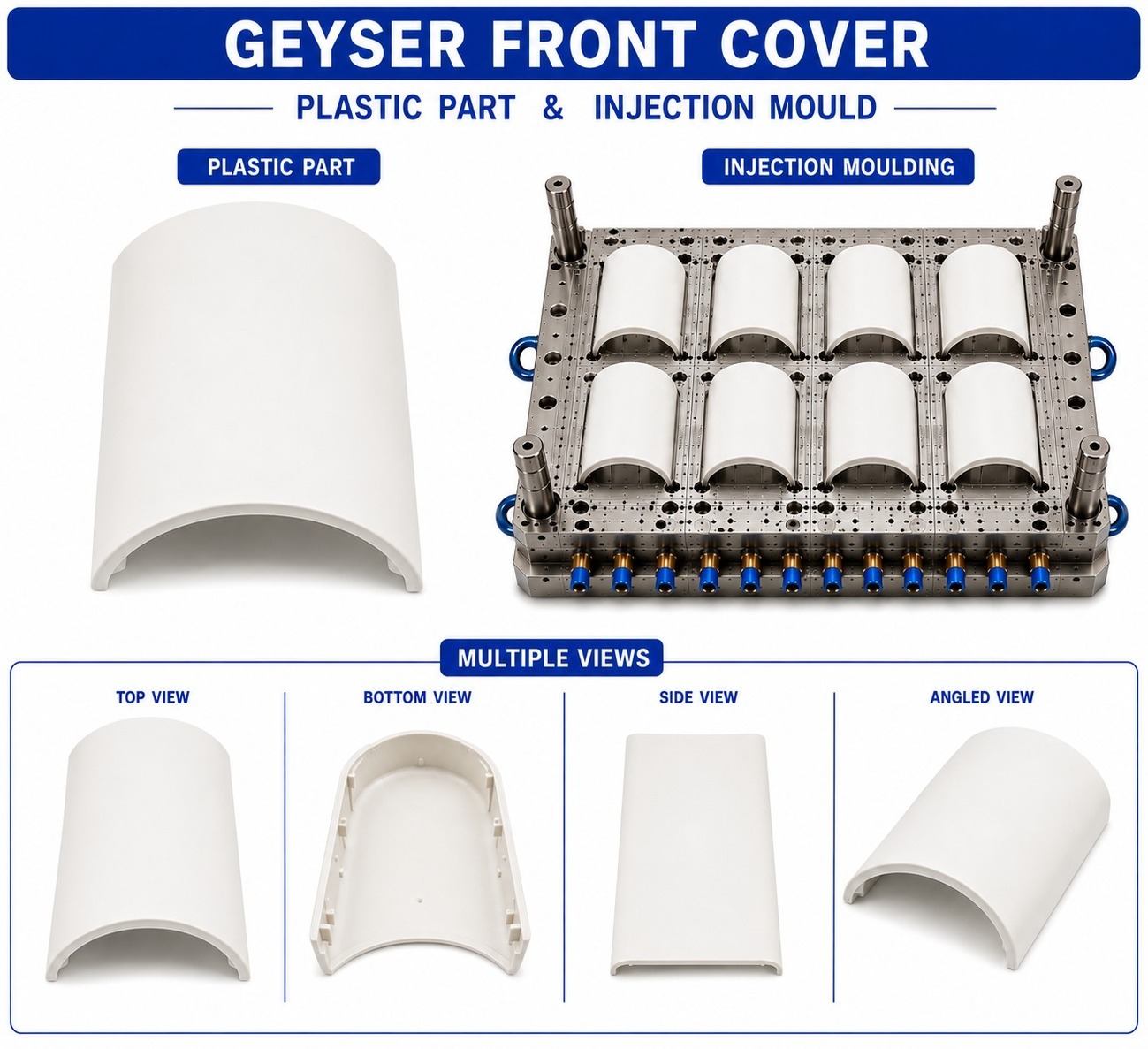
Geyser Plastic Front Cover Mould and Moulding Service
₹500.00
Geyser Plastic Front Cover Mould and Moulding Service | Renovator Appliances Ltd
Product Overview
Geyser Plastic Front Cover Mould and Moulding Service is a specialized plastic injection moulding solution for manufacturing the front cover used in electric geysers and water heating appliances. The front cover forms part of the visible external enclosure and can be designed to provide protection, aesthetic finishing, and integration with front-facing components such as indicators, control interfaces, display windows, labels, or other appliance features, depending on the geyser design.
Renovator Appliances Ltd provides an integrated solution covering product development, mould design, mould manufacturing, mould trials, plastic injection moulding, quality inspection, and bulk production. The Geyser Plastic Front Cover can be developed according to customer drawings, 3D CAD files, existing samples, dimensions, assembly requirements, and specific geyser model specifications.
The front cover can be customized with required mounting points, clips, ribs, bosses, openings, display provisions, surface textures, colours, and other design features.
Key Features
Precision injection moulded geyser front cover
Customized according to specific geyser design
Suitable for visible front-side appliance enclosure
Accurate dimensions and consistent geometry
Durable and lightweight plastic construction
Customized mounting and fixing provisions
Provision for control, indicator, display, or label interfaces where required
Smooth or textured surface finish
Customized colours and appearance
Suitable for OEM and bulk production
Repeatable production using precision-engineered moulds
Industrial Applications
The Geyser Plastic Front Cover is primarily used on the front-facing section of water heating appliances.
Typical applications include:
Electric Storage Geysers
Electric Water Heaters
Domestic Water Heating Appliances
Residential Geysers
Commercial Water Heating Equipment
OEM Geyser Assemblies
Customized Water Heater Products
Depending on the particular geyser design, the front cover may accommodate or interface with control panels, temperature displays, indicator lights, switches, labels, knobs, decorative elements, or other front-facing components.
Manufacturing Process
The Geyser Plastic Front Cover is manufactured using a controlled plastic injection moulding process.
1. Product Design
The front cover is designed according to the required dimensions, shape, wall thickness, mounting points, openings, clips, ribs, bosses, and front-facing interfaces.
2. Material Selection
A suitable thermoplastic material is selected according to the required strength, impact resistance, dimensional stability, appearance, temperature exposure, and application requirements.
3. Plastic Preparation
The selected plastic granules are prepared according to the material specifications and fed into the injection moulding machine.
4. Injection
The plastic is heated until molten and injected into the mould cavity under controlled pressure and temperature.
5. Filling and Packing
The molten plastic fills the cavity and holding pressure is applied to help maintain the required shape and dimensions.
6. Cooling
The mould cooling system removes heat from the component until the plastic becomes sufficiently rigid for ejection.
7. Ejection
After cooling, the mould opens and the finished front cover is removed using the mould's ejection mechanism.
8. Finishing and Inspection
The moulded component is inspected for flash, sink marks, warpage, surface defects, dimensions, colour consistency, and assembly fitment.
Mould Manufacturing Process
The Geyser Plastic Front Cover Mould is manufactured according to the component's geometry, surface requirements, production quantity, machine capacity, and expected mould life.
1. Product and Mould Design
Customer drawings, 3D CAD models, or approved samples are used to develop the mould. The cavity, core, parting line, gates, runners, cooling channels, and ejection system are designed according to the product.
2. Mould Material Selection
Suitable mould steel is selected based on production volume, expected tooling life, component complexity, dimensional requirements, and surface finish.
3. Precision Machining
The cavity, core, inserts, and other mould components are manufactured using CNC machining, EDM, drilling, grinding, and precision finishing processes.
4. Surface Finish Development
Where the front cover requires a glossy, matte, textured, or decorative finish, the mould cavity surface is finished according to the approved product specification.
5. Cooling System
Cooling channels are incorporated to provide controlled and uniform cooling during the injection moulding cycle.
6. Ejection System
Ejector pins, ejector plates, inserts, or other suitable mechanisms are incorporated according to the front cover's geometry.
7. Mould Assembly
The cavity, core, inserts, guide components, cooling system, runner/gating system, and ejection system are assembled and aligned.
8. Mould Trial
Trial production is performed to evaluate filling, cooling, ejection, dimensions, surface appearance, warpage, colour, and overall component quality.
9. Final Tool Correction
Any required modifications identified during the mould trial are completed before the mould is released for regular production.
Raw Materials
The raw material is selected according to the front cover's required mechanical strength, impact resistance, appearance, dimensional stability, temperature exposure, and customer specifications.
Potential materials include:
ABS – Acrylonitrile Butadiene Styrene
PP – Polypropylene
HIPS – High Impact Polystyrene
PC/ABS – Polycarbonate ABS Blend
Engineering-grade thermoplastics
UV-stabilized grades, where required
Flame-retardant grades, where required
For a visible front cover, material selection should also consider surface appearance, colour consistency, scratch resistance, and dimensional stability.
Quality Control
Quality inspection can include:
Overall length, width, and height
Critical mounting dimensions
Opening and cut-out dimensions
Wall thickness
Rib, boss, and clip dimensions
Control/display interface dimensions, where applicable
Surface finish
Colour consistency
Warpage and deformation
Flash and burrs
Sink marks
Short shots
Weld-line appearance
Scratches and surface defects
Assembly fitment
Batch-to-batch dimensional consistency
Critical dimensions can be checked against approved customer drawings or CAD specifications.
Production Capacity
Production capacity depends on product weight, mould cavity count, injection moulding machine capacity, plastic material, mould design, cycle time, and production efficiency.
For example, a single-cavity mould operating with a 30-second cycle has a theoretical output of approximately 120 pieces per hour, before accounting for machine downtime, inspection, material handling, mould maintenance, and other production factors.
Where technically suitable, multi-cavity moulds can be used to increase production output.
Actual production capacity should be established after reviewing the specific front-cover design, product weight, mould configuration, machine capacity, and required production volume.
Buyer Guide
Before ordering a Geyser Plastic Front Cover Mould and Moulding Service, buyers should provide:
2D product drawing
3D CAD model
Existing product sample, if available
Geyser model and capacity
Product dimensions
Required plastic material and grade
Target product weight
Required colour
Surface finish or texture requirements
Critical dimensional tolerances
Control/display interface details, where applicable
Mounting and assembly details
Required production quantity
Expected monthly or annual production volume
For front covers with displays, indicators, controls, or decorative features, their exact position and dimensions should be included in the product drawing.
Why Choose Renovator?
Renovator Appliances Ltd provides an integrated manufacturing solution for customized plastic components used in home appliances and industrial applications.
Our service can include:
Customized product development
Plastic injection mould design
Precision mould manufacturing
Injection moulding production
Mould trial and validation
Material selection support
Surface finish development
Dimensional quality inspection
OEM and bulk production
Customized colours and finishes
Support from mould development through finished component production
Our focus is on producing consistent front covers according to customer drawings, samples, technical specifications, appearance requirements, and production needs.
Frequently Asked Questions (FAQ)
1. What is a Geyser Plastic Front Cover?
A Geyser Plastic Front Cover is a moulded plastic component fitted on the front-facing section of a geyser or water heater. It provides external enclosure and can incorporate interfaces for controls, indicators, displays, labels, or other front-facing features depending on the design.
2. Which materials can be used for a Geyser Plastic Front Cover?
Depending on the application, ABS, PP, HIPS, PC/ABS, and suitable engineering-grade thermoplastics can be considered. Material selection depends on strength, appearance, impact resistance, dimensional stability, temperature exposure, and safety requirements.
3. Can the Geyser Plastic Front Cover be customized?
Yes. The product and mould can be customized according to 2D drawings, 3D CAD files, samples, dimensions, mounting points, openings, control/display interfaces, ribs, clips, colour, and surface finish requirements.
4. What determines the production capacity of the front cover?
Production capacity depends on mould cavity count, cycle time, injection moulding machine capacity, product weight, plastic material, mould design, and overall production efficiency.
5. Does Renovator provide both mould manufacturing and moulding services?
Yes. Renovator can provide an integrated service covering product development, mould design, mould manufacturing, mould trial, plastic injection moulding, quality inspection, and bulk production according to customer requirements.
- SKU
- REN-398C6C7CCE9113A0E0BC7861