INDUSTRIAL PRODUCT
Plastic Transit Crate
₹450.00
Plastic Transit Crate | Renovator Appliances Ltd
Product Overview
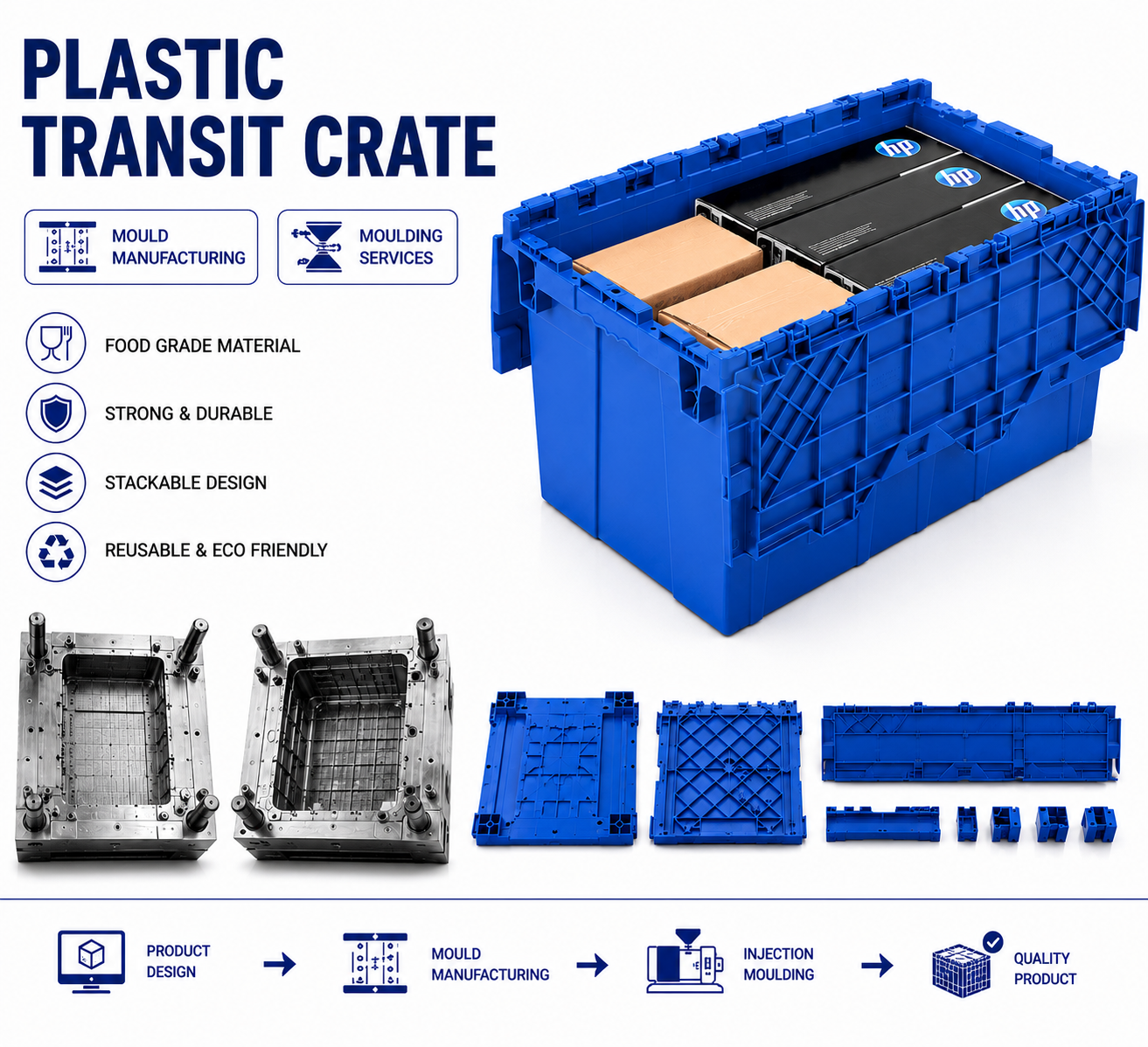
Plastic Transit Crate is a durable, reusable plastic container designed for the safe handling, storage, stacking, and transportation of products between manufacturing facilities, warehouses, distribution centres, and customers. Its rigid construction and stackable structure provide a practical solution for returnable packaging and industrial material handling.
The crate can be manufactured according to specific dimensions, internal capacity, load-bearing requirements, stacking arrangement, handle design, ventilation pattern, wall thickness, material, colour, and surface finish using precision plastic injection moulding.
Key Features
Durable reusable plastic construction
Designed for transit and material handling
Strong load-bearing structure
Stackable design
Reinforced corners and side walls
Ergonomic hand-grip openings
Smooth internal surfaces
Helps protect products during transportation
Easy to clean and maintain
Moisture-resistant construction
Suitable for repeated transit cycles
Customized dimensions and colours
Industrial Applications
Plastic Transit Crates are used in:
Manufacturing plants
Warehouses
Distribution centres
Logistics operations
Automotive industries
Electronics industries
Food and beverage distribution
Retail supply chains
E-commerce fulfilment
Agricultural logistics
Industrial material handling
Returnable packaging systems
Manufacturing Process
The Plastic Transit Crate is manufactured using the plastic injection moulding process. Selected plastic granules are fed into an injection moulding machine and heated to the required processing temperature.
The molten plastic is injected into a precision-engineered mould cavity containing the required crate dimensions, side walls, handles, stacking features, reinforcement ribs, and optional ventilation openings. Controlled cooling allows the plastic to solidify into the required shape.
After cooling, the mould opens and the finished crate is ejected. The moulded crate is inspected for overall dimensions, wall thickness, product weight, load-bearing capacity, stacking accuracy, handle strength, surface finish, flash, and warpage.
Mould Manufacturing Process
The mould is designed according to the required product drawing or 3D CAD model. Particular attention is given to the crate cavity, side walls, handles, stacking feet, reinforcing ribs, ventilation openings, corner geometry, wall thickness, draft angles, parting line, cooling channels, and ejection mechanism.
Suitable mould steel such as P20, H13, or S136 can be selected according to production volume, mould life, product complexity, and required surface finish.
Mould components are manufactured using CNC machining, EDM, precision drilling, grinding, polishing, and precision fitting. After mould assembly, trial moulding is performed to verify filling, cooling, ejection, dimensions, stacking performance, structural strength, and surface appearance.
Raw Materials
Suitable materials may include:
PP
HDPE
Impact-modified PP
HIPS
ABS
Recycled PP where permitted
Recycled HDPE where permitted
UV-stabilized grades for suitable outdoor applications
Material selection depends on load capacity, impact resistance, transit conditions, temperature exposure, chemical exposure, cleaning requirements, durability, and intended service environment.
Quality Control
The Plastic Transit Crate can be inspected for:
Overall dimensions
Internal dimensions
Product weight
Wall thickness
Handle dimensions
Stacking accuracy
Load-bearing capacity
Impact resistance
Corner strength
Ventilation openings where applicable
Surface finish
Colour consistency
Flash and burrs
Warpage
Cracks and sink marks
Internal surface smoothness
Production Capacity
Production capacity depends on mould cavity count, injection moulding machine capacity, crate weight, cycle time, cooling time, plastic material, and machine operating efficiency.
Large transit crates may require injection moulding machines with sufficient clamping force, injection capacity, platen dimensions, and mould installation space.
Actual production capacity is determined according to the final crate dimensions, product weight, mould configuration, machine specifications, and required production quantity.
Buyer Guide
When ordering a Plastic Transit Crate, buyers should provide:
Length
Width
Height
Internal capacity
Product/load weight
Static load requirement
Dynamic load requirement
Stacking requirement
Handle design
Ventilation requirements
Wall thickness
Material
Colour
Expected production quantity
For transit applications, buyers should also specify the required transportation method, stacking height, impact conditions, pallet compatibility, handling equipment, temperature range, cleaning requirements, and expected number of reuse cycles.
Why Choose Renovator Appliances Ltd?
Customized transit crate mould development
Precision plastic injection moulding
Durable returnable packaging solutions
Strong stacking structures
Impact-resistant material options
Customized dimensions and capacities
Ergonomic handle designs
Smooth internal surfaces
Customized colours and finishes
Single-cavity and multi-cavity mould solutions
High-volume production support
Consistent dimensional quality
Frequently Asked Questions (FAQ)
1. What is a Plastic Transit Crate?
A Plastic Transit Crate is a reusable plastic container designed for handling, storing, stacking, and transporting products between manufacturing, warehousing, distribution, and customer locations.
2. Which plastic materials are suitable for transit crates?
PP and HDPE are commonly used materials. Impact-modified PP and other suitable engineering or industrial grades can be selected according to the required load and transportation conditions.
3. Can the Plastic Transit Crate be customized?
Yes. The crate can be customized according to dimensions, capacity, load requirements, stacking configuration, handle design, ventilation pattern, wall thickness, material, colour, and surface finish.
4. Can the crate be used as returnable packaging?
Yes. Durable plastic transit crates can be designed for repeated loading, unloading, stacking, transportation, cleaning, and reuse, making them suitable for returnable packaging systems.
5. Can Renovator Appliances Ltd. manufacture the mould and produce the Plastic Transit Crate?
Yes. Renovator Appliances Ltd. can provide customized plastic mould manufacturing and injection moulding solutions according to customer drawings, 3D CAD models, material requirements, product dimensions, and production quantities.
- SKU
- REN-DF3041CF9A7E98BA49A1C89D